Forty-five office buildings sit inside Maitland Center's 226 acres, home to more than 400 businesses. That single fact shapes a lot of the locksmith work in this city: master key systems that need to make sense across dozens of suites, after-hours calls from a property manager locked out of a building nobody else is in at 7 p.m., and access control that has to keep working when the person who set it up has moved on.
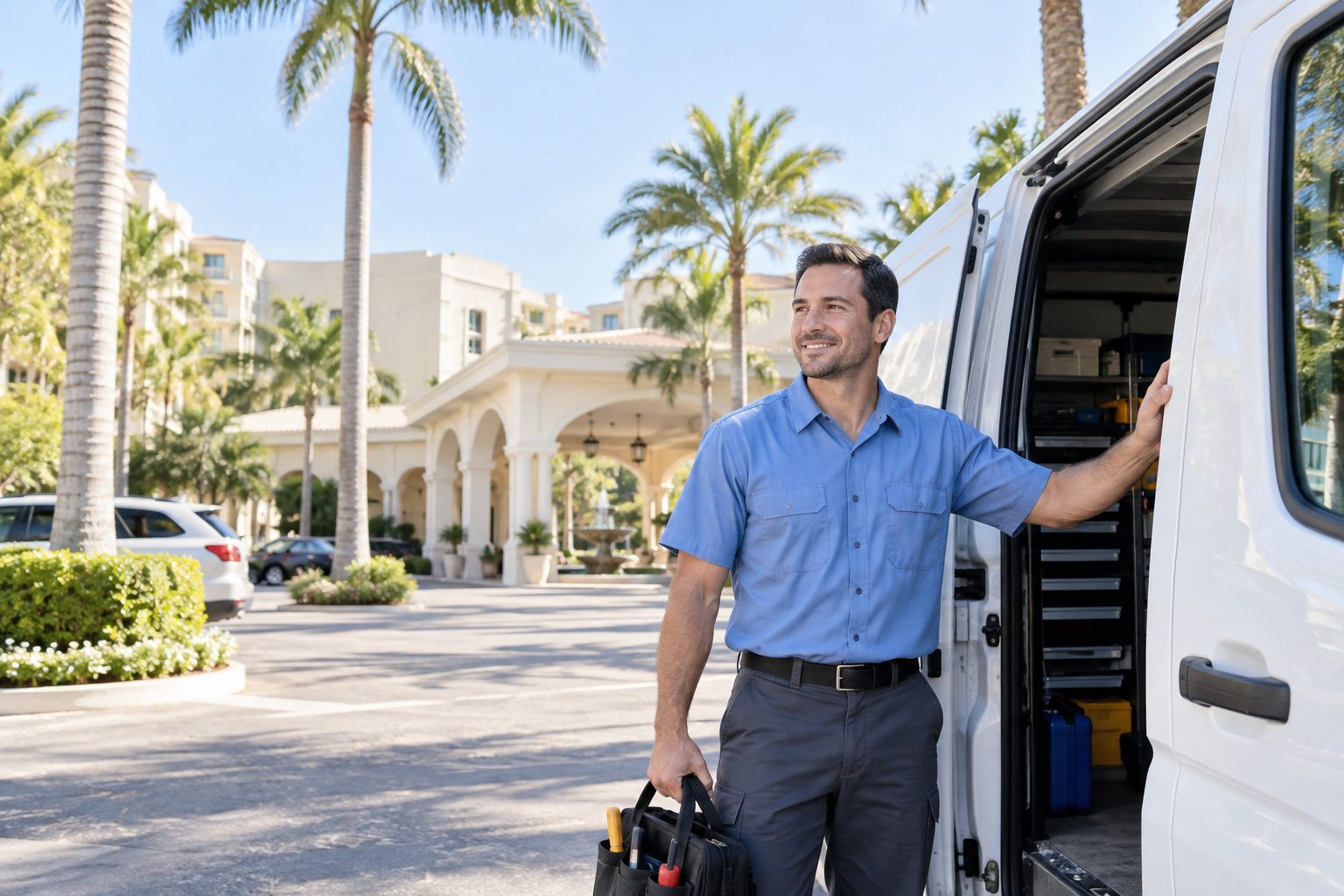
Drive a few minutes from the office park and Maitland turns residential fast -- century-old homes around Lake Lily and Lake Maitland, mid-century houses near Lake Catherine, commuters catching the SunRail into downtown. Orlando Mobile Locksmith covers both sides of this city, because they're rarely more than ten minutes apart.
A master key system only works if it's designed correctly from the start and maintained honestly after that. In an office park the size of Maitland Center, that usually means a hierarchy: individual suite keys, a sub-master for a floor or wing, and a grand master for building management. When one of those levels gets compromised -- a departing tenant who never turned in keys, a lost sub-master -- the fix isn't always a full rekey of every door. Sometimes it's restructuring one branch of the system without touching the rest.
With 400-plus businesses cycling leases across 45 buildings, key control tends to drift over time even when it started out clean. A property manager inheriting a building from a previous management company often has no accurate record of who still holds a working key, which is usually the real trigger for a rekey request -- not a break-in, just an unknown number of keys in circulation.
Office parks empty out fast after 6 p.m., which is exactly when a lot of commercial lock problems get noticed -- a cleaning crew that can't get past a jammed suite door, a broken key left in an exterior cylinder at closing, a property manager doing a final walkthrough who finds a door that won't lock at all. Maitland Center's buildings are largely unoccupied nights and weekends, so a lock issue that would be a minor annoyance during business hours can sit unresolved and become a security gap instead.
Access control adds another layer on top of the physical lock. A card reader or keypad wired into a mechanical deadbolt can fail on either side of that pairing, and diagnosing which half is actually broken -- the electronics or the mechanism underneath -- matters before anyone starts replacing parts.
The three lakes give Maitland three distinct residential pockets, and they don't share a housing era. Homes around Lake Maitland tend toward the century-old end, with the same mortise and skeleton-key hardware found in older neighboring cities. Lake Catherine's homes lean mid-century suburban, standard cylindrical locksets that are easier to source parts for. Lake Lily sits closer to the historic core and mixes both. We carry parts for all three rather than assuming one neighborhood's hardware for the whole city.
The Maitland Art Center, the Enzian Theater, and the Audubon Center for Birds of Prey draw a steady stream of people who don't live in Maitland and occasionally lock keys in a car in one of those parking lots. That's a smaller share of the work than the office park generates, but it's a real one, and it's a different job than a rekey -- usually a car lockout that needs to get resolved without damaging the vehicle.
Maitland's SunRail stop puts a slice of the city's older housing stock within walking distance of a daily commute into downtown Orlando, and those homes -- many of them older than the office park by decades -- carry the same aging hardware you'd expect from a house that's outlived several owners. A homeowner near the station who's owned the place for years and never gotten around to rekeying it after a previous tenant or roommate moved out is a routine call, not an unusual one.
It's a strange contrast to stand in front of a 1930s bungalow near the station and know that ten minutes away, a 45-building office park is running on electronic access badges. Both ends of that contrast are real Maitland, and both end up on our schedule the same week more often than you'd guess.
Service across Maitland's 32751 ZIP code, from Maitland Center to Lake Lily, Lake Catherine, and the neighborhoods around Lake Maitland.
For master key work, after-hours commercial calls, or a home lockout anywhere in Maitland, call (407) 792-1378.
A lot of the tenants in and around Maitland Center are professional practices: doctors, dentists, therapists, attorneys, accountants, insurance agencies and financial firms. For those offices, the lock on the suite entry is only the start. Inside the suite there are records rooms, medication or supply closets, server closets, file cabinets and desk drawers, and each of those has a lock that someone, at some point, lost the key to. When a practice moves into a space, it often inherits whatever the last tenant left behind, including keys that nobody can account for.
A sensible approach for a professional office looks something like this:
We cannot tell you what your particular industry requires for records security. Your compliance advisor or professional association can. What we can do is set up the physical hardware so that whatever your policy says, the keys and locks actually support it.
Office moves are one of the most common times for lock work, and one of the most commonly skipped. Before you move in, ask the landlord or building manager three questions: whether the suite is on the building's master key system, whether the landlord will rekey the entry before you take possession, and whether you are allowed to add your own locks to interior rooms. The answers vary from building to building, and knowing them up front saves an awkward conversation after you have already paid someone to change something.
When you move out, return every key you were issued, including keys to interior doors and furniture if they belonged to the landlord. If you added your own locks, check your lease about whether they stay or go. Leaving a suite with locks the landlord has no key for usually means a charge against your deposit when they have to be opened.
Commercial doors that serve as exits have to let people out quickly and without a key. That is why office building stairwell doors and main exits use panic bars, lever handles or other hardware that opens with a single motion from the inside. Adding a keyed deadbolt or a chain lock to an exit door to make it more secure after hours can create a serious safety problem if someone is inside during a fire. If you are worried about the security of an exit door, the right answer is hardware designed for it, such as an exit device with a keyed outside trim, an alarm on the door, or a better strike and closer. Your building manager and the local fire marshal are the authorities on what a particular door requires.
Door closers deserve attention too. A closer that no longer pulls the door fully shut leaves a suite or a building unlocked without anyone noticing. A closer that slams the door wears out the latch and the frame. Most closers can be adjusted for closing speed and latching force. When a closer leaks oil or will not hold an adjustment, it needs to be replaced.
The larger homes on the lakes often have banks of French doors or tall patio doors opening onto the view. Those doors use different hardware from a standard front door. A pair of French doors usually has one active door with the lock and one inactive door held in place by flush bolts at the top and bottom. If those flush bolts are not fully engaged, the pair can be pushed open with the lock still locked. Checking that the inactive leaf is bolted top and bottom is one of the simplest security improvements for a house with French doors.
Many newer and renovated homes use multipoint locks on patio and entry doors, where one handle drives bolts or hooks at the top, middle and bottom of the door. They seal well against wind and rain, which is useful on a lake. When they fail, the symptom is usually a handle that becomes hard to lift, or that lifts but does not lock. That often points to the door sagging out of alignment, not a broken lock, and adjusting the hinges and keepers can bring it back. If the gearbox inside the door is broken, it can usually be replaced with a matching unit, but the exact model matters, so a photo of the edge of the door showing the faceplate markings is very helpful when you call.
Owners of older homes near Lake Maitland and the historic core often face the same dilemma. The original mortise locks and glass or brass knobs are part of what makes the house what it is, but a mortise lock operated by a simple skeleton key provides very little real security. The good news is that you rarely have to choose.
Old doors also move with the seasons. A heavy wood door that latched fine in winter can swell and bind in a humid summer. Planing a door or moving a strike should be done carefully on an old door, since the original wood cannot be replaced once it is removed. We take the least invasive path that makes the door close and lock properly.
Bigger homes tend to have more people coming and going: housekeepers, landscapers, pool service, dog walkers, contractors on a remodel. Handing each of them a key is simple on day one and a problem a year later, when half of them have moved on and nobody is sure whether the keys came back. Two tools help here.
The first is a restricted key system for the house. Restricted keys are cut on blanks that are not sold to the general public and cannot be copied at a hardware store kiosk, so the number of keys that exist is the number you had made. The second is a keypad or smart lock on one entry for service providers, with a separate code for each person. Most smart locks keep a log of which code was used and when, which gives you a clear record without having to ask. When someone stops working at the house, you delete their code and nothing else changes.
People who ride the train into downtown leave their cars at the station all day. A few simple habits avoid a bad end to the workday:
Outside the office park, Maitland has restaurants, salons, fitness studios and small retail along its main roads. Their needs are different from a large office tenant. A small business with a glass storefront usually has an aluminum door with a narrow-stile lock and a cylinder at the top or middle of the door. When that lock starts to fail, the signs are a key that is hard to turn, a bolt that does not fully throw, or a door that must be pulled tight before it will lock. These locks are specialized, but the parts are standard across many storefront doors, and a worn cylinder or lock body can usually be replaced without changing the door itself.
For a small business, the most useful single change is often key control. Decide who truly needs to open and close, give only those people a key, and rekey when one of them leaves. It is inexpensive compared with the cost of wondering who can get into the building at night.
Maitland also has condominium buildings and townhome communities, many of them close to the lakes and the main roads. In a condo, the line between what you own and what the association owns matters for lock work. Your unit door lock may be yours to change, or the association may require it to stay on the building master so maintenance and emergency staff can get in. Lobby doors, garage gates, pool gates and mailroom doors almost always belong to the association and are controlled by its fobs, codes or master keys. If your building fob stops working, the association or management office handles that, not a locksmith.
Inside your own unit, the usual residential work applies: rekeying when you buy, a deadbolt that has started to drag, a sliding door onto a balcony whose latch has worn. On an upper floor balcony slider, people often skip security altogether. It is still worth keeping the latch in good working order, because a slider that does not latch will rattle and let in wind driven rain during a storm.
For an office call, tell us the building, the suite number, whether the suite is on a master key system and who manages the building. For a home, tell us the type of door and lock if you know it, and whether it is a historic or original fixture you want kept. For a car, the year, make and model and where it is parked. Those few details let us bring the right parts the first time.