We cut and program replacement keys and fobs where the vehicle is parked. Pick your make below, or just call
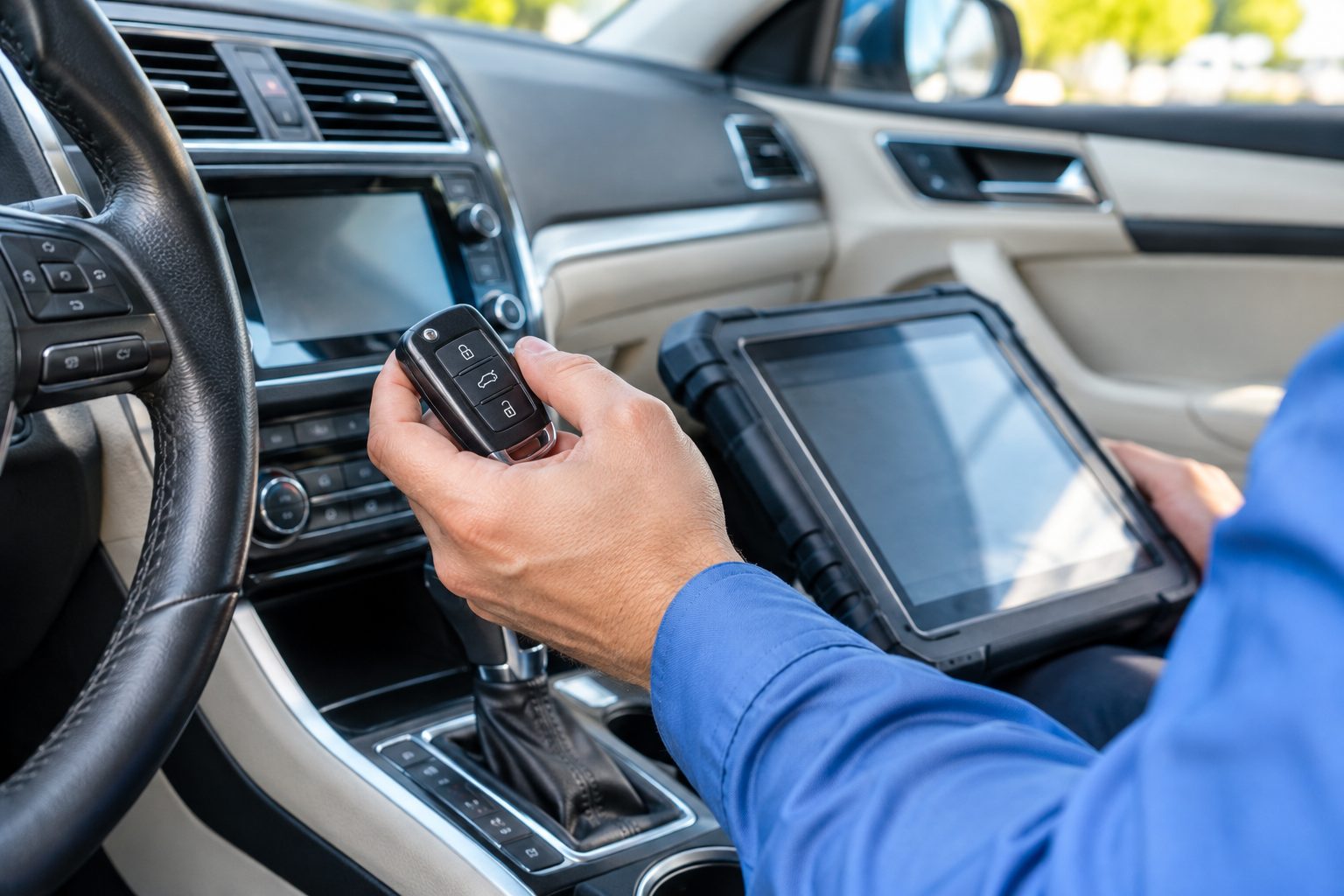
A modern car key is two things at once: a blade that turns a mechanical lock, and an electronic credential the vehicle has to recognise and accept. Cutting the blade is the straightforward half. Getting the car to trust the credential is the actual work, and it differs enough between manufacturers that it is worth reading the page for your own vehicle.
Everything here happens at the vehicle, a resort lot, a rental return, a driveway, a job site. There is no tow and no dealership appointment. Before any key is cut or programmed we confirm the car is yours with photo ID and a registration or title that matches it.
This covers the makes we see most across metro Orlando, but it is not the limit of what we work on. Call us with the year, make and model and we will tell you plainly whether it is something we can do at the vehicle.
That is a different and longer job than copying a key you still have, there is nothing to clone from, so the credential has to be created from scratch. The all keys lost page explains what that involves.
Most car brands belong to a larger group, and brands in the same group usually share key hardware, immobilizer designs and programming procedures. That is useful to know, because information about one brand often applies loosely to its siblings, but the details still vary by model and year. Here is how the makes on this page line up.
When you read something online about a sibling brand, treat it as a starting point, not an answer. We identify your exact vehicle before choosing a key or a method, because a small difference in year or trim can change which key the car accepts.
The single most useful piece of information for any car key job is the vehicle identification number, the 17-character code that uniquely identifies your car. It is printed on a small plate at the base of the windshield on the driver's side, visible from outside, and on a sticker in the driver's door jamb. It also appears on your registration, title and insurance card. The tenth character indicates the model year, which matters because key systems often change between model years even when the car looks the same.
Along with the VIN, tell us whether you have any working key, what kind of key it is, and whether the car starts with a key turn or a push button. If you have an old key or fob, even a broken one, keep it. The numbers printed on the back of a fob or inside its case help confirm the right replacement.
The metal blade can be produced in a few different ways, depending on what is available.
Duplicating copies an existing key. It is quick, but it copies any wear on the original, so a worn key produces a worn copy. Cutting by code uses the factory specification for the lock, which produces a key that matches the lock as it was built, not as it has worn. Decoding reads the lock itself to determine the cuts, which is how a key is made when every key is lost and no code is available. Many jobs use a combination: the lock is decoded or the code is looked up, and the new key is cut fresh to specification.
Blades come in two main styles. Traditional keys have notches cut along the edges. High security keys, sometimes called laser cut or sidewinder keys, have a wavy groove milled into the flat face of the blade. High security blades need different cutting equipment, which is why many hardware store kiosks cannot copy them.
Programming methods vary widely between manufacturers and years. Some older vehicles allowed an owner to add a key or remote by following a sequence of steps with existing keys, such as turning the ignition on and off a set number of times. Many newer vehicles require specialized equipment connected to the diagnostic port under the dashboard. Some require a security code or PIN that has to be obtained through the manufacturer's channels for security professionals, which involves verifying the person requesting it. Some impose a waiting period built into the car's security system that no one can shorten.
On some vehicles, the remote buttons and the immobilizer chip are programmed separately. That is why a key can sometimes start the car but not lock the doors, or lock the doors but not start the car. When we program a key, we test every function before we leave: the blade in the door and ignition where there is one, each button on the remote, remote start if the car has it, and the engine start itself.
Car owners generally have three places to get a replacement key. A dealer can make a key for its own brand, but usually needs the car brought to the service department, which may mean a tow if no key is left. Some dealers need to order parts, which adds days. A mobile locksmith comes to the car, often completes the job the same visit for many makes, and works across brands. Buying a key or fob online can look like the low-cost route, but the key still has to be cut and programmed, and a fob that turns out to be the wrong part or a low quality copy wastes time and money.
If you have already bought a key or fob online, tell us the part number and FCC ID printed on it when you call. We will tell you honestly whether it is likely to work with your car. Some do, some do not, and it is better to know before anyone drives out.
A lot of cars in Central Florida have aftermarket remote start systems installed, because starting the air conditioning before getting in is a real comfort in August. Many of those systems use a bypass module that has to recognize the car's key in order to start the engine remotely. When a new key is programmed to the car, the factory system accepts it, but the aftermarket module may need to be reset or taught as well, depending on how it was installed. If your car has aftermarket remote start or an alarm, mention it when you call. It does not stop a new key from being made, but it may add a step.
Proximity keys, the fobs that let you open the door and start the car without pressing anything, communicate with the car over short range radio. Thieves have used relay devices that extend that signal from a fob inside a house to a car in the driveway. It is not common, but it is real. Simple precautions help: keep fobs away from doors and windows at home, store them in a signal blocking pouch or a metal container overnight, and turn off keyless entry if your car allows it and you do not use the feature. Many newer fobs go to sleep when they are not moving, which also reduces the risk.
Certain key-start Hyundai and Kia models from roughly the 2010s through the early 2020s were built without an engine immobilizer, and they became frequent theft targets. The manufacturers released security software updates and offered steering wheel locks for many affected vehicles. If you drive a key-start Hyundai or Kia from those years, check with a dealer whether your car qualifies for the update. A new key cut for one of these cars works the same as any key, and it does not change the car's security. For more on those makes, see the Hyundai and Kia pages.
Some newer vehicles let a smartphone act as a key, or use a thin card that is tapped against the door pillar or console. These systems usually still rely on a physical fob or card as a backup, and they are managed through the owner's account with the manufacturer. If you are locked out of a car that uses a phone key, the fastest route is often the manufacturer's app or roadside service. If the car also accepts a physical fob and yours is lost, call us with the year, make and model, and we will tell you whether a physical key can be added at the vehicle.
Metro Orlando has a vehicle mix unlike most places. Rental fleets near the airport and the parks put large numbers of late model sedans and SUVs on the road, many driven by visitors who do not know the car. Commuters on I-4 and SR-408 drive everything from new crossovers to high mileage sedans. Contractors and landscapers run pickups and vans from every brand. And a lot of older vehicles stay on the road longer here, because there is no road salt to rust them away. That range means we see every generation of key system, from plain metal keys to the latest smart fobs, often in the same week.
The easiest car key job is adding a spare while a working key still exists. The hardest is starting from nothing. Once you have two working keys, keep the spare at home in a place you will remember, not in the car, not in a magnetic box under the bumper and not in a glove box. If two drivers share a car, each should carry their own key rather than passing one back and forth. If you ever lose a key in a way that could tie it to your car, ask about removing it from the car's memory when a replacement is programmed.
Buying a used car in Central Florida often means getting one key, sometimes two, and no idea how many others exist. A previous owner, a family member, a valet service or a repair shop may still have a key. On older cars without an immobilizer, any copy of the key can start the engine. On newer cars, each programmed key is stored in the car's memory, so the list of accepted keys can often be cleared and rebuilt with only the keys you have. That makes every unknown key useless. If you just bought a used car and are not sure of its key history, this is worth doing at the same time you add a spare.
Central Florida has plenty of motorhomes, travel trailers, box trucks and work vans, and many of them carry more locks than a regular car: compartment doors, storage bays, tool boxes and rear cargo doors. These often use separate keys from the ignition, and they get lost more often because they are used less. Compartment locks can frequently be replaced or rekeyed so one key opens them all. The ignition side follows the same rules as any vehicle of that make and year. When you call about a work vehicle, tell us about every lock you need handled, not just the ignition.
Two car key calls that sound the same on the phone can take very different amounts of time at the vehicle. A spare for a common sedan with one working key may be quick. The same model with every key lost takes longer, because the lock has to be decoded, the key cut from that information, and the car programmed from scratch. Some makes add a mandatory waiting period during programming. Some require a security code from the manufacturer that has to be requested and verified. And some vehicles have steering column or console designs that make access to the diagnostic port or the ignition more involved. We explain which of these applies to your car before starting, so you know what to expect.
Once a new key is programmed, test it yourself before we leave: lock and unlock with the buttons, open the trunk or liftgate, start the car, and try the blade in the driver's door. If the car has remote start, test that too. Put the new key on a light ring, not a heavy bundle of keys that strains the ignition. Replace fob batteries on a regular schedule, especially in a hot climate. And note the date the key was made, so that if a question comes up later, you know when it was added.
Many calls that start as "my key stopped working" turn out to be something else. A weak car battery can make a perfectly good fob seem dead. A worn ignition cylinder can refuse a good key. A failing door lock actuator can make the remote unlock every door but one. A blown fuse can knock out the keyless entry system. Before making a new key, we check whether the key you have is actually the problem, so you do not pay for something that will not fix the car. If the problem is the ignition, our ignition repair page explains what comes next. If the car simply needs to be opened, see car lockout.
Because the work happens at the vehicle, the location matters. Tell us the exact address, or for a large lot, the store, entrance or row. In a parking garage, give the level and nearest stairwell. At an apartment complex, give the building number and any gate code. At the airport, resorts or theme parks, tell us which lot or garage, since many have more than one. If the car is on the shoulder of a highway, get yourself to a safe spot away from traffic and tell us the direction of travel and the nearest exit or mile marker. The more precise the location, the less time anyone spends searching.
Searching locksmith near me in Orlando for a house lockout? We are mobile across metro Orlando and quote the price before we come out. Call us.
ZIP codes we cover in Orlando: 32801, 32803, 32804, 32805, 32806, 32807, 32808, 32809, 32810, 32811, 32812, 32814, 32817, 32818, 32819, 32820, 32821, 32822, 32824, 32825. City services: Orlando Official Website.
Describe the situation by phone and we will tell you what the job involves. Quotes are given by phone. Jobs that cannot be quoted without seeing them need a technician on site, and the service call charge is explained on the phone before anyone is dispatched.