A car key hasn't been just a piece of cut metal in a long time. Since the late 1990s, most vehicles pair the physical key or fob with a transponder chip that talks to the car's immobilizer, a short radio exchange that has to go correctly or the engine won't start no matter how well the blade was cut. Cutting the blade is the mechanical half of the work, and it's also the smaller half. Getting the vehicle to accept the result is the actual job.
Metro Orlando makes this more complicated than most places, because a large share of the cars on the road at any given moment are rentals. A locked-out driver near a theme park or an airport hotel is often standing next to a car they don't own and won't own again next week, which changes what has to be verified before any key work starts.
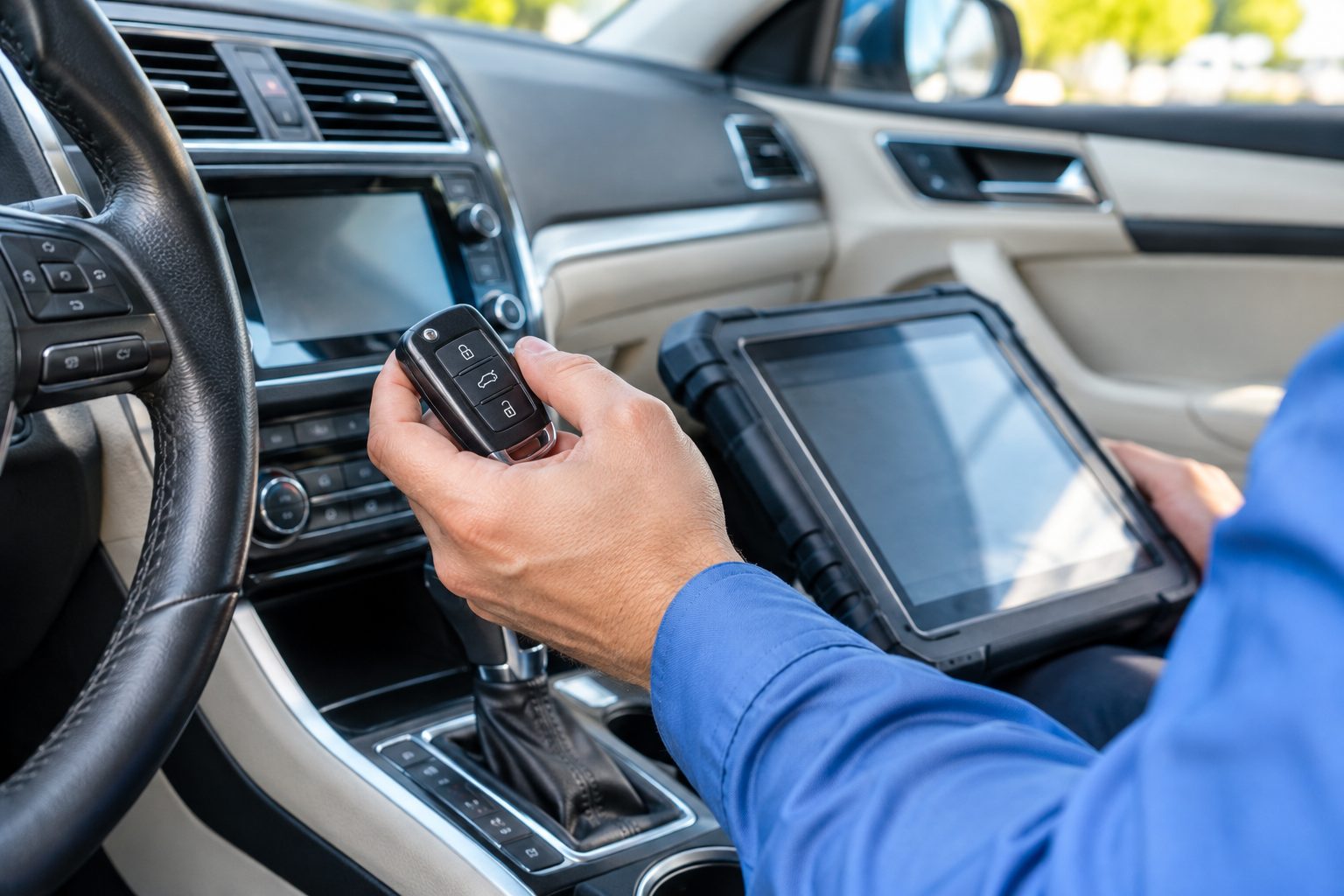
The mechanical side is cutting a blade to match the tumblers inside the door or ignition lock, a process that hasn't changed much in decades and is the part most people picture when they hear 'locksmith.' The electronic side is newer and does the real gatekeeping: matching a transponder chip's code to the vehicle's immobilizer so the engine control unit actually lets the car start. Some vehicles allow that pairing to happen through the car itself, using a sequence built into the ignition. Others require a diagnostic tool plugged into the vehicle's data port, and a handful of manufacturers build in a security wait timer that has to run its course no matter what equipment is on hand, that part isn't negotiable, it's built into the car itself.
Originating a new key, cutting and programming one from scratch, especially when no working key exists, means creating something capable of starting and driving off in that vehicle. That doesn't happen on a promise. ID matched against registration or title for that specific car gets checked before anything is cut or programmed, on every vehicle, every time. It's a slower first step than most people expect, and it's also the line between a locksmith and someone who'll hand a working key to whoever happens to be standing next to the car.
A lost single key with a spare still sitting in a drawer at home is the simplest version of this work, a straightforward duplicate. All keys lost is a different problem: no working key exists to read from, so the key code has to be pulled by VIN and the immobilizer addressed from a blank state, which always takes longer than a duplicate and always starts with the ownership check. An ignition that's worn, sticking, or won't turn at all is usually mechanical, worn tumblers or a failing switch, even though it can feel electronic from the driver's seat. A fob that's stopped working is frequently a dead coin cell battery rather than a dead fob, which is worth ruling out before anything gets replaced outright.
Toyota, Honda, Ford, Chevrolet, Kia, Hyundai, Nissan, every manufacturer handles this differently, and a single manufacturer can change its approach across model years. A transponder system on a mid-2000s sedan and a proximity push-to-start system on a current SUV don't share much beyond both being called 'the key.' Knowing which generation of system sits in a given vehicle, and whether it programs onboard or needs a diagnostic tool, is most of what decides how the visit goes.
A car key that won't start the car is an electronics problem wearing a metal disguise. Whether it's a lost key, a dead fob, or a stubborn ignition, bring ID and something that ties you to the vehicle, registration, title, or a rental agreement, and call
Programming differs enough between manufacturers that it is worth reading the page for your own vehicle before you call.
Can you make a key for a rental car?
The same ownership verification applies to a rental as to a personally owned vehicle, in that case, matched against the rental agreement and the driver's ID. That gets sorted out before any work starts.
Why does 'all keys lost' take longer than a duplicate?
Because there's nothing to copy from. The key code has to be pulled by VIN and the vehicle's immobilizer addressed from scratch, and some manufacturers build in a security wait timer as part of that process that can't be skipped.
Before you call about a car key, it helps to know what you are holding, or what you lost. The type of key shapes nearly everything about the visit: what equipment is needed, how the blade is cut, and whether programming happens through the car or through a diagnostic tool.
If you are not sure which one you have, look up your vehicle's year, make and model and tell us whether it starts with a turn of a key or a push of a button. That alone narrows it down a lot.
A lot of confusion comes from the fact that one plastic key head often contains two separate systems. The buttons that lock and unlock the doors are a remote transmitter. The part that lets the engine start is a transponder, a tiny chip that answers the car's immobilizer when the key is in the ignition or the fob is inside the car. They can fail independently.
If the buttons stop working but the car still starts, the problem is usually the remote side: a weak battery, a worn button contact, or a remote that has lost its pairing. If the buttons work but the car cranks and will not start, or a security light flashes on the dash, the issue is on the transponder side. Telling us which symptom you have helps figure out whether the fix is a battery, a repair, a reprogramming or a new key.
When a fob needs replacing, there are usually three kinds of parts available, and each has tradeoffs.
Original equipment keys come from the vehicle maker's supply chain. They match the car exactly and tend to hold up well, and they typically cost more.
Aftermarket keys are made by third-party companies to work with specific vehicles. Good ones work well and cost less. Poor ones have weak buttons, short range or shells that crack. The quality varies a lot between suppliers, which is why the source of the key matters.
Used or refurbished fobs bought online are the riskiest option. Many smart keys and remotes can only be programmed to one vehicle. Once they have been paired with a car, they lock to it and cannot be reused on another, no matter what equipment is used. A fob that looks identical to yours may not be usable at all. If you have already bought one, tell us the exact part number printed on the back or inside the case before we come out, so we can tell you whether it can be programmed before you pay for a visit.
Both can make keys for most cars, and it is worth being clear about when each one makes sense.
A mobile locksmith comes to the car. That matters most when you have lost all your keys, since the car cannot be driven to a dealer without one, or when the car is parked somewhere awkward such as a garage, a workplace lot, or a relative's driveway. It also saves you from booking a service appointment and waiting for a key to be ordered.
A dealership may be the better or only route for some of the newest vehicles, particularly models whose key programming is tied to the manufacturer's online systems, and for some luxury and European makes during their first years on the market. A dealer is also the place to go when a car has an electrical fault that goes beyond the key, such as a failed immobilizer module or a body control module that needs replacement. If your vehicle falls into one of those categories, we will say so on the phone rather than sending someone out to find out the hard way.
Broken key extraction
Keys snap, usually at the shoulder, after years of being used as a lever or carrying a heavy key ring. When part of the blade stays inside the door lock or the ignition, do not try to push it further in or dig at it with a knife or a paper clip. That usually drives it deeper or damages the wafers in the lock. Extraction tools grip the broken piece and slide it out. Once it is out, the broken halves can often be used to cut a replacement, and the lock usually works normally again.
Door locks and trunk locks
On many cars the driver door lock cylinder is the only keyed lock left. When the fob battery dies, that cylinder is how you get in, and it may not have been turned in years. Cylinders that have been neglected can seize or have worn wafers that no longer respond to the key. We can repair or replace a door cylinder and match it to your existing key so you do not end up with a second key for one door.
Heavy key rings and ignition wear
A heavy bundle of house keys, fobs and trinkets hanging from the car key puts weight on the ignition every time the car hits a bump. Over the years that wears the ignition cylinder and the key itself. Keeping the car key on its own light ring, or a detachable clip, is one of the easiest ways to extend the life of both.
Businesses that run several vehicles have different key problems from a household. Keys get passed between drivers, spare keys go missing, and nobody is sure which spare belongs to which truck. A few practices help:
Motorcycles and scooters are common in Central Florida, where the weather allows riding most of the year. Many use simple keys that can be cut from a code or from the lock itself, and some newer bikes use transponder keys or proximity fobs much like cars. The ignition, the fuel cap, the seat lock and any hard luggage may all be keyed differently, especially on a used bike with replacement parts. If you are replacing a lost motorcycle key, let us know which of those locks you need a key for, so the new key opens all of them if possible.
The best time to handle with a car key is before it is lost. The cost and effort of making a spare while you still have a working key is far lower than originating a key after every key is gone. A few suggestions:
If you are stuck with a car that will not open or start, a few simple steps make the wait safer and the visit shorter. Move somewhere comfortable and visible, such as inside a nearby store, a lit lobby or a shaded bench, rather than standing beside the car in the heat or in a dark lot. Keep your phone charged and on. Do not try to force a door with a coat hanger or a wedge, since modern cars have side airbags, wiring and window seals inside the door that are easily damaged. Do not keep trying to start a car that shows a security light; repeated attempts can sometimes put certain immobilizers into a lockout mode that adds time to the programming. And if anyone or any animal is inside a hot car, call 911 before anyone else.
When the technician arrives, expect to show your ID and paperwork first. After that, most of the time is spent on the car itself: opening it, reading or cutting the key, programming, and then testing every function, including the remote buttons, the ignition or start button, and the door lock by hand, before the job is called finished.
Searching locksmith near me in Orlando for a house lockout? We are mobile across metro Orlando and quote the price before we come out. Call us.
ZIP codes we cover in Orlando: 32801, 32803, 32804, 32805, 32806, 32807, 32808, 32809, 32810, 32811, 32812, 32814, 32817, 32818, 32819, 32820, 32821, 32822, 32824, 32825. City services: Orlando Official Website.
Describe the situation by phone and we will tell you what the job involves. Quotes are given by phone. Jobs that cannot be quoted without seeing them need a technician on site, and the service call charge is explained on the phone before anyone is dispatched.