
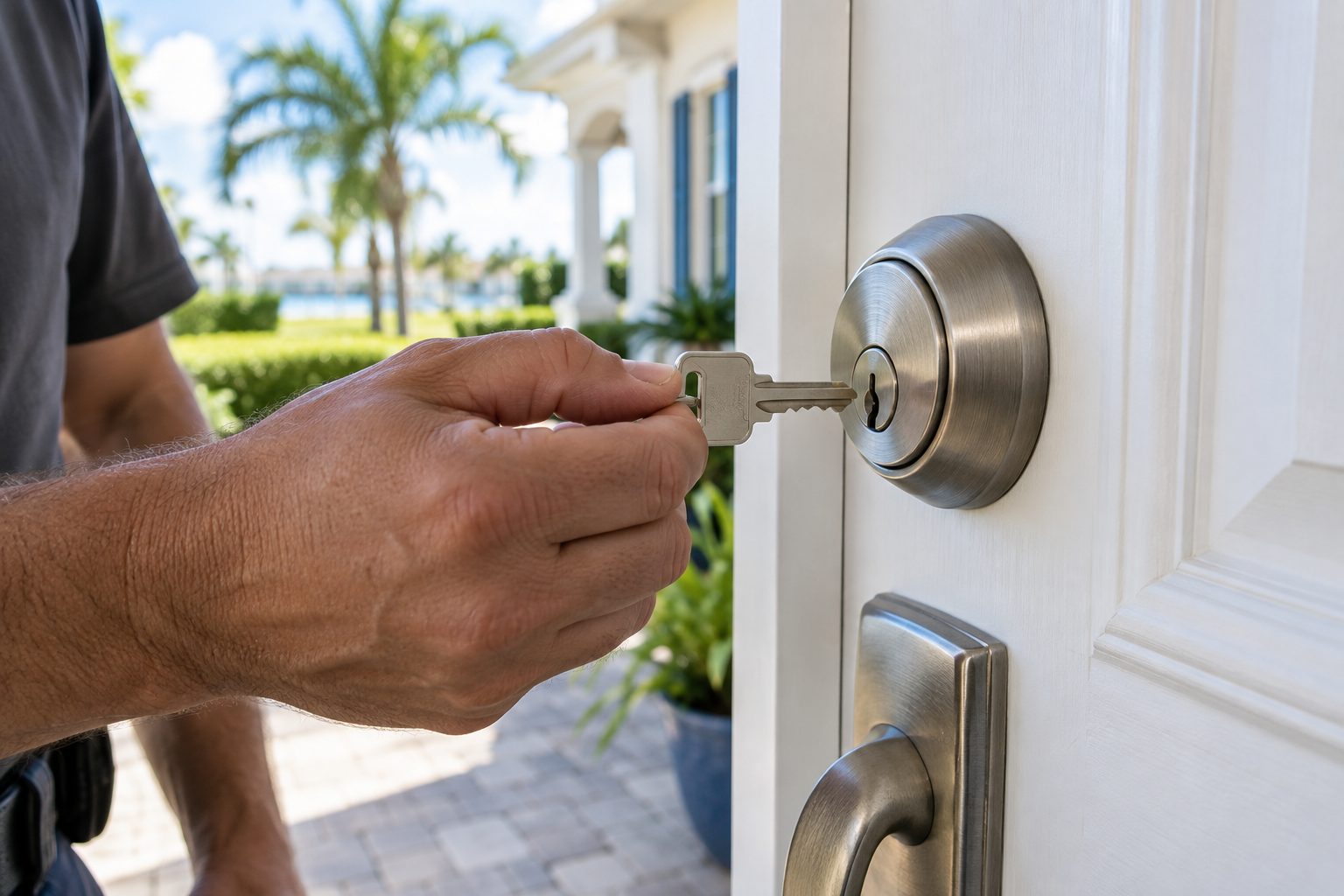
- Keys and Locks for Orlando Short Term Rentals: A practical host guide to keys, codes, lockboxes and smart locks for Orlando vacation rentals, from guest turnover to storm season and lockout planning.
- Hurricane Season Checklist for Doors: A practical Orlando checklist for doors, locks and spare keys before hurricane season: what to inspect, what to stage and what to do if you are locked out.
- Locked Out of an Orlando Apartment or Condo: Shut out of your Orlando apartment or condo? Learn who controls your door, who to call first, what to have ready, and how to avoid damage or lease trouble.
- Key Fob Stopped Working in Orlando? Heat: A practical Orlando guide to a dead or erratic key fob: how heat, humidity and storms play a part, what you can safely check, and when to call a locksmith.
- Access Control: Compare card, keypad and mechanical key systems for small offices: costs of management, audit trails, lost credentials, power outages and when each one fits.
- Car Key History: From simple metal keys to smart keys: how automotive keys evolved, what is inside each type and why newer keys take more work and cost more to replace.
- Commercial Hardware: Plain-language basics of commercial door hardware: lock grades, hinges, door closers, exit devices and how the parts work together on a storefront door.
- Condo Locks: What condo and high-rise owners in Orlando should know about association rules, fire-rated doors, lobby fobs and unit locks before changing any hardware.
- Deadbolt Grades: Understand deadbolt grade categories in plain terms: what ANSI grades test, what they mean for a home or business door, and what matters beyond the label.
- Lock Passcode Habits: Best practices for keypad and smart lock passcodes in Orlando: rotation, guest passcodes, avoiding obvious combinations and what to do when one is shared.
- Car Key Documents: Find out which documents a locksmith asks for when replacing a car key in Orlando: ID, registration, title, VIN, and why each one exists to protect you.
- Door Frame Security: Why door frames, strike plates and hinges decide how secure a door really is in Orlando homes, and what a locksmith checks beyond the lock cylinder.
- Historic Homes: How owners of older Orlando homes can keep original door hardware and character while improving security, from mortise locks to worn strikes and loose frames.
- Home Security Checklist: A room-by-room home security checklist for Florida: doors, windows, sliding glass, garage, lighting and daily routines that lower risk without gadgets or hype.
- Phone Quotes: Learn why locksmith quotes are given by phone, what the service call charge covers, and when a job needs an on-site look before a final quote.
- Keyed Alike: How keyed-alike locks let one key open several doors, when that convenience makes sense for homes and small businesses, and when separate keys are safer.
- Mobile Service: How a mobile locksmith works in Orlando: what is in the van, how dispatch and phone quotes work, and what happens when the technician arrives.
- Choosing a Locksmith: A practical guide to choosing a locksmith in Orlando: what to ask on the phone, how to verify credentials, and the red flags that should make you hang up.
- Key Codes: Understand how key codes work, where stamped and VIN-based codes are found, and when you do not need one to get a new key made for your car or lock.
- Locksmith Scams: Learn how bait advertising, unmarked vehicles and vague phone quotes work in locksmith scams, and the simple steps that protect you before and after a call.
- Humidity and Locks: How Central Florida humidity, rain and salt air corrode locks and swell doors, and the maintenance habits that help hardware last longer.
- Hurricane Lock Prep: How Orlando homeowners can prepare doors, locks, keys and documents before a storm, and what to check on hardware once the wind and rain have passed.
- Relay Theft: How relay theft targets keyless car fobs and what Orlando drivers can do: signal pouches, storage habits, steering locks and general awareness.
- Key Control Policy: How to write a key control policy for a small business: key logs, restricted keys, issuing and returning keys, and steps to take when an employee leaves.
- Keypad or Fob: Compare keypads, key fobs and smart keys for homes and vehicles in Orlando: convenience, battery needs, loss risk and what to do when each one fails.
- Landlord Lock Duties: General public information on who handles locks and keys in Florida rentals, how to document problems and when to check official sources or seek advice.
- Accessible Locks: Accessible lock options for older adults and people with limited grip in Orlando: lever handles, keypads and easy-grip hardware that stay secure.
- Child Safety Locks: Door lock safety for Orlando families with young children: inside latches, safe escape routes, pool access and keeping kids in or out without trapping them.
- Lockout Prevention: Practical routines, spare plans and keyless options that reduce lockouts at home and in the car for Orlando residents, visitors and busy families.
- Master Key Planning: Plan a master key system for a small business: who needs which door, how to design the hierarchy, keep key logs and leave room to grow without rekeying.
- New Home Security: A practical order of operations for securing a new Orlando home: who still holds keys, rekeying, door openers, alarm resets and smart lock accounts.
- New Construction: A step-by-step lock and key checklist for new Orlando homes, covering builder keying, punch list items, garage entries and what to do after closing.
- Neighborhood Security: How door, lock and key needs differ across Orlando, from downtown condo towers to older bungalows and suburban subdivisions, and what to check at home.
- Rekey or Replace: Should you rekey or replace your door locks? A clear decision framework based on lock condition, security goals and how to discuss cost by phone.
- Rental Car Lockouts: Locked out of a rental car in Orlando? Learn who to call first, what roadside coverage may include, and what a mobile locksmith can and cannot do.
- Garage Security: How to secure the garage entry in Orlando homes: emergency release safety, side doors, opener habits, and the door between garage and house.
- Securing Sliders: How to secure a sliding glass door in Central Florida: track bars, pin locks, door lifting, glazing, hurricane season and what a locksmith can add safely.
- Smart Lock Guide: How to choose a smart lock for an Orlando home: connection types, battery planning, backup keys, door fit and what to check before you buy or book an install.
- Snowbird Lock Checklist: Leaving an Orlando home empty for months? Plan access, key control, lock upkeep and arrival checks so your property stays secure while you are away.
- Spare Key Storage: Where to keep spare keys safely in Orlando: trusted neighbors, lockboxes, keypads and the hiding places that fail. Plain advice from a mobile locksmith.
- Student Housing Locks: Roommates, shared keys and turnover make student housing hard to keep secure. Learn what to ask your landlord, when rekeying matters and how to manage keys.
- Key Fob Heat Care: How Orlando heat, hot dashboards, humidity and rain affect car key fobs and batteries, plus habits that help them last and what to do when one fails.
- Theme Park Key Tips: Visiting an Orlando theme park by car? Learn how to avoid lost keys and parking lot lockouts, protect your fob on rides, and what to do if it goes wrong.
- Door Lock Types: Compare knob locks, lever handles, deadbolts, mortise locks and smart locks: how each works, where it fits, and what to consider for Orlando doors.
- Pick Resistance: Why security pins, restricted keyways and good cylinders matter for homeowners, explained at the level of design and choice, with no technique details.
- Vacation Lock-Up: A room-by-room checklist for securing doors, windows and the garage before a trip, with advice on spare keys and trusted contacts while you are away.
- Immobilizers: Learn what a car immobilizer does: the chip in your key, the antenna at the ignition and how the car decides to start, plus what it means for replacement keys.
- Stolen Vehicle: If your car was stolen and your house keys were inside, here is the order to follow in Orlando: police report first, then insurer, then rekey and reset.
- What to Expect: A step-by-step walk through a locksmith service call in Orlando: phone intake, arrival, identification, assessment, quote and payment, so nothing surprises you.
Talk to 24/7 Locksmith Orlando
Describe the situation by phone and we will tell you what the job involves. Quotes are given by phone. Jobs that cannot be quoted without seeing them need a technician on site, and the service call charge is explained on the phone before anyone is dispatched.
How this guide library is organized
The guides in this section are written for people who want to understand a lock, key or access question before they pick up the phone. Each one takes a single topic, such as rekeying versus replacing, car immobilizers or key control for a small business, and walks through it in plain language. They are meant to be read in any order. If you already know your situation, jump straight to the topic that matches it, and use the related links at the end of each page to move on to the next question that usually follows.
The topics fall into a few natural groups. Some deal with homes, such as choosing hardware, planning backups and thinking about security upgrades. Others cover vehicles, including transponder keys, smart keys and what paperwork a replacement needs. A third group is aimed at businesses and landlords, who face questions about master keys, key logs and handling staff changes. Reading across groups can be useful too, because the same ideas, like limiting who holds a key and knowing how many copies exist, apply to a house, a car and a storefront alike.
These guides explain general principles and common practice. They are not a substitute for a conversation about your particular doors and vehicles, because hardware, frame condition and vehicle model change the answer. When you are ready to talk, call us and describe what you have read and what you are trying to solve. The scope of any work and any quote are explained before anything begins, so you can decide with the full picture. Treat the guides as preparation that makes that conversation shorter and more useful. Write down what you notice as you go, because small details are easy to forget once the situation is resolved.
Who these guides are written for
Homeowners are the first audience. A person who just moved into a house in the Orlando area often wonders who still holds a key, whether the locks are worn, and whether a keypad deadbolt makes sense in a humid climate. The guides answer those questions in everyday terms, without assuming any trade knowledge. Renters and landlords come next, since turnover between tenants raises the same practical question each time: which keys still exist, and who might be carrying one. Several pages speak directly to that cycle and to the habits that keep it manageable.
Drivers form the second large audience. Modern vehicles hide a surprising amount of electronics inside a small plastic fob, and when one fails people are confused about what is broken and what can be fixed on the spot. The vehicle guides explain batteries, programming, immobilizers and ownership paperwork so you know what to expect. They also cover situations that fill Central Florida parking lots, like a locked trunk after a long day at an attraction, or a spare that was never tested before it was needed. If something here does not match what you see, say so on the call, since your own observations matter more than any general rule.
Small business owners and property managers are the third audience. They face questions of accountability that a household rarely does: how to record who has a key, how to retire access when someone leaves, and how to keep a growing set of doors organized. Those pages lean toward written policies and simple tracking methods. Whichever group you belong to, the aim is the same, which is to help you walk into a decision informed and unhurried, instead of making it while standing outside a locked door. Take your time with this step, as rushing is the most common way a small issue turns into a larger one.
Reading a guide alongside your own doors and vehicles
The most effective way to use a guide is to read it with a pen and a short walk around your property. Stand at each door, note the lock type, check whether the key turns smoothly, and count how many keys are in circulation. Then read the relevant guide and compare. You will often spot something you had not noticed, such as a gate lock nobody has a spare for, or a second car with only one key. Writing these observations down gives you a concrete list to bring to a conversation instead of a vague worry.
Vehicles deserve the same treatment. Look at the keys you have and note whether each one has a plastic head, a chip, a push button or a flip blade. Find the second key and try it in the door, trunk and ignition, not just the lock you use daily. The vehicle guides explain why that test matters, and it takes only a few minutes. If a spare fails, you have learned it on a calm afternoon and can address it deliberately instead of discovering the failure at the worst possible moment.
Finally, notice what changes. A guide is a snapshot, but your situation moves: a roommate leaves, a child gets old enough to carry a key, an employee is promoted, a car is added to the household. Each change is a good moment to reopen the relevant page and ask whether your setup still fits. Many lockouts and security gaps come not from a single bad decision but from small drift over time. A short periodic review, guided by these pages, keeps that drift in check. Keep any old keys, receipts or notes together in one place so the next decision is easier to make.
Questions worth asking before any lock work begins
Whatever the job, a handful of questions improve the outcome. What exactly is the problem I am trying to solve: a lost key, a worn lock, a change of occupants, or a wish for a more convenient entry method? What is already working that I should keep? Which doors or vehicles are involved, and are there any I forgot, like a side gate or a mailbox? Answering these in advance narrows the options quickly and prevents work that fixes a symptom while leaving the cause in place. Ask questions whenever a term or a recommendation is unclear, and expect a plain answer in return.
It also helps to ask about tradeoffs. Rekeying and replacing differ, a keypad and a fob differ, and a restricted keyway has benefits and limits. A good explanation covers what each choice protects against, what it does not, and what ongoing care it needs. Ask about key counts, about how future copies will be handled, and about what happens if a component fails. These guides try to equip you with the vocabulary to ask such questions, so you can follow the answers instead of nodding along to terms you do not know.
Lastly, ask for the scope and quote to be explained before work starts, and expect a clear answer. A reputable conversation should leave you understanding what will be done, why it is being done, and what you will hold afterward, including how many keys and whether any codes or fobs need to be recorded. If anything is unclear, say so. Taking a moment to understand costs little and prevents the frustration of surprises. The guides here are intended to make that moment easier by giving you background before the call.
Local conditions that shape lock and key advice
Central Florida is not a neutral setting for hardware. Warm, humid air, frequent summer storms and strong sun all act on locks, fobs and door frames. Brass and steel components can corrode near the coast or in damp garages, plastic housings can fade and become brittle, and wooden doors swell and shrink with the seasons. Several guides mention these conditions because they explain symptoms that people blame on the key, such as a lock that sticks in the wet months and feels fine in the dry ones. Local weather and daily use both play a part, so think about how your own routine affects the hardware involved.
Housing and use patterns matter as well. The Orlando region has a large share of apartments, condominiums, townhomes and single family houses, and it also has many vacation rentals where guests come and go. Each of those has different key control needs. A rental with a code lock can change access without a new key, while an older house with a traditional deadbolt may rely on a small set of metal keys. The guides explain how those differences change the advice, instead of offering one answer for all doors.
Travel and tourism shape the vehicle side. Residents and visitors alike park in large lots, leave bags in trunks and carry rental cars with unfamiliar keys. Heat inside a closed car can affect fobs left on a dash, and sudden rain can find the gap in a poorly seated battery cover. Where a guide mentions these realities it keeps to widely known, general facts about the region, and it avoids making claims about any specific street or business. The goal is practical advice that fits the place you actually live and drive.
Putting what you learn into a simple plan
Reading is useful only if it leads to a few small actions. A good starting plan has three parts: an inventory, a backup and a routine. The inventory lists every door, gate, mailbox, car and storage space with a lock, along with the number of keys that exist. The backup means a tested spare for anything essential and a safe place for it. The routine is a regular moment, perhaps twice a year, when you check batteries, test spares and confirm that everyone who should have a key still does.
Prioritize by consequence. A lock that protects a front door or a business office deserves attention before a shed. A car with a single key and no spare deserves attention before a car with two working keys. If you are short on time, pick the item whose failure would hurt most and address it first. The guides point out which problems tend to get worse if ignored, such as worn keys that eventually snap or a fob battery that dies without warning. It helps to share this information with everyone in the household or workplace who might be affected by the outcome.
When a step needs a professional, plan the call rather than waiting for an emergency. Gather your notes, decide what outcome you want and bring your questions. We explain the scope and quote before work begins, so you can compare options calmly. Keep your inventory updated afterward and add any new keys or codes to it. Over time this habit turns lock and key management from a recurring crisis into an ordinary, low-stress part of looking after your home, vehicles and business. Write down what you notice as you go, because small details are easy to forget once the situation is resolved.