Growers here call Apopka the Indoor Foliage Capital of the World, and the greenhouse acreage backs it up, shade houses and growing houses stretch for acres north and west of the city, each one a working commercial operation rather than a hobby garden. That industry sits inside the same city limits as an ordinary US 441 suburb, and the two sides of Apopka need almost nothing in common from a locksmith.
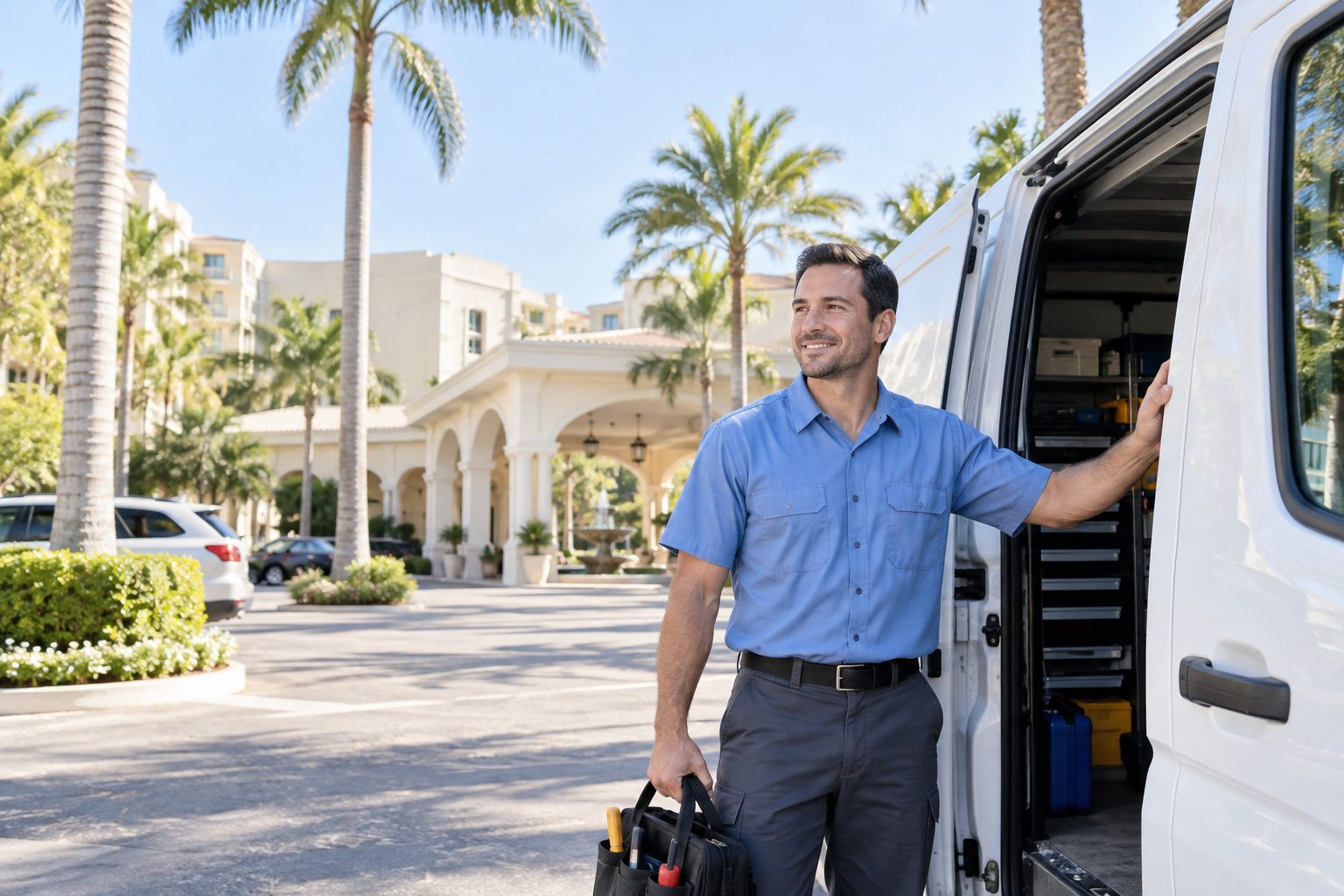
One end of the job is a walk-in cooler latch on a cut-foliage packing operation. The other is a homeowner locked out after dinner near AdventHealth Apopka. Both are regular work here, and neither one prepares a locksmith for the other.
A commercial growing operation runs on delivery and shipping schedules, and the gate at the road has to serve both, open enough for a truck during a loading window, closed and secured the rest of the time without anyone standing there to manage it by hand. Keypad gate operators and heavy-duty rolling gates are common on nursery frontage, wired into a schedule rather than left to whoever remembers to lock up.
Florida humidity is hard on that kind of hardware. A keypad that's corroded from months of irrigation overspray, or a rolling gate track that's seized with rust, tends to fail exactly when a truck is waiting on it.
A single nursery property can run dozens of individual greenhouse and shade house structures, each with its own door and, often, its own lock, installed whenever that particular structure went up. Some of that hardware dates back years, doesn't match anything else on the property, and has outlasted more than one change in who's actually managing the operation day to day.
Standardizing a whole property onto one keyway is common work here, not because anything's broken, but because a crew moving between forty greenhouse doors with forty different keys is losing real time every shift.
Cut foliage and plant material headed to shipping needs a cooler that holds its seal as tightly as it holds its lock, a latch that doesn't fully catch costs a grower actual product, not just security. That's a different standard than a typical commercial door, and it's worth getting the hardware right rather than treating a walk-in cooler like any other exterior entry.
A cooler door also gets opened and closed dozens of times in a single shift, far more than a typical exterior door on a house or office. Hardware that would hold up fine on a once-a-day entrance wears out faster under that kind of repeated use, which changes what's worth installing in the first place.
Tractors, sprayers, forklifts and hand tools for a working nursery live in equipment barns that sit locked for most of a shift and then need to open fast when something breaks mid-morning. Loading dock doors see similar wear, heavy daily use, constant weather exposure, and a lock that has to keep working through all of it without slowing down a shipment.
Nursery and greenhouse operations change hands and change management more often than the buildings themselves get rebuilt, and each change raises the same question as any other business sale: how many keys are actually still out there. A property that's run through two or three operators over the years can end up carrying just as many different keyways, one left over from each era, until someone finally consolidates it.
Rekeying an entire growing operation after a change in management is a bigger job than a single storefront rekey, simply because of how many separate structures are involved, but it's the same underlying logic. Old keys shouldn't still open a lock after the people who held them are gone.
Away from the growing district, Apopka runs like an ordinary suburban city along US 441, plenty of married-couple households in standard single-family homes, regular lockouts, rekeys after a move. The streets around AdventHealth Apopka and The Lodge, the historic Masonic building downtown, see nothing unusual in the hardware. That plainness is exactly the contrast with the nursery side of the city.
Coverage spans zips 32703 and 32712, from the greenhouse and nursery district to the US 441 retail corridor and the neighborhoods near AdventHealth Apopka.
US 441 corridorAdventHealth Apopka areagreenhouse and nursery district3270332712
Do you work on nursery and greenhouse properties, not just houses?
Yes. Gate operators, greenhouse access doors, equipment barns and cold storage locks are regular calls in Apopka's growing district.
Can you set up one key for a property with dozens of greenhouse doors?
Yes, keying a whole property to one system is common work when a crew is otherwise juggling a different key for every structure.
Do you also do regular house lockouts in Apopka?
Yes, standard residential work along US 441 and the surrounding neighborhoods comes up just as often as the nursery-side calls.
If a nursery changes management, do all the locks need to change?
Not necessarily every one, but any lock that old keys are still out for is worth including, and doing several structures in one visit is common on an operation this size.
Apopka runs two industries at once inside one city limit, working greenhouses with their own gates and cold storage, and an ordinary US 441 suburb around them. us covers both.
Much of the recent growth in Apopka has happened north along the Wekiva Parkway and out toward Kelly Park Road, where whole neighborhoods went up in a few years. A new-construction home comes with a set of keys at closing, but the same keyway was often used during construction by framers, drywall crews, painters, flooring installers, the cleaning crew and the builder's own walk-through staff. Some builders use a construction core or a particular key that is supposed to be retired when the first homeowner key is used, and some do not. There is no way to know from the outside which method your builder used.
Rekeying the exterior locks right after closing is the simplest way to know exactly who can get in. The job keeps the existing hardware, which on a new home is usually fine, and changes the pins inside each cylinder so only your new keys work. While the locksmith is there, it makes sense to key the front door, the garage entry door and any side or back door to one key, so you are not carrying three keys that came in three different envelopes.
Closer to the historic center of Apopka, around Main Street and the older grid of streets near Park Avenue, the housing stock is a mix of concrete block ranch homes and smaller frame houses built decades ago. Those homes often carry hardware that has been replaced piecemeal over the years: a newer knob on the front, an original deadbolt that has been painted over twice, and a back door lock nobody has a key for anymore. We see a lot of calls where the owner just wants every lock to work with one key again.
On older doors, the door itself is part of the job. Frames settle, hinges sag, and a deadbolt that used to throw smoothly starts dragging against the strike plate. A locksmith can often fix that by adjusting the strike, tightening or replacing hinge screws with longer ones that reach the framing, and lubricating the cylinder with a dry lubricant rather than oil, which collects dust and pollen in a Central Florida yard. Forcing a dragging bolt every day is what eventually breaks the tailpiece inside the lock.
West and north of Apopka, toward Lake Apopka and along the roads leading out to Zellwood and Plymouth, there are still properties on an acre or more with detached workshops, horse barns, pole barns and sheds. Those buildings tend to accumulate padlocks, hasps, and low-cost entry locks bought at different times. When someone buys one of these properties, they inherit a ring of unlabeled keys and a few locks that nothing on the ring opens.
A practical way to handle an acreage property is to decide which buildings actually need to be secured and which just need to latch. A detached shop with tools and equipment deserves a real deadbolt or a heavy shrouded padlock on a solid hasp. A feed room might only need a keyed-alike padlock that matches the rest. Keying all the padlocks and door locks on the property to one key is possible with most major padlock brands, and it saves a lot of fumbling at the barn door in the rain.
Kelly Park and Rock Springs draw crowds on hot weekends, and Wekiwa Springs State Park sits just east of the city. People go tubing and swimming, leave their keys in a bag, and come back to find the bag locked in the car or the key fob soaked. Water damage to a fob is a common reason for an Apopka car key call in summer. A fob that got dunked may start working again once it dries, but often the battery contacts corrode and the fob fails a few days later.
If you are locked out at a park, it helps to know the exact parking area or lot, the make, model and year of the vehicle, and whether the key is visible inside or lost somewhere on the property. A locked-in key is usually a straightforward entry job. A lost key at a spring means the car needs a new key made on site, which requires proof that the vehicle is yours before any work starts.
Errol Estate and several communities along Wekiva Springs Road and Sheeler Road have HOAs with their own rules about exterior hardware, front door appearance, and in some cases gate access. If you plan to change the finish or style of your front door hardware, check the HOA guidelines first. Many associations care about how the door looks from the street and less about what is inside the cylinder, so a rekey never runs into that problem, while a full hardware replacement sometimes does.
For gated sections, the community gate itself is usually managed by the association or a management company, not by individual homeowners. If a resident's gate remote or code stops working, that is a question for the HOA. What a locksmith handles is everything on your side of the property line: your doors, your garage entry, your mailbox lock if the association allows it, and your vehicles.
Apopka sits in the path of the afternoon thunderstorms that build over Central Florida nearly every summer day. Doors on the west side of a house take direct afternoon sun, then get hit with wind-driven rain, and that cycle is hard on locks. Wood doors swell and bind, metal doors expand in the heat, and weatherstripping that seals well in the morning can make a deadbolt hard to throw by late afternoon.
A few signs mean a lock is heading toward failure rather than just being sticky:
Worn keys are worth mentioning because a worn key slowly wears the cylinder along with it. A new key cut from the original code, rather than copied from the worn one, often solves a sticking problem on its own.
When a hurricane threatens Central Florida, a lot of Apopka homeowners realize their doors are harder to secure than they thought. Double doors, French doors and older sliders are the usual weak points. A double door with no top and bottom flush bolts on the inactive leaf can push open under strong wind pressure even when the deadbolt is locked, because the deadbolt is only throwing into the other door, not into the frame.
Before storm season, it is worth checking that the inactive side of any double door has working flush bolts that seat fully into the header and the threshold, and that strike plates are held by long screws. After a storm, doors that were soaked may bind or stop latching until the wood dries out. If a door will not lock after a storm and you need the house secured, a locksmith can often adjust the strike or the latch temporarily until the door returns to normal.
Apopka has plenty of single-family rentals, and owners who manage their own properties often ask what the best practice is between tenants. Rekeying every exterior lock between tenants is the common approach, since you cannot know how many copies a previous tenant made. Some landlords prefer to keep the property on a small rotation of cylinders they swap between units. Others move to a keypad deadbolt on the front door so a code can be changed between tenants without a service call, while keeping a keyed deadbolt on the other doors.
Whatever the approach, keep a written record of which key opens which property and when each lock was last changed. It sounds simple, but that record is exactly what is missing on most properties we visit when an owner has several homes.
Most Apopka calls fall into one of three choices, and the right one depends on the condition of the hardware and what you want to accomplish.
It is also fine to mix these. A common setup is a keypad deadbolt at the front door and rekeyed standard deadbolts on the other doors, all set to the same mechanical key so the backup key works everywhere.
A little information up front helps the job go smoothly, whether it is a home, a car or a nursery building.
Proof of ownership or residence is part of every lockout and key job. It protects you as much as anyone, since the same rule is what keeps a stranger from getting into your home or car by calling a locksmith and claiming it is theirs.
Many Apopka lockouts could be avoided with a spare key stored somewhere other than under the mat. A neighbor you trust, a family member in town, or a small key lockbox mounted out of sight are all better options. If you have a keypad deadbolt, write the master code somewhere safe away from the door. For cars, a second key or fob stored at home turns a lost-key emergency into a simple trip back to the house.
Describe the situation by phone and we will tell you what the job involves. Quotes are given by phone. Jobs that cannot be quoted without seeing them need a technician on site, and the service call charge is explained on the phone before anyone is dispatched.