A fob that will not lock, unlock or start the car is usually suffering from a short list of causes: a tired battery, a lost pairing, interference or physical damage. This page walks through each one and explains what a technician checks.
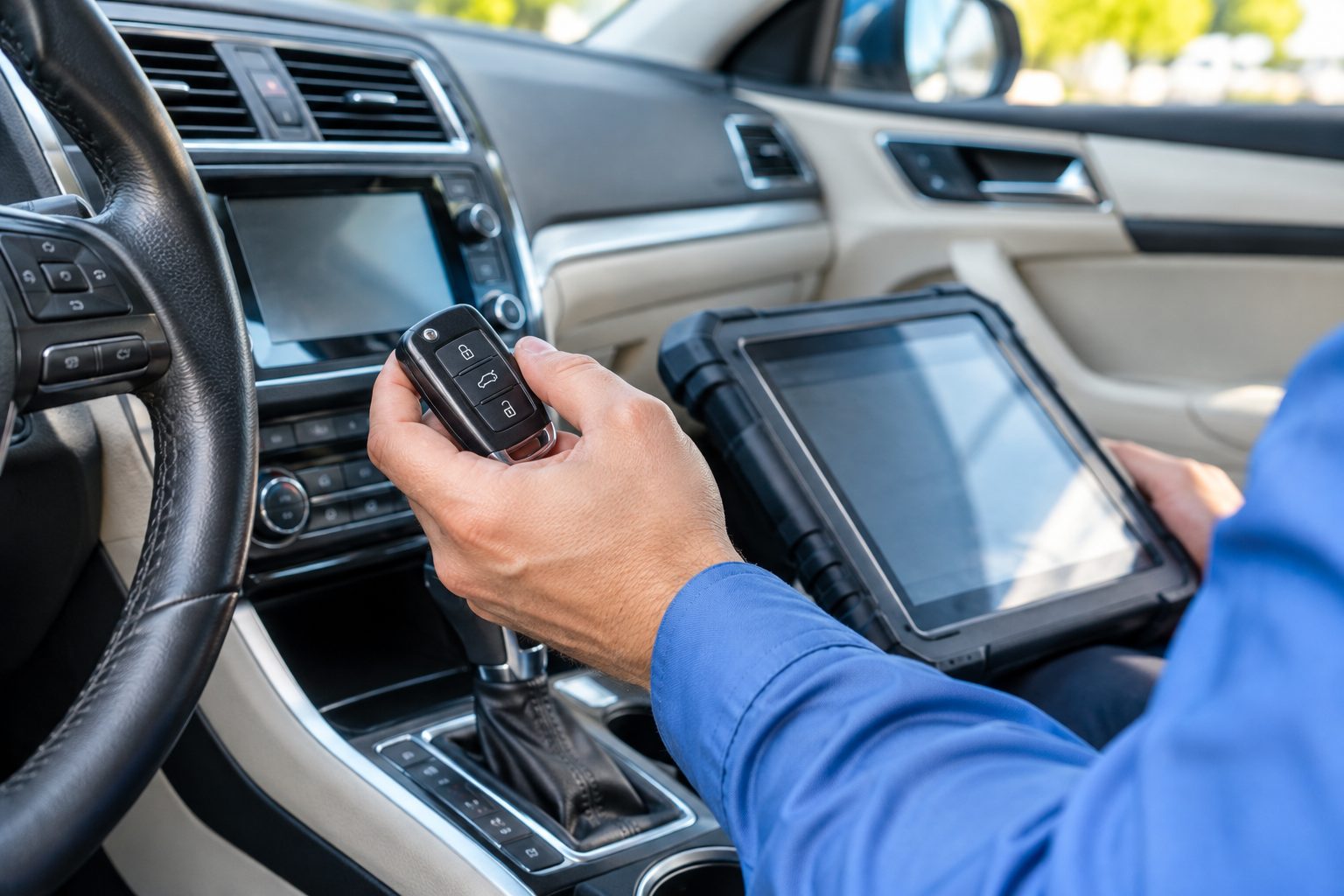
A key fob is a small radio. When you press a button, it sends an encrypted signal to a receiver in your car. The car checks that the signal belongs to a paired fob and, if so, locks or unlocks the doors, opens the trunk or starts the engine on push button models. Many fobs also contain a transponder chip, which talks to the car's immobilizer at very short range so the engine will run only for a recognized key.
Because the fob is a radio, it depends on three things: power, a pairing with the car, and a clear signal path. If any of these fails, the fob appears to be dead. Most failures are simple. A weak battery makes the range shrink. A lost pairing makes the fob appear fine but the car ignores it. Interference or a damaged antenna inside the fob blocks the signal.
Understanding that split helps with troubleshooting. If the fob does nothing at all, power is the first suspect. If the fob lights up but the car does not respond, pairing or interference is more likely. If the fob works only when held right against the car, the battery or antenna is weak. Our guide on what an immobilizer is explains the second system that many fobs also depend on.
The battery is the most common cause by a wide margin. Most fobs use a small coin cell, and it wears down gradually. Early signs include shorter range, needing to press the button several times, a dashboard warning about a low key battery and sluggish response from the car. Eventually the fob stops working altogether.
Replacing a coin cell is simple on many fobs: pry the case open along a seam, note the orientation of the battery, swap it for the correct type and snap the case closed. The battery type is printed on the old cell. Be careful not to touch the circuit board with oily fingers, not to bend the contacts and not to force the case, since the plastic can crack. If the case will not open easily, look for a hidden screw or a release button.
After a new battery goes in, most fobs work again at once. A few models need to be resynchronized, and a few keep their memory only while power stays connected. If the fob remains dead after a fresh battery, the problem lies elsewhere. Do not keep swapping batteries, since a fob that has been dropped in water or has corrosion on its contacts needs different attention.
Each fob is paired to its car. If the pairing is lost, the fob powers up and the light blinks, but the car ignores it. This can happen after a dead car battery, a jump start, a repair that disturbed the vehicle's computer, or a fob replacement that was not programmed correctly. Sometimes a fob that has been out of range for a long time falls out of sync, especially after a battery swap.
Some vehicles allow the owner to reprogram a fob using a sequence of key turns and button presses described in the owner's manual. Others need manufacturer or locksmith equipment. Many modern vehicles require a diagnostic tool that connects to the car's data port, writes the new fob into the memory and checks that the immobilizer accepts it. Our page on key programming explains how a technician does this.
Do not run through random sequences found online. Entering the wrong sequence on some vehicles can lock the system for a time or erase an existing fob. If your manual includes a procedure, follow it exactly. If it does not, a technician can handle the job. A fob that was programmed in the past by a different shop may also be a clone or an aftermarket unit, and an experienced technician can tell.
Radio signals can be blocked or confused. Strong nearby transmitters, such as cell towers, large electrical equipment, broadcast antennas or crowded parking lots with many wireless devices, can reduce a fob's range. Metal roofs and parking garages create reflections that make signals unreliable. A fob stored beside a phone, a wallet with metal shielding or a bag with metal lining can lose range.
Heat and humidity matter too. A fob left on a dashboard in Orlando summer sun can overheat, and the plastic case may warp and the battery lose life faster. Humidity can creep into a fob and corrode contacts. Splashes at a pool or beach, or a ride in the washing machine, can wreck a fob. Our guide to summer heat and car key fob care offers simple habits to protect your fob.
If the fob works in some places and not others, interference is a strong suspect. Try it in a different parking spot, away from heavy equipment, or hold the fob close to the car's door handle. If it works only at very short range, the battery is probably weak. A technician can test the fob's signal strength with a small device and tell you whether the fob or the car's receiver is at fault.
Fobs live hard lives. They are dropped, sat on, carried with heavy keyrings, run through laundry and left in sun. The buttons wear through, the rubber pad compresses, and the solder joints inside can crack. A fob that works when you press at a certain angle probably has a worn switch or a cracked joint.
A worn button case is sometimes repairable. A technician can replace the case shell, swap in a new battery and move the internal board into a fresh shell. This restores the appearance and the button feel. If the board itself is damaged, or if the transponder chip is cracked, a replacement fob is the practical choice.
Water damage is a separate case. If a fob went into a pool, a washing machine or a puddle, remove the battery at once, dry the fob gently and let it sit in a dry place for a long time before trying it again. Even then, corrosion may have started. Our page on key fob replacement explains how a new fob is sourced and programmed to your car.
Before calling, a short routine often sorts the problem. The routine is safe and does not involve tools beyond a small screwdriver or coin to open the fob case. It also gives the technician useful information if you do need to call.
Begin with the physical key blade, if your fob has one. Many fobs hide a mechanical key that opens the driver door when the fob is dead. Using it may set off the alarm, which usually stops once you start the car with the fob in the right place. If your car has push button start, the owner's manual usually shows a spot where you hold the dead fob against the steering column or a marked pocket so that the car reads the chip even without battery power.
Next, try the spare. If the spare works, the fault is with the first fob and not with the car. If neither fob works, the car's receiver or its battery is a more likely cause. Check the car's own battery, since a weak car battery can stop the receiver from working.
If both fobs fail, look at the vehicle. A weak or dying car battery can cause the receiver to misbehave, and a jump start or a battery swap can scramble the fob pairing. A blown fuse for the body control module, a damaged receiver antenna or a wiring fault from a past accident can also be to blame. In some vehicles, a recall or a software update touches the fob receiver.
A technician with the right diagnostic tool can read the vehicle's data and see whether the car is recognizing the fob signal at all. If the car sees the signal but rejects the key, the immobilizer data may need rewriting. If the car does not see the signal, the receiver or its power may be at fault. Some of these repairs are best handled by a shop that does electrical work on the car, and a locksmith will tell you honestly when a job belongs elsewhere.
You may also face a car that will not start even when the key turns or the fob is recognized. Our page on a car that will not start when the key turns covers that situation, and it overlaps with immobilizer faults.
If a fob cannot be repaired, a replacement is the answer. Options range from a new original style fob to an aftermarket unit that is built to match your car. The right choice depends on the make, model and year, on whether your vehicle uses a standard transponder key or a smart key, and on whether you want features such as remote start or a power liftgate button.
A mobile technician can cut the blade if the fob has one, program the transponder and the remote functions and test every button on your car. This is often more convenient than visiting a franchised service center, since the work happens where the car is. Our page on smart key replacement covers the push button type, and our guide on car key types through the years shows how keys have changed.
To order the right part, the technician needs the vehicle identification number, proof of ownership and your ID. Have the registration or title ready. Our guide on documents needed for car key replacement lists the items. Quotes are given by phone only, and no price appears here. A service call charge applies and is explained before dispatch.
A few habits extend a fob's life. Replace the battery at the first sign of weak range, rather than waiting for failure. Keep the fob out of direct sun and away from pools, beaches and washing machines. Avoid hanging a heavy bunch of keys from it, since the weight stresses the case and the keyring hole. Keep a spare at home, and test it from time to time so you know it works.
When a fob fails at a bad moment, such as at a theme park lot or a late-night shopping center, a mobile locksmith can come to you. Describe the car, the symptoms and what you have tried. If the car is locked with the fob inside, mention that too, and if there is a child or animal inside the car, call 911 first.
A fob problem is almost always fixable. When you are ready, call and tell us what your fob is doing. We will help you work out whether it needs a battery, a reprogram or a replacement, and arrange the visit.
The most common cause is a worn battery, which often shows up first as shorter range. Other causes include a lost pairing after a car battery change, interference, water damage or a cracked circuit board. Try the spare fob, replace the battery and check for dashboard warnings. If neither fob works, the car's receiver may need attention.
Usually yes. Pry the case open carefully along the seam, note which way the old battery sits and install the same type. Avoid touching the circuit board and avoid forcing the case. If the fob still does not work with a new battery, or if the case will not open, a technician can help without damaging it.
That is usually a sign of a weak fob battery. Many push button cars have a backup spot where the car can read the transponder chip without battery power. If you rely on it, replace the battery soon. If a new battery does not help, the fob may be damaged or the car's reader may need service.
Not necessarily. A mobile locksmith can often supply and program a fob for many makes and models, with proof of ownership and ID. Some vehicles need manufacturer-specific procedures, and a technician will tell you honestly if yours is one of them. Quotes are given by phone before any visit is booked.
It can disturb the pairing on some vehicles, though it often does not. If your fob stops working right after a battery change, try the hidden key, resynchronize if the manual provides a procedure and replace the fob battery. If it still fails, a technician can reprogram the fob using diagnostic equipment.
Quotes are given only by phone. Share the make, model and year, the fob type and what it does. A service call charge applies and is explained before dispatch. For complicated cases, such as no working key at all, an on-site visit may be needed before a firm quote can be given.
Describe the situation by phone and we will tell you what the job involves. Quotes are given by phone. Jobs that cannot be quoted without seeing them need a technician on site, and the service call charge is explained on the phone before anyone is dispatched.
A fob that seems dead is not always the culprit. Begin by noticing which functions fail. If the remote buttons stop working but the physical key still turns the door lock and starts the car, the fob electronics or battery are suspect. If the fob works from close range but not at a distance, the battery is weak or the antenna is blocked. If nothing works, including the car's interior lights or dashboard, the vehicle's own battery may be low. Sorting these cases helps you avoid replacing a perfectly good fob.
Try a few simple comparisons. If you have a second fob, test it in the same spot and compare. If the spare works, the first fob is the problem. If neither works, the cause is more likely on the vehicle side or in the environment, such as interference near strong radio sources. Try the fob right next to the driver door handle, and try pressing a button while holding the fob against your chin or the door, which sometimes helps weak signals. These steps are safe and require no tools.
Pay attention to patterns. A fob that fails mostly in a particular parking garage or shopping center may be affected by local interference. A fob that works after a battery change and fails again soon may have a failing contact or an internal fault. A car that has begun to have trouble with the fob and the interior lights together may point to a weak vehicle battery. Share these observations when you call, and the scope and quote are explained before work begins, so the repair addresses the real cause.