A modern car key is a small radio with a battery, a circuit board and a plastic shell, and it spends the summer in one of the harshest places possible: a hot car, a wet pocket or a beach bag. A few habits keep a fob working longer and make failures less of a surprise.
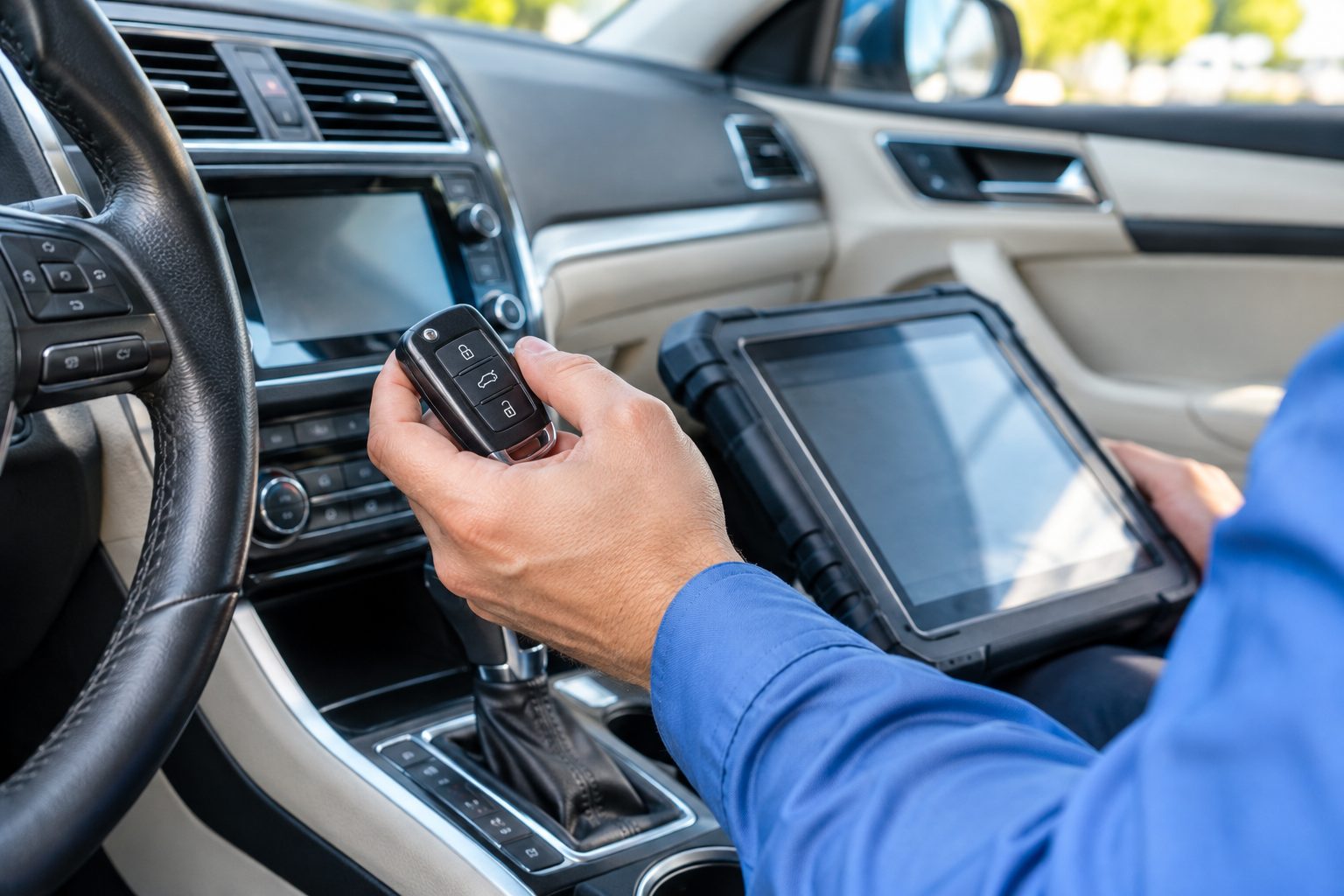
Most people think of a fob as a button remote, but it is a small electronic device with several jobs. A circuit board holds the chip that identifies your car. A radio transmitter sends signals when you press a button. In many vehicles there is also a transponder, a tiny chip that talks to the ignition system so the engine will start. Keyless or smart keys add a low-power transmitter that responds when you are near the car, so the doors unlock when you touch the handle and the engine starts from a button.
All of that runs from a small coin cell battery, usually a flat lithium type about the size of a coin. The battery powers the buttons and the proximity signal. In some vehicles the transponder chip works without the battery, so the key can still start the car when the fob is dead, but the remote functions stop. In others, a dead battery can make the whole system unreliable.
Inside the plastic shell are contacts, a rubber button pad and often a small mechanical key blade that folds out or slides from the fob. Each of these parts reacts differently to heat, moisture and wear, which is why summer in Orlando is hard on them.
A car parked in the sun can become much hotter inside than the air outside, especially on the dashboard, the seats and the center console. Leaving a fob in that space for hours, day after day, exposes the battery and electronics to temperatures they were not designed to sit in. Batteries tend to lose capacity faster when they are repeatedly heated, and some can swell or leak after a long period of stress. Plastic shells can warp slightly, and the adhesive or rubber used for button pads can soften and peel.
You may notice the symptoms as a shorter range, buttons that need pressing harder or several times, a dashboard warning about key battery, or a fob that works in the morning and fails in the afternoon. Intermittent behavior like this is a classic sign of a tired battery or a worn contact.
None of this means the fob is ruined. In most cases a fresh battery restores normal operation. The point is that heat shortens the useful life, so it is worth paying attention to the warning signs and keeping the fob out of the hottest spots.
The simplest habit is to take the fob with you instead of leaving it in the car. Many people leave a spare in the glove box, the door pocket or on the dash. Those are hot places, and they are also the places a thief checks first. A fob left in a vehicle also removes one layer of protection against theft, since anyone who gets into the car can drive away with it.
At home, store the fob away from the windows, direct sun and heat sources. A hook by the door inside the house or a drawer in a cool room is better than a windowsill. If you commute, a pocket or bag that stays with you is better than the cupholder.
Avoid keeping a fob in the same pocket as a phone for hours. This is not a heat issue so much as a wear issue, since pressing keys against hard objects can wear down button pads and cases. A simple silicone cover protects against scratches and knocks, though it does not make the fob waterproof.
Heat is only half the story. Central Florida has a long wet season, and the air is humid for much of the year. Moisture creeps into fobs through button gaps and seams. Over time it can corrode battery contacts and the traces on the circuit board. A green or white crust on a battery contact is a sign that moisture has been at work.
Water exposure is more sudden around pools, theme park water rides, beaches and boats. A fob that goes through a wash in a pocket, falls into a pool or gets soaked at the beach may stop working at once or may work for a few days and then fail as corrosion sets in. Salt water is harder on electronics than fresh water because it conducts electricity and speeds up corrosion.
If a fob gets wet, do not press the buttons repeatedly. Open it if you can do so without damage, remove the battery, dry the parts and let them air out in a cool, dry place. Do not use a hair dryer or an oven. Heat can warp plastic and damage solder joints. Rinse salt water off with fresh water first if the fob was in the sea, then dry it. If it will not recover, a replacement is likely needed. The page on key fob replacement explains how that works.
A fob battery rarely dies without warning. You might see a message on the dashboard saying the key battery is low, or notice that the car needs the fob to be closer than before. Buttons might work only on the third press. The lock click might be faint. In a keyless car, the doors might not unlock when you touch the handle until you hold the fob near the door.
Many drivers ignore these signs until the fob fails in a parking lot. A better approach is to replace the battery at the first sign of trouble, or as routine maintenance if the fob is a few years old. The battery type is printed on the battery itself, usually a model number stamped on the surface. Buying the same type and fitting it correctly matters, with the positive side facing the way the old one did.
Opening a fob can be easy or fiddly. Some have a slot where a small flat tool or coin pops the shell open. Others are glued or clipped in ways that crack if forced. If you are unsure, ask a professional rather than risk damaging the case or the circuit board. A mobile technician can change a battery and check the fob at the same time.
Before you open anything, look up the model or search for the type of battery your fob uses. Have the new battery ready, a clean surface and good light. Work gently. The goal is to open the shell without bending the circuit board or tearing the rubber pad.
Note the orientation of the old battery before you remove it. Photograph it if that helps. Take care not to touch the flat surfaces of the new battery with oily fingers, since the oils can reduce contact quality. Place the battery in the same orientation, close the shell until it clicks and test every button near the car.
If the fob still does not work after a fresh battery, the problem may be a worn contact, a cracked board, a damaged button pad or a fob that has lost its programming. Do not keep opening and closing it. At that point it is better to have it checked. Some fobs need to be reprogrammed after the battery has been out for a long time, though many do not.
Cars with keyless ignition have a backup for exactly this situation. The usual method is to hold the fob against a marked spot on the steering column, the start button or the center console. The car reads the chip in the fob through close contact, even with a dead battery, and allows the engine to start. Your owner's manual shows where the spot is.
Cars with a traditional key and a remote usually start from the key itself, as long as the transponder chip is intact. The remote buttons may not work but the mechanical key turns in the door and the ignition. If a key turns but the car does not start, the problem is often the transponder chip, which is covered in the page on a car that will not start when the key turns.
If the fob works for the doors but not for starting, or the reverse, that gives a technician useful information. Describe exactly what works and what does not when you call. The article about a car key fob that has stopped working offers further guidance.
Summer adds a safety dimension to car lockouts. A locked car in Orlando heat can become dangerous quickly for a child or a pet inside, and if that is the case, call 911 immediately. Do not wait for a locksmith. Emergency services can open the car and are the right first call when anyone's safety is at risk.
For lockouts where nobody is inside, take a moment to move yourself and your belongings into the shade, and call. A mobile technician can come to the vehicle. Have your location, the make, model and year of the car, and proof of ownership ready. The page on car lockout service explains how the process works from the moment you call.
A good way to avoid summer lockouts is to keep a spare key in a safe place that is not the car. A spare fob in a purse or a bag, or one held by a trusted relative, is worth more than a hidden magnetic box under a bumper, which can fall off or be found by someone else. For more ideas, see the spare key storage guide.
Orlando visitors and residents spend a lot of time at parks and attractions, where keys often go into lockers, bags and pockets that get wet or crushed. If you are heading to a water park or a ride that gets you soaked, leave the fob in a secure locker or with a member of your group who is staying dry. A waterproof pouch helps for water play, though it is not a guarantee.
Smart keys carry an extra risk at attractions: they can be left on a ride or fall out of a pocket. Check that you have the fob each time you move from one area to another. A quick pocket pat before leaving a parking space or a restaurant is a sensible habit.
If the car is a rental, the same rules apply, but your options after a loss are different. The rental company has to be involved, and replacing a key on a car you do not own needs their approval. The guides on theme park visitor car key tips and rental car key lockouts go through what to do.
Smart keys constantly listen for a signal and respond to the car when they are close. Thieves have used devices that pick up and relay that signal from a fob inside a house to the car outside, allowing them to unlock and drive off. The risk varies by vehicle, and automakers have improved their systems, but a few simple habits reduce exposure.
One habit is to keep fobs away from doors and windows, since signals travel more easily there. Another is to use a shielded pouch or box, often called a Faraday pouch, that blocks the signal when the fob is inside. Some fobs also have a motion sensor that puts them to sleep when still, which you can check in the manual. The guide on keeping car keys safe from relay theft goes through the topic in detail.
None of this has anything to do with heat, but the two issues overlap: the places people leave fobs to avoid theft, such as drawers and boxes, should also be cool and dry.
A fob with a cracked board, a failed transmitter, heavy corrosion or lost programming usually cannot be repaired economically. A technician can tell you after a quick check. Replacement means a new fob that is programmed to your car. Depending on the make and model this can mean cutting a new key blade, programming a transponder and syncing the remote.
Which fob you need depends on your car, and not every part number that looks right will work. Frequency, chip type and key blade profile must match. Buying a fob from an unknown seller can lead to a fob that cannot be programmed. Ask a professional to confirm before you buy, or let them supply the fob. See key programming and the guide on documents needed for car key replacement.
Quotes for replacement are given by phone once you provide your vehicle's make, model and year and describe the fob. If you have no working key at all, that is a different situation and usually involves more steps. See all keys lost for how that is handled.
A little attention goes a long way. A seasonal routine takes only a few minutes, and it saves most of the trouble described above. It also gives you a chance to confirm that you have a working spare, which matters far more than the fob itself.
If any item on the list shows a problem, act on it early, and when you are ready to arrange a battery change, a spare or a replacement, call. A mobile technician can meet you where you are, and the dispatcher can explain what is needed and give a quote by phone.
It varies with the fob, how often you use it and the heat it sits in. Many last for a few years, but heat and heavy use can shorten that. Rather than going by a date, watch for warning signs such as shorter range, repeated presses, or a dashboard message, and replace the battery when you see them.
It is not ideal. Repeated high temperatures can shorten battery life and wear plastic and rubber parts. It also leaves the key where a thief might look. Take the fob with you when you can, and keep spares in a cool, dry place at home rather than in the vehicle.
Do not keep pressing the buttons. If you can open it safely, remove the battery, rinse off salt or chlorine with fresh water, then dry it in cool air. Avoid hair dryers and ovens. Let it dry fully before trying a new battery. If it still fails, it may need replacement, and a technician can advise.
Often yes. Many keyless cars have a backup start position where you hold the fob near a marked spot so the car can read the chip with no battery. Cars with a mechanical key usually start with the key itself. Your owner's manual shows the correct method for your model.
Usually not, as most fobs keep their programming in memory that does not depend on the battery. Some fobs that were without power for a long time may need to be resynchronized. If the fob does not respond after a fresh battery, have it checked rather than opening it repeatedly.
Call 911 straight away. Heat inside a closed car can become dangerous very quickly, and emergency services can get to the vehicle fast and are equipped to open it. Do not wait for a locksmith in that situation. Once everyone is safe, a locksmith can help with the key or lock afterward.
Describe the situation by phone and we will tell you what the job involves. Quotes are given by phone. Jobs that cannot be quoted without seeing them need a technician on site, and the service call charge is explained on the phone before anyone is dispatched.