Cutting a key and programming a key are two separate jobs that happen to usually occur in the same visit. Cutting shapes metal to match a lock's mechanical pins. Programming is electronic, teaching the vehicle's immobilizer to recognize the chip inside the key as one that's allowed to start the engine. A key can be cut perfectly and still leave a car cranking without starting, because the immobilizer hasn't been told to trust that chip yet. Getting both halves right, not just one, is the actual job.
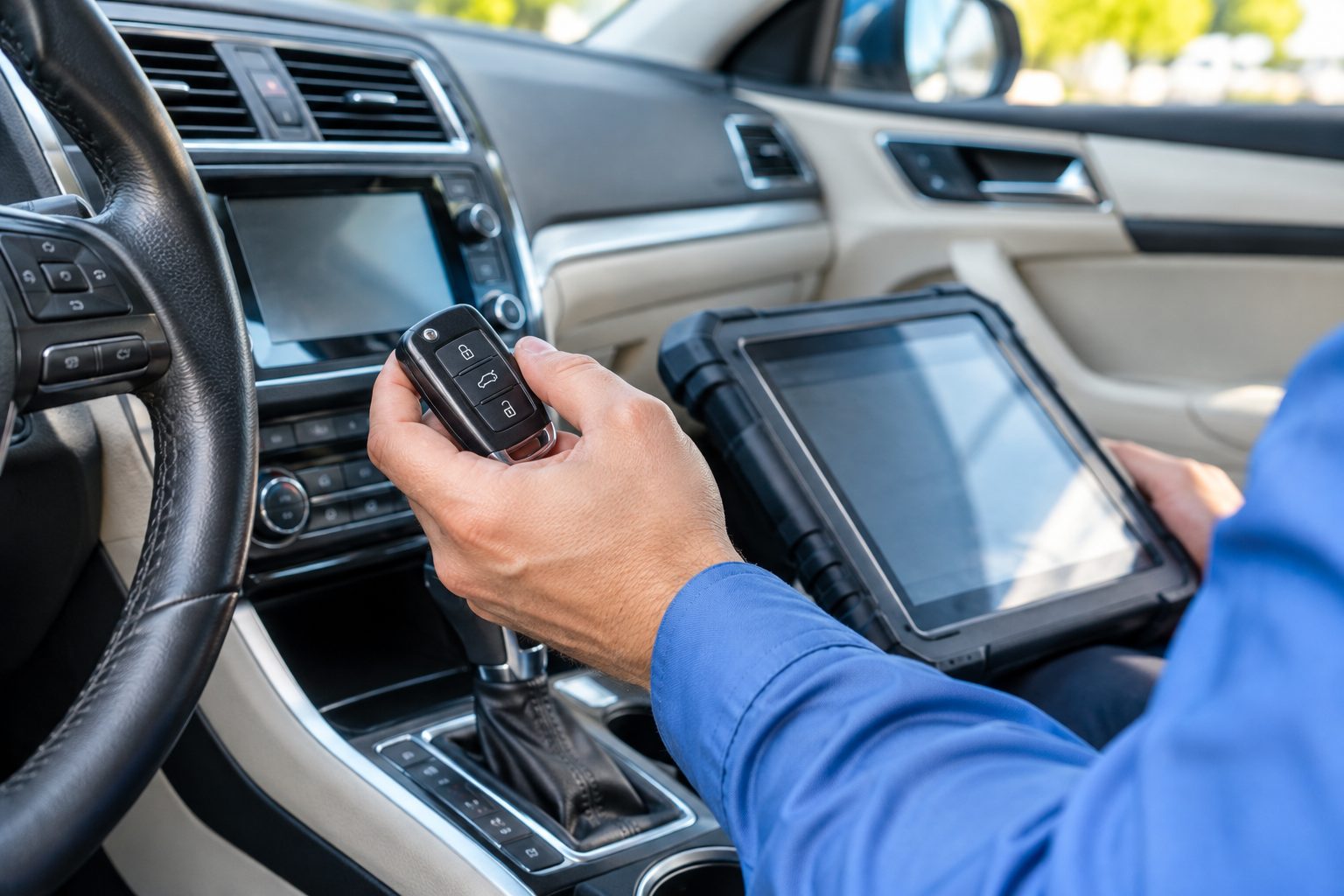
How that second half happens depends heavily on the vehicle. Some cars will teach themselves a new key with nothing more than a sequence performed with an existing key. Others need an external tool talking directly to the immobilizer module. And a few makes build in a mandatory waiting period that no tool, however capable, is allowed to shorten.
Transponder technology has moved through several generations since chipped keys became standard equipment, early fixed-code chips that broadcast the same signal every time, rolling-code systems that change the expected response on a schedule, and current encrypted chips that use cryptographic handshakes between key and immobilizer. A chip family that works in one model year of a given vehicle often isn't compatible with a newer version from the same manufacturer, even when the physical key blank looks nearly identical. A Toyota from one generation and a Toyota from the next can use entirely different chip families under blanks that appear interchangeable at a glance.
Matching the right chip generation to the specific vehicle is the first decision, made before any programming attempt starts, and getting it wrong means a key that cuts fine on the machine and still never talks to the car once it's in the ignition. That match gets confirmed against the vehicle itself, not just the model name, since trim level and production date can shift which chip a given car actually expects.
Certain vehicles, some Ford, Chevrolet, and Kia models among others, support a documented sequence performed with an existing working key that puts the immobilizer into a mode where it will learn an additional key without any external programming tool at all. It typically involves a specific pattern of ignition cycles or door actions within a set window, and it only works when at least one valid key is already available to initiate it. Where it's supported, it's the most direct path, since nothing beyond the vehicle and the keys themselves is involved.
Plenty of vehicles don't offer an onboard sequence, or the situation doesn't allow for one, no working key to start the process, or a platform that requires professional-level access regardless. In those cases, a diagnostic programming tool connects through the vehicle's data port and communicates with the immobilizer module directly, writing the new key's identity into the system the way the manufacturer's own service equipment would. This is also the route for many Honda, Nissan, Hyundai, Subaru, Mazda, Volkswagen, GMC, and Ram models where the security architecture doesn't leave an owner-accessible onboard path.
Certain platforms, a number of Dodge and Jeep vehicles among them, build in a mandatory delay after a new key is introduced or after a failed programming attempt, sometimes running around ten minutes, before the immobilizer will accept another try. That timer is written into the vehicle's own security firmware specifically to slow down anyone attempting to program keys without authorization, and it applies exactly the same way to a qualified locksmith as it would to anyone else. No tool bypasses it, and no amount of urgency changes the count.
This is worth knowing going in, because it means a car with this kind of protection can take noticeably longer to finish than one without it, through no fault of the technician or the equipment. The delay isn't a sign anything went wrong, it's the vehicle doing exactly what its manufacturer designed it to do, and the only way through it is to let it run.
Programming is the half of a key job that doesn't show up until the ignition turns and the car either starts or doesn't. Call us with your vehicle's make and model year, and we'll work out whether it's an onboard sequence, diagnostic programming, or a security timer that needs to run its course.
Can any key be programmed to any car?
No. The chip generation has to match what the vehicle's immobilizer expects, and the physical key blank has to match the ignition or door lock. Both are specific to the make, model, and often the model year.
Why does my car need a wait before accepting a new key?
Some manufacturers build a mandatory security delay into the immobilizer as an anti-theft measure. It's part of the vehicle's own firmware and applies regardless of who's programming the key.
Do I need my existing key present to add a new one?
For onboard programming, yes, it's what initiates the process. Diagnostic-tool programming can sometimes proceed without one, depending on the vehicle.
Three kinds of vehicle keys get called "programmed keys," and each involves different work.
That distinction matters because a remote head key can start the car and still fail to lock the doors if only the chip was programmed, or it can lock the doors and never start the car if only the remote side was set up. A complete job confirms both functions before the technician leaves.
When a key is lost or stolen, programming a new one is only part of the job. On many vehicles, the immobilizer keeps a list of every key it has been taught. If the lost key is still on that list, it can still start the car for whoever has it. Many programming procedures allow the stored keys to be cleared and only the keys you still have to be added back. That step should be part of any lost or stolen key replacement.
It also means you should bring every key you want to keep using. If the procedure clears all stored keys, any key not present at the time will stop starting the car. A spare sitting in a drawer at home will need to be programmed later if it was not there when the list was rewritten.
When no working key exists at all, the job gets more involved. The blade has to be cut from the vehicle's key code or by decoding a lock on the car, and the immobilizer has to accept a new key without an existing one to start the process. Some vehicles allow that through a diagnostic tool, some require a security code tied to the VIN, and some require removing a module for the key data to be read. The approach depends on the make, model and year, and it is the main reason the vehicle details matter so much when you call.
Several manufacturers require a security PIN or code before a new key can be added. On some vehicles the tool can retrieve that code from the car itself. On others the code has to be obtained through an authorized source using the VIN and proof of ownership. Either way, the vehicle's registration or title and your ID will be checked before any key is programmed. That rule protects owners from someone trying to add a key to a car that is not theirs.
Replacement keys come in two broad types. Original equipment keys are made by or for the vehicle manufacturer. Quality aftermarket keys are made by other companies to work with the same system. Both can work well. Original keys generally match the factory look and button layout exactly, while good aftermarket keys can be a practical choice on older vehicles or when a factory key is hard to get. Very low-cost keys bought online are a different story: many have the wrong chip, a weak transmitter, or a blade that wears the ignition. If you buy a key yourself, confirm it matches your exact model and year before asking anyone to program it, and understand that some online keys cannot be programmed at all.
Not every no-start is a key problem, but some patterns point straight at it:
If a spare key starts the car, the problem is with the first key, not the car. A cracked key head can break the chip's antenna or dislodge the chip. A dying fob battery is the most common cause of a weak remote and of a "key not detected" message. Replacing the battery is worth trying first.
Keys in daily use wear out on the outside long before the electronics fail. Rubber buttons tear, plastic cases crack, and flip-key hinges loosen. In many cases the internal circuit board and chip can be moved into a new shell, keeping the same programming. That is a smaller job than making a new key, as long as the board and chip are undamaged. If the board has been exposed to water or crushed, a new key is usually needed.
Orlando sees a huge number of rental cars, and people often ask whether a locksmith can make a key for one. Rental vehicles belong to the rental company, which usually has its own process for lost keys, and many contracts say how a replacement must be handled. Contact the rental company first. For leased vehicles, the lease holder is typically the registered owner, so bring the lease paperwork along with your ID and registration.
Summer heat inside a parked car can be extreme, and a fob left on the dashboard or in a cup holder in direct sun ages its battery faster. Fobs also get soaked in pools, at the springs and at the beach. If a fob gets wet, remove the battery right away, let the case and board dry completely, then try a fresh battery. Corrosion on the contacts is common after water exposure and can cause the fob to fail days later. Keeping a spare fob at home, out of the heat, gives you a backup when the everyday one gives out.
Many used cars in Central Florida are sold with a single key. That works until the day it is lost, when the job becomes an all keys lost situation, which is usually more involved than adding a spare while a working key still exists. Adding a second key soon after buying a used vehicle is one of the most practical things an owner can do. It is also a good moment to clear any keys stored in the car's memory from previous owners, if the vehicle allows it.
When a car will not start because the key is missing or not recognized, the car cannot drive itself anywhere. The traditional alternative is towing it to a dealer's service department and waiting for an appointment, which in a busy metro can mean days without the vehicle. Mobile programming brings the key blanks, the cutting machine and the programming tools to where the car sits: an apartment lot near UCF, a theme park garage, a hospital parking deck, a driveway in Clermont. For most common vehicles, the full job of cutting and programming happens right there.
There are exceptions. A handful of newer vehicles and some luxury models have systems that only the manufacturer's dealer equipment can access, or that require parts only the dealer can order. When that is the case, it is better to know up front than to have someone arrive without the ability to finish. That is why the year, make and model matter so much in the first phone call.
Almost every smart key vehicle has a backup method for starting when the fob battery is dead. Usually the fob is held against a marked spot on the steering column, the start button itself, or a slot in the center console. The car reads the chip directly at close range, even with no battery power in the fob. If your car says the key is not detected, try that before calling anyone. The owner's manual shows the exact spot.
The emergency blade hidden inside most fobs opens the driver door when the remote does not work. Some vehicles hide the door keyhole behind a small cap on the handle, which pops off with the tip of the blade. Knowing both tricks can turn a stranded moment into a two-minute inconvenience.
Key programming is not limited to passenger cars. Many pickup trucks, work vans and fleet vehicles use the same transponder systems as cars, and a lot of Orlando contractors depend on a single work truck to get to every job. For fleet owners, keeping a spare programmed key for each vehicle, stored at the office, is the easiest way to avoid a truck sitting idle because one employee lost the only key. If an employee leaves with a key, clearing it from the vehicle's memory and programming a new one prevents the old key from starting the truck later.
Before the technician leaves, test everything: start the engine several times, lock and unlock with the remote from a normal distance, open the trunk or liftgate if the key has that button, and use the blade in the door. If the car has a push-button start, walk away and come back to be sure the doors respond as you approach. It is much easier to fix a missed function on the spot than on another day. Then decide where the spare will live, away from the car and away from the everyday key.
Searching locksmith near me in Orlando for a house lockout? We are mobile across metro Orlando and quote the price before we come out. Call us.
ZIP codes we cover in Orlando: 32801, 32803, 32804, 32805, 32806, 32807, 32808, 32809, 32810, 32811, 32812, 32814, 32817, 32818, 32819, 32820, 32821, 32822, 32824, 32825. City services: Orlando Official Website.
Describe the situation by phone and we will tell you what the job involves. Quotes are given by phone. Jobs that cannot be quoted without seeing them need a technician on site, and the service call charge is explained on the phone before anyone is dispatched.