A front door on a house gets used a handful of times a day. A front door on a storefront gets used hundreds of times before lunch. Commercial hardware doesn't wear out on a calendar, it wears out on a cycle count, and a door that's three years old with heavy foot traffic can be more worn than a house door three decades older. That single difference reshapes almost everything about how this category of work gets approached.
It also has to answer to people who aren't the business owner at all: a fire marshal, an insurer, a landlord. A fire marshal cares whether the door can be exited without a key, full stop. An insurer cares whether key control was ever actually documented. A landlord cares whether whatever gets installed matches the terms of the lease. Getting locked out of a break room is the least complicated problem a commercial door presents.
Life-safety code is blunt about one thing: a person inside a building has to be able to get out without a key, a code, or a tool, every single time, regardless of what's locked from the outside. That's the entire reason panic bars and push bars exist on doors that would otherwise use a standard deadbolt. It's also the first thing checked on a walkthrough, because a door that satisfies an owner's preference for security but fails this test isn't a security upgrade, it's a liability the business is carrying whether or not anyone's noticed yet.
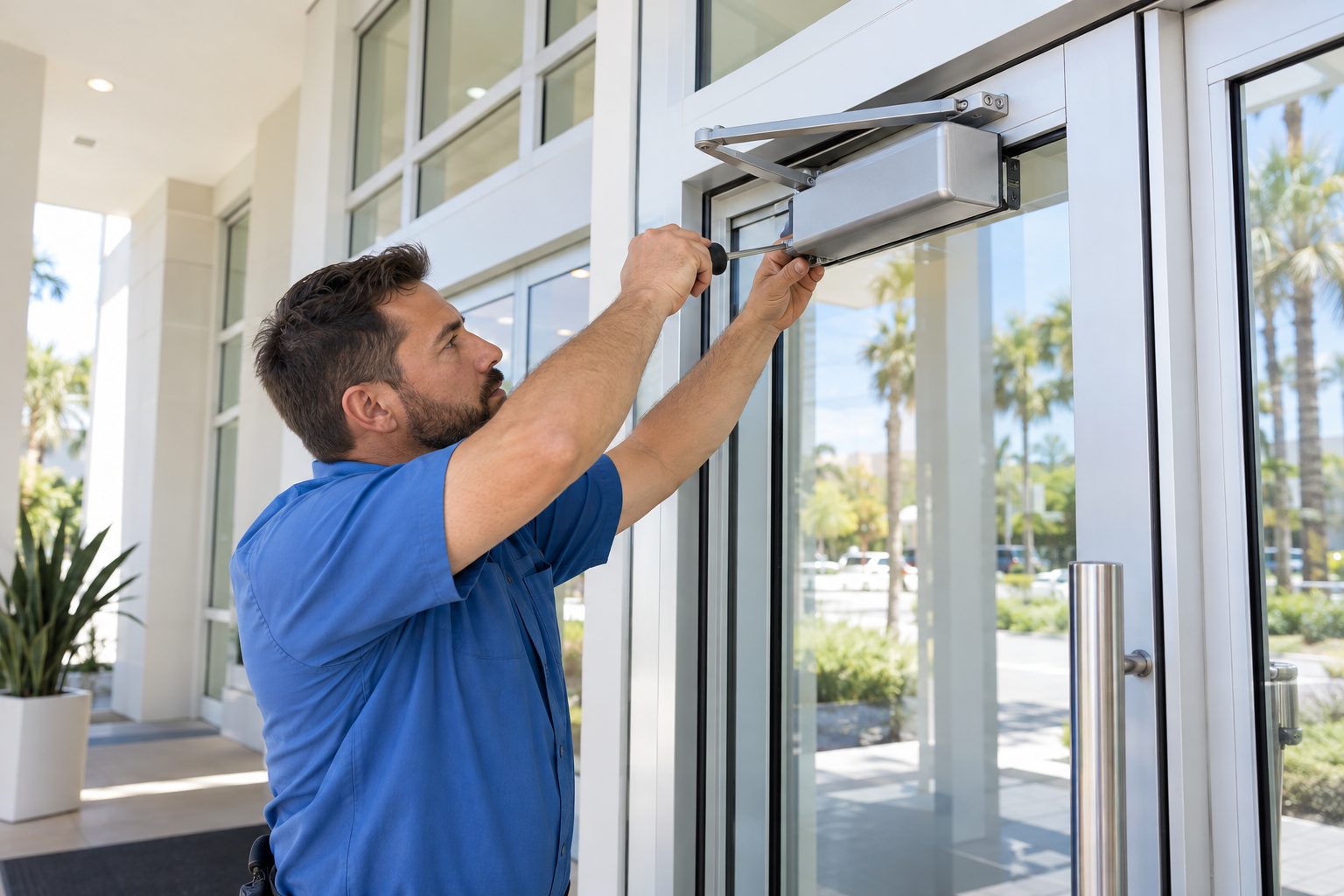
A closer arm gets bent by a delivery cart wedging the door open. A panic bar's internal mechanism wears from thousands of pushes, not from age sitting idle. A storefront door's pivot hinges sag under repeated daily traffic until the door drags across the threshold and the deadlatch stops striking cleanly, at which point the lock gets blamed for a problem that's actually the door. None of these failures follow a calendar-based maintenance schedule. They follow one tied to use, which is why a busy retail entrance and a rarely opened back-office door age at completely different rates even when the hardware is identical.
Staff turnover is constant in most commercial settings, and every employee who leaves without turning in a key is a small, unresolved question about who can still get in. A master key system built with a real hierarchy, grand master, master, sub-master, change keys, solves this by controlling access at any level without rekeying the entire building every time someone quits. Without that structure, a business either rekeys constantly out of nervousness or slowly loses track of who holds what, and an insurer reviewing a claim after a loss will ask exactly that question.
A commercial lease usually says something about what hardware can be installed and whether it reverts to building-standard at move-out. An insurance policy may condition coverage on documented key control. A fire inspection walks the exits specifically, confirming panic hardware dogs correctly, that nothing requires a key from the inside, and that closers aren't propped open or disabled. None of these three parties cares about the same thing a business owner cares about day to day, and satisfying all of them at once is a large part of what this category of work is actually for.
Some of this is straightforward hardware service, rekeying after an employee leaves, repairing a storefront door that's started to drag, replacing a closer that's leaking oil instead of just tuning one. Some of it is a broader look at the property: walking every door, checking who holds keys to what, and flagging what's likely to fail first before it becomes a fire-code citation or an insurance problem. That broader look is its own service for exactly that reason, it's a different conversation than fixing one door.
Commercial hardware fails on a schedule set by how the door gets used, not by how long ago it was installed. Call us to talk through what's actually happening at the door, a dragging storefront entrance, a closer that's leaking, a key that's unaccounted for, or a full walkthrough before an inspection catches it first.
Can panic hardware be locked from the inside?
No, not in a way that requires a key or a code to exit. That's the entire point of the hardware, and it's checked on any fire inspection.
Do you rekey a whole building or just one door?
Either, depending on the key structure already in place. A property with a master key system can often have one door or one key level rekeyed without touching the rest.
Commercial locks are made to different durability standards than most residential locks. In the United States, locksets are commonly rated under ANSI/BHMA grades, with Grade 1 built for the heaviest use, Grade 2 for moderate commercial or heavy residential use, and Grade 3 for lighter residential duty. A Grade 3 lever that would last years on a spare bedroom can be worn out on a busy office door in months. When a business owner buys hardware at a big box store to save money on a replacement, it is often a residential grade product, and it fails quickly under commercial traffic.
The grade is not the only factor. Lever style matters too. Solid levers with strong return springs hold up better than hollow designs that start to droop. On doors that see carts, strollers or wheelchairs, a lever that sags becomes a daily annoyance and eventually a failure. When we recommend replacement hardware for a business door, the grade and the way that door is actually used both factor in.
Aluminum and glass storefront doors, common across Orlando's plazas, strip malls and office buildings, use narrow stile hardware designed to fit the thin metal frame of the door. The lock is usually a hook bolt or deadbolt operated by a mortise cylinder, and many also have a deadlatch for everyday latching. These are not standard residential parts, and they are not interchangeable with a regular deadbolt. The door's backset, the depth of the frame and the style of the cylinder cam all have to match.
Common problems on these doors include a hook bolt that no longer catches because the door has sagged, a cylinder cam that has worn so the key turns without moving the bolt, and a thumb turn on the inside that has been installed where the building really needs a keyed inside cylinder or panic hardware. If your storefront key spins without locking, the cam or the cylinder connection is the usual cause, and it is a quick repair once the right part is on hand. Our storefront door repair page covers the door side of these problems.
Restaurants have their own lock patterns. The back door takes deliveries at odd hours and gets propped open during service, which is hard on closers and latches. Grease, heat and constant cleaning wear finishes and keyways faster than in an office. Managers change often, and each one tends to end up with a full set of keys. The office where cash is counted and the storage room where alcohol is kept both need tighter key control than the dining room.
A practical setup for many restaurants is a small hierarchy: one key that opens the front, back and dining areas for opening and closing staff, a separate key for the office and liquor storage held only by managers, and an owner key that opens everything. When a manager leaves, only the manager level needs to be changed. A keyed lock on the office door is a minimum, and a small safe for the cash drop keeps money out of desk drawers.
Offices that store patient records, medications or client files have more to protect than the front door. File rooms, medication cabinets, server closets and the records area behind reception often need locks that only certain staff can open. Many of these offices started with a single key for everything and never changed it as the practice grew. A walkthrough that separates public areas, staff areas and restricted rooms, and assigns keys accordingly, is usually the first step.
Cabinet and drawer locks are part of this. Medication cabinets, file cabinets and desk pedestals often come with generic keys that are shared across many units from the factory. Rekeying or replacing those locks with ones on your own system means a stray key from a used furniture store does not open your records cabinet.
Orlando has a lot of flex and warehouse space, from the areas near the airport to the industrial parks off the major highways. These buildings often have a mix of doors: a glass office entry, steel man doors on the sides and back, and large roll-up or sectional doors for trucks. The man doors are where most key problems show up. Steel doors in steel frames last a long time, but their locks take a beating from weather, forklifts and heavy use, and the frames can get bent by impacts.
For warehouses, a lock plan that separates the office from the floor, and the floor from any caged storage for high value inventory, makes key control manageable. Padlocks on cages and gates should be keyed to the same system so a departing employee's keys can be accounted for all at once.
A "Do Not Duplicate" stamp on a key is a request, not a barrier. Many key cutting counters will copy it anyway, and some kiosks never see the stamp at all. If controlling copies matters to your business, a restricted keyway is the real answer. With a restricted system, key blanks are only available through the locksmith or the authorized dealer that set up the system, and copies require authorization from someone the business names. Some systems add patent protection that makes making blanks legally and practically harder for others.
A restricted system costs more up front than standard cylinders, but it saves on rekeying over time, because keys do not multiply without the business knowing. It pairs naturally with a key log that records who holds which key and when it was issued.
At some point, many businesses ask whether they should replace keys with cards, fobs or codes. The answer usually depends on turnover and the number of doors. A business with a few doors and a stable staff can manage well with a good key system. A business with frequent staff changes, several entrances, or a need to know who opened a door and when is often better served by electronic access control on at least the main entries. Old credentials can be turned off instantly, schedules can lock and unlock doors automatically, and there is a record of use.
Electronic access control relies on electric strikes, maglocks or electrified locksets at the door, and those have their own rules for fire safety and egress. Our electric strikes and maglocks page explains how that hardware works and what to watch for.
Aluminum storefront doors expand in the Florida sun, and a west-facing entrance can bind in the late afternoon even if it works perfectly in the morning. Glass lets in heat that bakes the inside of the door too, and weather stripping and closers suffer. If your storefront door locks easily at opening and fights you at closing, heat expansion is a likely cause. Adjustments to the strike, the pivots or the closer usually solve it, and tinted glass or an awning can help over the long run.
Before a storm, businesses usually focus on shutters, plywood and sandbags. Locks deserve a few minutes too. Make sure every exterior door fully latches and locks, and that doors with flush bolts or top and bottom rods have them engaged. Make sure someone other than the owner has keys and knows the alarm code, in case the owner cannot get back to the building after the storm. Keep a set of keys and a list of lock types somewhere off site.
After a storm, check every door before opening. Water, wind and debris can bend frames and jam locks. Electric locks may have lost power and switched to their fail safe or fail secure mode, depending on how they were installed. Knowing which mode each door uses before the storm keeps you from being surprised afterward.
Commercial work requires confirming that the person asking for it is authorized. Have your name, your role, and something that ties you to the business, such as a lease, a business card with ID, or confirmation from the owner or property manager. Tell us the type of door, the number of doors involved, and whether the building is on a master key system. If you are a tenant in a multi-tenant building, check whether the landlord needs to approve lock changes or keep a key.
In a shopping plaza or a multi-tenant office building, the locks on a single suite often sit inside a larger system run by the landlord. The building may have a master key that opens every suite for emergencies and maintenance, and the lease may require that tenant locks stay on that system. Changing a suite lock without checking can take the suite off the master, which causes trouble the first time a fire alarm or a water leak needs someone to get in overnight. The reverse happens too. Tenants assume their new lock is private, not realizing the landlord's master still opens it.
The simplest approach is to ask the property manager before any lock change. If the building uses a master system, we can often rekey the suite to a new change key that still works under the landlord's master, so both sides get what they need. If the building has no master system, the tenant may be allowed to rekey, but most leases still require giving the landlord a copy of the key.
The most common commercial emergency is simple: the person who opens the business shows up and cannot get in. The key was left at home, the manager who had it quit last night, or the lock finally failed on the coldest, wettest morning of the year. For a business, every hour the door stays shut costs sales, so a lockout at opening feels bigger than a lockout at home.
Planning helps more than anything. Make sure at least two people who live nearby can open the building. Keep a spare key in a secure spot off site, not hidden near the door. If the building has an alarm, make sure the people who can open the doors also have the alarm code. And if a lock has been getting harder to operate, handle with it before it fails at six in the morning.
Beyond the doors, most businesses have dozens of small locks: employee lockers, cash drawers, key cabinets, display cases, mailbox units, and filing cabinets. These are often forgotten until a key goes missing. Many can be rekeyed or fitted with replacement cores, and some can be brought onto the same system as the building's door locks. Keep track of these small keys the same way you track door keys, because a key cabinet that anyone can open defeats the purpose of controlling the keys inside it.
Searching locksmith near me in Orlando for a house lockout? We are mobile across metro Orlando and quote the price before we come out. Call us.
ZIP codes we cover in Orlando: 32801, 32803, 32804, 32805, 32806, 32807, 32808, 32809, 32810, 32811, 32812, 32814, 32817, 32818, 32819, 32820, 32821, 32822, 32824, 32825. City services: Orlando Official Website.
Describe the situation by phone and we will tell you what the job involves. Quotes are given by phone. Jobs that cannot be quoted without seeing them need a technician on site, and the service call charge is explained on the phone before anyone is dispatched.