A car key used to be a piece of cut metal. Today it can be a radio transmitter, a security chip and a computer credential in one small shell. Understanding how keys evolved explains why replacing a newer key involves programming, equipment and verification, and why the cost varies so much between vehicles.
For many decades a car key was only a shaped piece of metal. The cuts on the blade lifted pins or wafers inside the ignition and door locks, and if the pattern matched, the cylinder turned. There was no electronics in the key at all. A hardware store could copy one in a few minutes with a simple duplicating machine, and losing a key was mostly an inconvenience measured in a short trip to get a duplicate.
That simplicity had a downside. Because the mechanical pattern was the only secret, anyone with a copy of the key could start the car. Over time manufacturers added variations, such as separate keys for the doors and the ignition, or different blade profiles in the same brand, but the underlying idea stayed the same. Vehicle theft by copied or forced keys was common enough that the industry looked for something stronger.
Some older vehicles still on the road around Orlando use these all-metal keys. If you drive one, you have a straightforward situation. A skilled locksmith can cut a replacement from the lock itself, from the key number, or from a code on record where permitted, without special electronics. Our page on how to find your key code explains how the information is traced.
As carmakers sought better protection, key blades changed shape. Early keys had cuts on a single edge, and some brands used a flat key that worked with the teeth facing up or down. Later designs added cuts on both edges, which allowed more combinations and made casual picking harder. A newer cut style, often called a laser cut or sidewinder key, has a groove milled into the flat side of a thicker blade instead of teeth on the edge.
These keys look different, feel thicker and are harder to copy on ordinary machines. A hardware kiosk may not carry the right blank or the machine to cut it. A locksmith with a precision key cutter can handle them, but each brand and model has a particular blank and cutting method. The more complicated the blade, the more important it is to match it exactly.
The mechanical part of a key still matters even in modern cars. Many smart keys hide an emergency blade for the door lock. The blade is usually a laser cut design, and if it is cut incorrectly it may not turn the lock at the moment you need it. When you order a replacement, ask whether the emergency blade will be cut and tested, not only the electronics programmed.
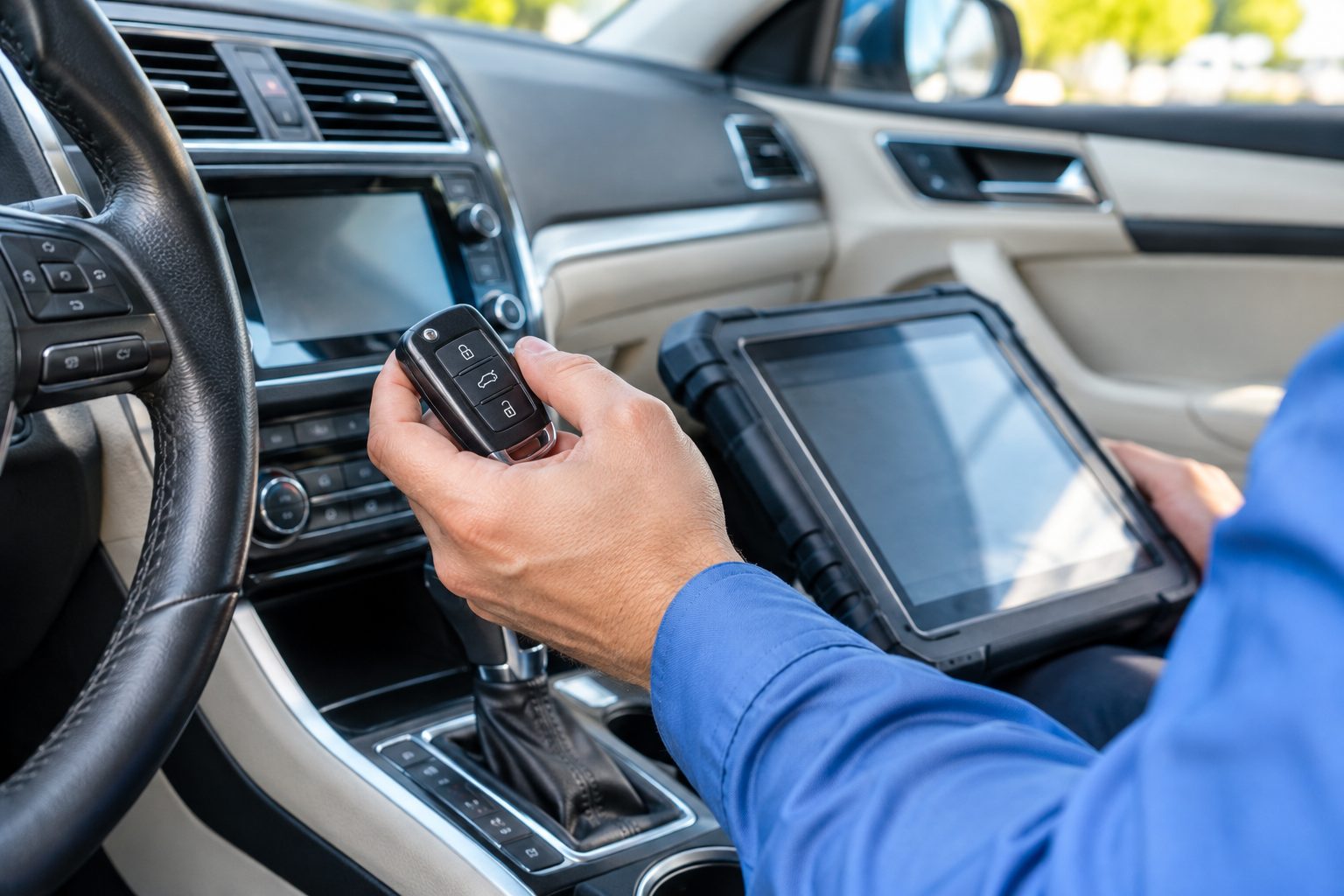
In the 1990s many manufacturers introduced transponder keys. Inside the plastic head of the key sits a small chip that holds a unique identifier. When you put the key in the ignition, an antenna ring around the cylinder energizes the chip and reads its signal. If the signal matches what the car has stored, the vehicle allows the engine to run. If it does not, the engine may start briefly and then stop, or not start at all.
This was a major step against theft. A copied blade alone would turn the ignition but could not start the car, because the electronic part would be missing. It also made replacement keys more involved. A new key must be cut and then registered with the vehicle through a programming step, using diagnostic equipment connected to the car or following a specific procedure that some models support.
Transponder chips come in several families, and the right one depends on the make, model and year. A blank that looks right can have the wrong chip. If you are curious how the car and key communicate, see what is an immobilizer. To understand the service side, read our page on transponder key programming.
The next step combined the key and the remote in one. A remote head key has buttons built into its head for lock, unlock and sometimes trunk or panic, plus the transponder chip for starting the engine. You use the blade in the ignition and the buttons for convenience at a distance. This type is common across many popular models from the 2000s and 2010s.
It is convenient but more fragile than a plain key. The head contains a circuit board and a small battery, and the plastic shell can crack from drops or heat. In Central Florida, a key left on a dashboard in summer can be exposed to extreme temperatures, which is hard on glue, plastic and batteries. Buttons wear down from daily use, and moisture from a rainy day or a pool trip can corrode contacts.
A replacement remote head key requires three things: a correctly cut blade, a matching chip registered to the vehicle, and a remote function paired with the car's receiver. Sometimes these steps happen together, and sometimes the remote pairing is separate. If your remote buttons stopped working but the key still starts the car, you may only need a new battery or remote pairing, not a whole new key. See car key fob not working for a sensible first checklist.
Flip keys, sometimes called switchblade keys, fold the blade into the fob body when not in use. They aim to keep your pocket from filling with sharp metal and to protect the remote electronics from wear. Press a button and the blade swings out. They are common on a range of models and have become familiar to many drivers.
The folding mechanism is a point of potential trouble. Springs and pivot pins can wear out, and a fob that has been dropped many times may fail to extend or retract correctly. If the blade breaks off, the electronics may be fine but the key cannot be used in the ignition if the model needs the blade. In that case a repair or replacement of the shell and blade may be possible without replacing the entire fob.
Because the shell and electronics are separate parts, replacements vary. Sometimes a locksmith can transfer the chip and circuit board into a new shell and reuse the original programming. Other times a new key must be programmed from scratch. Whether that works depends on the model, and you will get the clearest answer when you describe your vehicle and the exact failure on the phone.
Smart keys, also called proximity keys, removed the need to insert anything. A set of antennas in the vehicle senses the fob, and the doors unlock when you touch the handle. Inside, a start button replaces the ignition cylinder. If the fob is present, the car starts when you press the button with your foot on the brake. The key can stay in a pocket or purse the entire time.
Under the surface this is a conversation. The car sends a low power signal asking whether the key is nearby, the key replies with an encrypted response, and the car checks it against stored credentials. If the key battery is weak, this conversation fails, and the car may display a message about key not detected. Most systems provide a workaround, such as holding the fob against the start button, but the steps vary by model.
Replacing a smart key is more involved than any earlier type. The fob must be matched to the vehicle's security system, which often requires specialized equipment and, on some vehicles, a security verification step. If all keys are lost, the process can be longer than adding a spare, because the car has to be told to accept a new set. Our page on smart key replacement and the guide on documents needed for car key replacement explain what to prepare.
The cost difference between a simple copy and a modern key comes from what is inside and what must be done. A modern key includes a blank with the right chip or board, a shell that fits the model, a precisely cut emergency blade, and programming performed with equipment that must be kept updated for each manufacturer. The locksmith also spends time verifying ownership, connecting to the vehicle and testing every function.
Time and equipment matter as well. Programming tools and software subscriptions are costly, and different makes need different procedures. Some vehicles require a security access step that takes time. If all keys are lost, the work may include generating a new key from vehicle data rather than copying one that already exists. These are real labor and tooling costs, not just parts.
Prices are not listed here because they vary by make, model, year and situation, and honest quotes depend on details. Quotes are given by phone after you describe the vehicle, the keys you have and what you need. More complicated jobs may call for an on site visit, with a service call charge explained before anyone is dispatched. Be cautious of any company that gives a firm number without asking about the vehicle.
The table below summarizes the major steps in key design. Dates are general, since manufacturers adopted features at different times, and your own vehicle may sit between categories. The point is to see how each step added a layer of verification beyond the cut of the blade.
| Type | What is in it | How the car checks it | Replacement needs |
|---|---|---|---|
| All-metal key | Cut blade only | Mechanical lock pattern | Cutting from the lock or key number |
| Laser cut key | Thicker blade with milled groove | Mechanical pattern, harder to copy | Precision cutter and correct blank |
| Transponder key | Blade plus a security chip | Antenna reads chip near ignition | Cutting plus chip programming |
| Remote head or flip key | Blade, chip and remote buttons | Chip for starting, radio for locks | Cutting, chip and remote pairing |
| Smart key | Radio fob with encrypted credentials | Car senses fob and verifies it | Programming with security verification |
Whatever type you own, a few habits extend its life. Avoid leaving keys on a dashboard or in a parked car in the heat. Keep fobs away from water and beach sand, and dry them thoroughly if they get wet. Do not carry a heavy bunch of keys on the ignition of an older car, since the weight wears the cylinder over time. If a key begins to feel loose, bent or worn, replace it before it breaks.
Keep a spare, and keep it somewhere sensible. A spare in a drawer at home is much safer than one hidden on the car. If you have only one working key and it is a transponder or smart type, getting a second one made while you still have the first is usually simpler than starting from nothing after a loss. Our guide to spare key storage ideas shows safer places to keep it.
If something goes wrong, describe the vehicle and the key to the dispatcher and let them explain the options. Many drivers worry that a new key means a new car computer, which is rarely the case. When you are ready, call and tell us what key you have, what happened to it and what you would like to end up with.
Look at the key. A plain metal key with no plastic head is mechanical. A thicker plastic head usually holds a transponder chip. Buttons mean a remote head or flip key, and a fob with no visible blade or only a hidden one is a smart key. Your make, model and year help confirm it.
Most vehicles built since the late 1990s check a security chip or encrypted fob before allowing the engine to run. A cut blade alone will turn the lock but not start the car. Programming registers the new key with the vehicle so it recognizes the credential.
In many cases a locksmith can add a new smart key to a vehicle with the right equipment, even if you only have one working fob. Ownership verification is normal. The details depend on the make and model, so describe your vehicle on the phone and the process will be explained.
Usually the key is the simpler path, but it depends on what failed. If the ignition cylinder is worn or damaged, repair may be needed as well. A technician can check the symptoms and explain what is required. Quotes are given by phone, and more complex work may need an on site visit.
An all keys lost situation can still be solved by a mobile locksmith, though it often involves more steps than copying a key. Have identification and proof of ownership ready, along with the vehicle details. See our page on all keys lost for the usual process.
Usually not. A car with a purely mechanical key can often have a replacement cut from the lock or the key number without electronics. If you are unsure which category your car falls into, describe it on the phone and the locksmith can tell you what to expect.
Describe the situation by phone and we will tell you what the job involves. Quotes are given by phone. Jobs that cannot be quoted without seeing them need a technician on site, and the service call charge is explained on the phone before anyone is dispatched.
If you are not sure what kind of key your car uses, a few clues help. A plain metal key with no plastic head is the oldest style. A thicker plastic head often hides a transponder chip. A head with buttons usually means a remote is built in. A fob that stays in your pocket and a start button on the dash point to a smart key system. Photograph both sides of your key and the ignition area. Pictures are handy when talking to a technician, especially if the key head has a logo, a button layout or a blade shape that helps identify it.
Your owner manual or the vehicle make, model and year can narrow it down, but even within a single model, equipment varies by trim and production date. Some cars offered more than one key style in the same year. Looking at the key itself and the ignition type usually settles it. If your car has a push button start, check for a hidden emergency blade inside the fob. Many smart keys include one, and knowing how to release it can get you into the car even when the fob battery is flat, though starting the engine may need the special reading spot.
When you call for help, describe the key, the ignition and any warning lights you see. Have the vehicle identification number ready, since it helps a technician check which key and programming method apply. The scope and any quote are explained before work begins. Do not be discouraged if you cannot place your key. Cars from the same maker can differ widely, and a technician deals with such questions daily. A short description and the vehicle details are usually enough to narrow the possibilities and explain the process.