A transponder key is more than a cut piece of metal. A small chip inside the head talks to the vehicle, and the car will not run unless it recognizes that chip. This page explains how pairing works, what programming involves at a high level, and why cloned or mismatched keys sometimes fail.
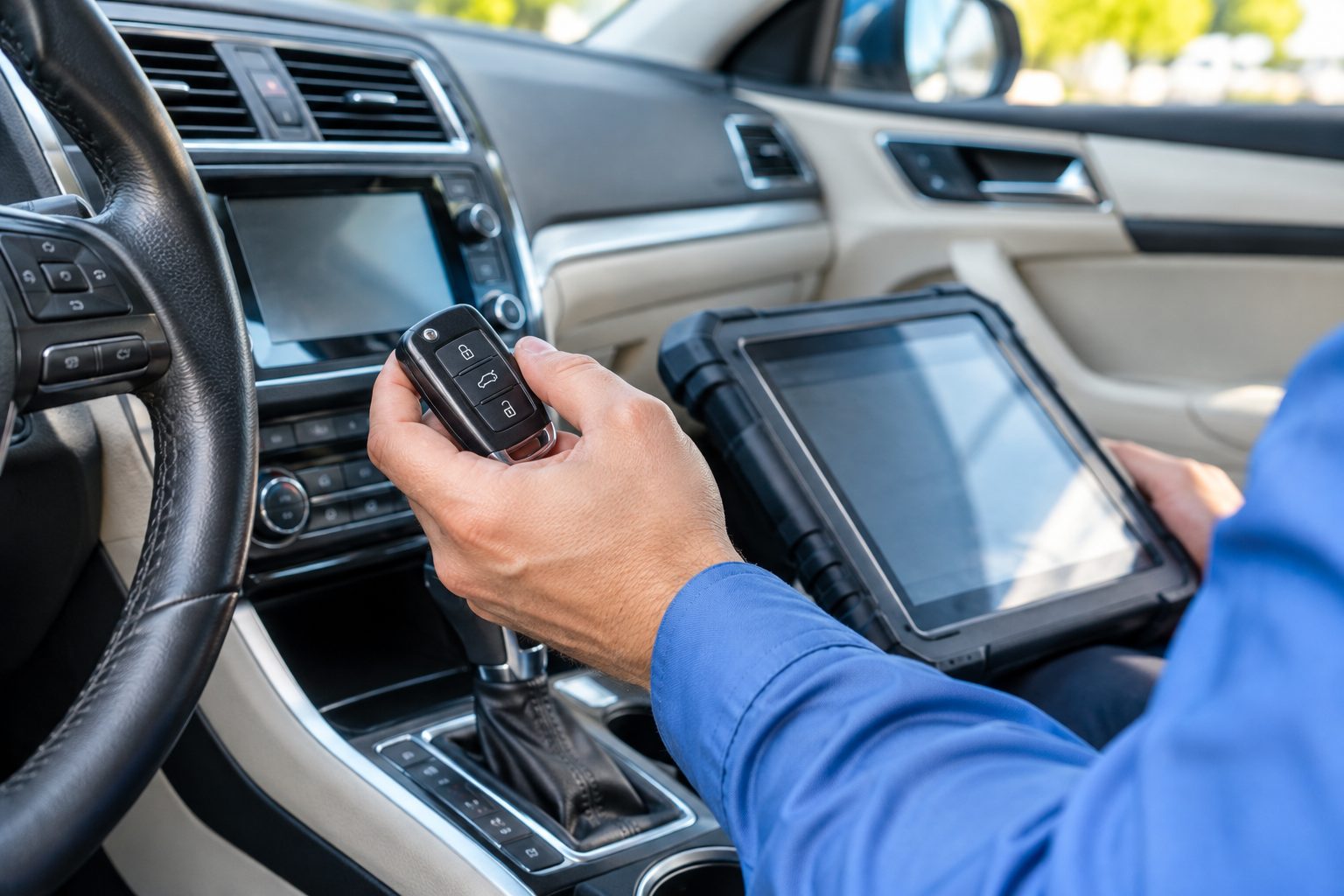
A transponder key looks like a normal car key with a plastic head, but inside that head is a tiny glass or ceramic capsule containing a microchip and a coil of wire. The chip has no battery. When you turn the key in the ignition, a ring around the ignition cylinder sends out a weak radio field. That field energizes the chip, which answers with a short identifying message. The vehicle computer compares the answer with what it has stored. If it matches, the engine is allowed to start. If it does not, the engine may crank briefly and shut off, or it may not crank at all.
This system is called an immobilizer. It was introduced to reduce theft, because a thief can no longer start a car simply by cutting a blank key that fits the ignition. Most vehicles built from the late 1990s onward use some form of it, and by the 2000s it was nearly universal. If you want a fuller explanation of how the vehicle side works, read our guide on what an immobilizer is.
The key therefore has two jobs. The blade must physically turn the ignition and unlock the doors. The chip must identify itself to the car. A key that does only one of these jobs is not a working key. That is why a hardware store blank that fits the ignition may turn the switch and still not start the engine, and why a locksmith has to attend to both halves of the work.
Pairing is the heart of programming. Each chip carries an identifier, and some systems add an encrypted exchange so the car and the key prove themselves to each other instead of simply announcing a number. The vehicle keeps a list of the identifiers it accepts. Programming means putting the identifier of a new chip onto that list, or writing a matching identifier onto a blank chip so that it matches a list the vehicle already holds.
Different manufacturers use different approaches. Some allow a technician with the right equipment to connect through the diagnostic port under the dashboard and add a key to the vehicle's memory. Others require that the existing keys be erased and re-registered together, so any key that is not present during the process stops working afterward. Some makes require a security authorization from the manufacturer's system before a key can be added, and that is one reason proof of ownership is needed.
The practical point is that programming is not a single universal procedure. It depends on the make, model, year, and sometimes the trim of the vehicle. A technician will ask for those details by phone so that the right blank, the right chip type, and the right equipment are on the van. We do not describe the exact steps for any particular vehicle, because the process differs, and because a good technician adapts to what the car actually does.
A typical visit follows a clear sequence. The technician first confirms the vehicle details and checks your identification and proof of ownership. Next, the correct key blank is selected, with the right blade profile and the right chip. If the key must be cut, the blade is cut to match the ignition and doors, either from an existing key or from information about the vehicle's lock.
Then the programming step begins. Using professional equipment, the technician communicates with the vehicle and registers the new key. Depending on the system, this may include reading the vehicle's security data, adding the key to the list, and testing that the car recognizes it. If remote buttons are part of the key, they are programmed as a separate function, so that lock, unlock, trunk, and panic buttons work.
Finally, the technician tests everything. The engine should start and stay running. The doors should lock and unlock with the blade and with the remote. Any existing keys should be tested as well, because some procedures affect them. You should leave with all keys working, and with a clear idea of which one is the master. Our related page on key programming covers the broader range of programming work.
Cloning means copying the chip identifier from an original key onto a new chip, so that the new key presents the same message as the old one. For many vehicles this works well, and it has the advantage of not needing to touch the car's computer. It is a legitimate method, and a competent technician uses it where it fits.
It can fail for several reasons. Some chips are encrypted in ways that cannot be copied directly. Some vehicles use rolling or paired data that changes with use, so a cloned key can drift out of step. A worn original may give an unreliable read. A low quality blank may contain a chip that does not behave consistently under heat or vibration, and the car may reject it on some days and accept it on others. The result is a key that works sometimes, which is more frustrating than a key that never works.
If a cloned or copied key is behaving unpredictably, bring it to a technician for testing. It may be a matter of reprogramming it properly through the vehicle, rather than copying. Our page on copied keys that do not work explains what to look for. A genuine programming procedure, using the right chip, is generally more stable than a clone of a worn key.
Not every transponder blank is the same. The chip inside may be one of several families, and each vehicle expects a particular type. A blank sold online at a very low price may look right and still contain the wrong chip, or a chip of poor quality. Programming equipment may refuse to accept it, or may accept it and then fail later. A technician who buys blanks from reliable suppliers and matches them to the vehicle is protecting you from this.
Another trap is the pre-cut blank that does not match your lock exactly. The blade profile may be correct for the brand, and yet the cuts differ from your original. A key that does not turn smoothly puts stress on the ignition, and forcing it can damage both key and lock. Better to cut the blade to your vehicle than to rely on a generic shape.
If you have ordered a key yourself, you can still ask a locksmith to look at it. Be honest about where it came from. A technician can check the chip type, tell you whether it is compatible, and say whether programming it is reasonable. Sometimes it is, and sometimes the better path is a proper replacement. Either way you should hear the facts before you pay for work on the vehicle.
A lost key with a working spare is a modest problem. A lost key with no spare is a bigger one, because the vehicle has no key to copy and the immobilizer is waiting for a chip it knows. In that case the technician creates a new key from the vehicle's identification and security data, rather than from an existing key. This is often called an all keys lost situation, and it takes longer and may require more equipment.
The vehicle may need to stay where it is while the technician works. If it is parked at home, the job can usually be done there. If it is at a theme park garage, an airport, or a hotel, the technician can often come to the location, subject to access. We describe this scenario on our all keys lost page, and it is worth reading if you are in that position.
In an all keys lost job, proof of ownership is more important than ever. You may be asked for registration, title, and photo identification. Some vehicles also require the vehicle identification number, which is visible through the windshield on most cars. If the vehicle is leased or financed, the paperwork may be in the owner's name, and you may need documentation showing you are authorized. Our guide on documents needed for car key replacement lists these details.
People use the word transponder loosely, so it helps to sort the common key types. A standard transponder key has a metal blade and a plastic head, and the chip is inside the head. You insert it into the ignition and turn. A flip key, sometimes called a switchblade key, folds the blade into a fob with remote buttons, and the chip may sit in the fob body. A smart key, or proximity fob, has no required insertion at all, and a push button starts the engine when the fob is near. Each type is programmed differently, and each has its own risks when it is lost or damaged.
The important point for owners is that the type decides the job. A flip key needs the blade cut, the remote programmed, and the chip registered. A smart key needs the fob registered to the vehicle, and an emergency blade may be cut as a backup. A plain transponder key is the simplest of the three, but it still needs registration. When you call, say which type you have, or describe it: does the blade fold, are there buttons, and do you push a button to start the car? Our page on smart key replacement covers the proximity type, and our overview of car key types through the years shows how the designs developed.
Knowing your key type also helps you avoid buying the wrong part. Many online listings use the same photo for keys that look alike and are not compatible. A technician who sees the vehicle and the existing key can tell which blank belongs, and can explain why a lookalike will not work. That saves you from paying for a part that cannot be programmed.
A transponder key is hardy but not indestructible. The chip is small and sealed, and normal use will not harm it, yet it can be damaged by a hard drop onto concrete, by crushing, or by heat. A key left on a dashboard in the Florida summer can reach a temperature that stresses the plastic and the chip's glue. If the head is cracked, the chip may rattle or fall out, and that is a sign to have a spare made before it fails completely.
Keep the key away from strong magnets and from the large bunch of other keys that can wear its cuts and its plastic. A heavy ring hanging from the ignition puts weight on the cylinder and shortens the life of both key and lock. Moderate the load by using a lighter ring and keeping extra keys elsewhere. If your key has a remote with a battery, replace the battery on schedule, and note that the chip itself does not need one. Our article on summer heat and car key fob care offers more tips.
Finally, have a spare made while the original works. Making a spare from a working key is a simpler job than replacing a lost one, and it lets the technician test the whole set together. Read about it on our spare key duplication page.
To start, tell us the make, model, and year of the vehicle. If you know the trim or engine, say so. Tell us how many keys you have, whether any key works at the moment, and whether the vehicle has a push-button start or a traditional ignition. These answers help us determine whether the key you need is a standard transponder key or a smart key, and the difference affects the job.
When the technician arrives, have the vehicle accessible, the identification and ownership documents ready, and any working keys at hand. The more complete the picture, the quicker the visit. A technician will also ask whether the vehicle has any security features added after purchase, such as an aftermarket alarm, because these can interact with programming.
Quotes are given by phone. There is a service call charge, which we explain before a technician is dispatched. Some jobs are straightforward, while others need an on-site look at the vehicle first. If your situation is complicated, we will say so on the call. When you are ready to talk it through, give us a call and describe the vehicle, and we will explain the next step.
Cutting shapes the metal blade so it fits the ignition and door locks. Programming registers the chip inside the key so the vehicle recognizes it. A transponder key needs both. A key that is cut but not programmed may turn the ignition and still fail to start the engine, which is a common sign that the chip was not paired.
Not every make is the same. Many common vehicles can be programmed on site with professional equipment. Some brands need extra authorization or tools that are not always available. The dispatcher can tell you, based on the make, model, and year, whether your key is a good fit for on-site programming or whether a different path is needed.
This often happens when the key blade turns the ignition but the chip is not recognized. The engine may run for a moment before the immobilizer cuts it off. It can mean a key that was cut but not programmed, a damaged chip, or a mismatched blank. A technician can test the chip and find out which applies.
It depends on the vehicle and the chip. Cloning works well on many systems and does not need access to the car's computer. On others it can be unreliable or impossible. A technician can choose the method that suits your vehicle, and if a clone behaves oddly, reprogramming through the vehicle may be more stable.
It is far easier to make a spare while one working key exists. With no working key, the vehicle has nothing to copy, and the job takes longer and needs more proof of ownership. If you have only one transponder key, making a spare is one of the most practical steps you can take.
On some vehicles, adding a key leaves the others untouched. On others, the process re-registers all keys, so any key not present during programming may stop working. A technician will explain which applies to your car, and will ask you to bring every key you use, so they can be tested together.
Describe the situation by phone and we will tell you what the job involves. Quotes are given by phone. Jobs that cannot be quoted without seeing them need a technician on site, and the service call charge is explained on the phone before anyone is dispatched.