Cutting a spare key from a working original is a fairly quick job, the original tells the machine everything it needs, both the mechanical cut and, on a transponder key, the code the immobilizer expects to hear. All keys lost is the opposite situation. There's no original in hand, nothing to clone, and nothing to compare a new key against except the car itself. It's the most involved job in mobile automotive locksmithing, and it's worth understanding why before assuming it works like ordering a spare.
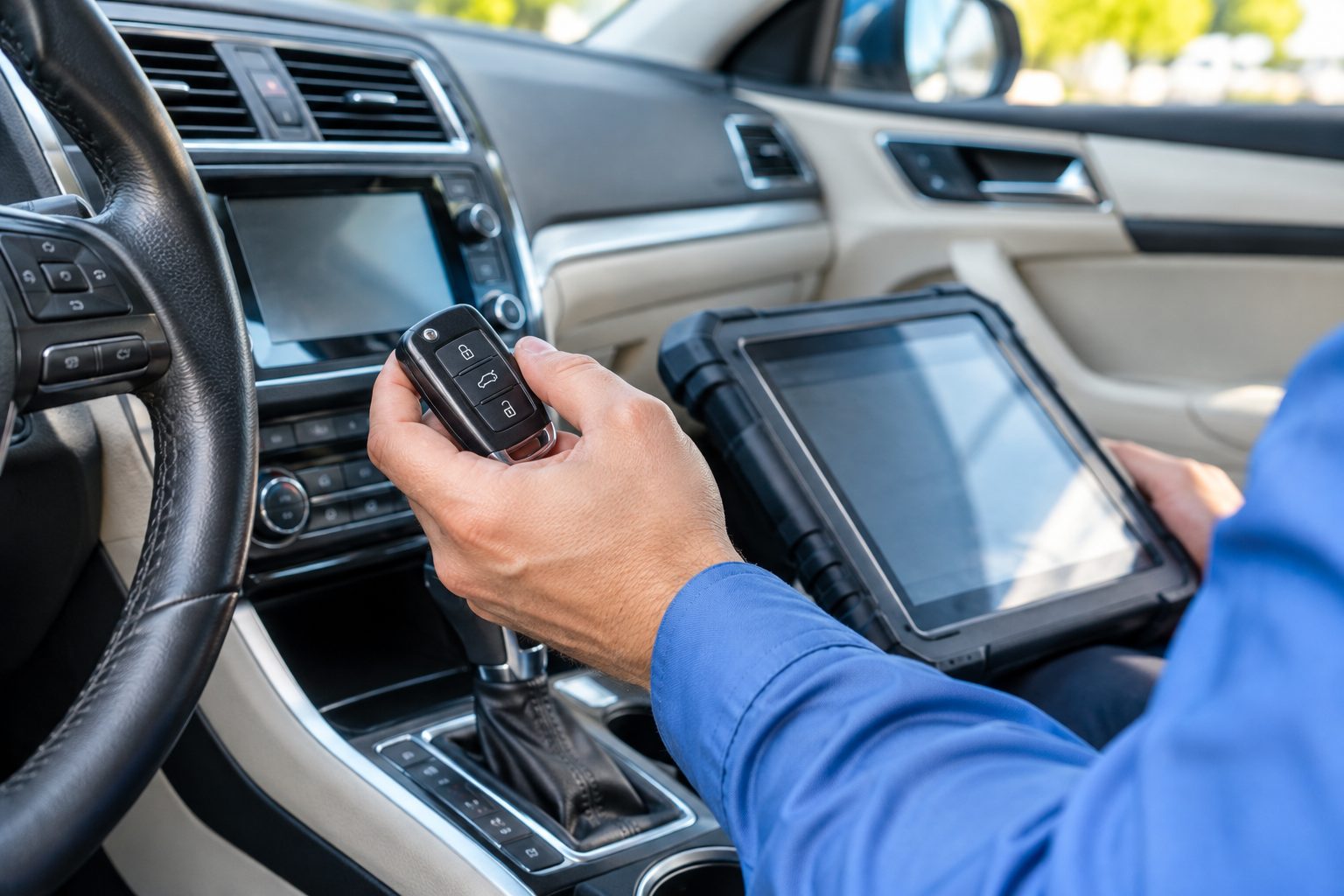
The approach differs by make, model year, and whether a vehicle runs an older transponder system or a newer proximity setup, but the shape of the job stays consistent across brands like Toyota, Honda, Ford, Chevrolet, Kia, Hyundai, Nissan, Jeep, Dodge, Subaru, Mazda, Volkswagen, GMC, and Ram: get information out of the vehicle's immobilizer, obtain or generate a matching key code, then cut and program a key that never existed a moment ago.
Every other automotive key job has a reference point, a working key, a spare in a drawer, an old fob that still opens the doors even if the battery's dead. All keys lost has none of that. The immobilizer module has to be approached cold, with no valid transponder anywhere nearby to compare against, which means the diagnostic and mechanical steps that would normally be shortcuts have to be done the long way instead: reading data directly from the vehicle rather than reading it off a key that already has the answer.
Under normal conditions, an immobilizer challenges a key's transponder chip and checks the response before allowing the engine to start, a conversation that happens in a fraction of a second every time the ignition turns. With no key present, that conversation has to be initiated from the other direction, connecting through the vehicle's diagnostic port to communicate with the immobilizer module directly and, depending on the make, sometimes accessing security data that a working key would normally supply on its own. Some platforms allow this through the diagnostic port alone; others require additional steps to get past a security gateway before the module will cooperate at all.
Some manufacturers keep a cut code or key data tied permanently to a vehicle's VIN in a secure database, retrievable through proper channels once ownership is verified. Others don't offer that lookup at all, and the working key code has to be derived by reading data live off the vehicle's own module instead of pulling it from a manufacturer record. Which path applies depends entirely on the make and model year, and it's one of the first things that gets sorted out before any cutting or programming starts, since it changes how the rest of the job proceeds.
Originating a key from nothing is, mechanically, the same capability someone would need to steal a car that isn't theirs. That's exactly why it's mandatory, not optional: a government-issued photo ID plus a vehicle registration or title with a name and VIN that match the car in the driveway. A financed vehicle, a company car, or a name that doesn't line up cleanly sometimes needs an extra document, a lease agreement, a letter from the lienholder, but the requirement itself never gets waived because someone's in a hurry.
Every step that a duplicate key skips has to happen here instead: verifying ownership before touching anything, reading or requesting security data the car would normally supply through an existing key, and in some cases waiting through a security delay the vehicle's own computer imposes before it will accept a newly written key. None of that is padding, it's the actual difference between cloning something that already works and building a working key where nothing usable existed a few minutes earlier.
All keys lost means building a working key with no original to reference, and doing it right takes verified ownership before anything else. Call us with your ID and registration or title ready, and we'll walk through what your specific make and model needs.
What if I can't find my registration?
A title works in its place, and in some cases a lienholder letter or other document tying the name on your ID to the vehicle can substitute. Some form of matching documentation is required either way.
Can a rental car get an all-keys-lost service?
Rental agreements complicate ownership verification significantly, and this is typically handled through the rental company rather than as an on-site origination.
Is all keys lost more expensive than a spare?
It involves more steps, ownership verification, immobilizer access, and sometimes a code lookup or derivation, so it isn't comparable to cutting a duplicate from an original that already works.
Before anyone starts cutting or programming, spend ten minutes making sure the keys are truly gone. It sounds obvious, but a surprising number of all keys lost calls end with a key turning up in a jacket pocket, a gym bag, or a lost and found desk. A short checklist:
If the key is visible inside the car, you do not have an all keys lost situation. You have a lockout, which is a much simpler job covered on our car lockout service. If the keys are really gone, the steps below explain what happens next.
If your keys were lost somewhere with nothing identifying the car, the main goal is simply getting a working key. If they were stolen along with a purse or bag that contains your registration or address, the goal changes. Whoever has those keys may be able to find the car and drive away with it.
On many vehicles, programming a new key also gives us the option to remove old keys from the immobilizer's memory, so the missing key will no longer start the engine even if it still turns the door lock. Whether that is possible, and exactly how it works, depends on the make and model. If there is any chance your keys were stolen, tell us when you call so we can plan for it. It is also worth reporting the theft to police, and in some cases rekeying or replacing the door lock cylinders so the missing key cannot open the doors either.
Because this service is mobile, we come to the vehicle. The location affects how the job goes, so be specific when you call.
The page above explains the electronic side: reading the immobilizer and getting security data from the vehicle or from a VIN based lookup. The mechanical side is just as important. A new key has to turn the ignition, or at least the door lock, and on many vehicles the physical cut still matters even when the car starts with a button.
When a key code is available through a VIN lookup, the key can be cut directly to that code. When it is not, the cut has to be worked out from the vehicle itself. Common methods include decoding a door lock cylinder, which means reading the depths of the wafers inside the lock, or in some cases removing a lock cylinder to read it on the bench. Once enough of the code is known, the remaining cuts can be worked out and tested. These are standard locksmith techniques, but they take time and care, and they are part of why this job does not happen in the few minutes a duplicate takes.
Each type has its own programming procedure and its own cost in parts. We will confirm which one your vehicle uses when you call, based on the year, make and model.
When every key is lost, owners often assume the car has to be towed to a dealership. That is one option, and for some very new or specialized vehicles it may be the only one. For many common vehicles, though, a mobile locksmith can originate and program a key on site. Consider:
If we cannot do your specific vehicle, we will say so when you call. That saves you from waiting for a trip that cannot end with a working key.
Visitors with their own car. Plenty of people drive to Orlando from other states. An out of state registration works the same way as a Florida one for ownership verification, as long as the name and VIN match your ID and the vehicle. Keep a photo of your registration on your phone when traveling, since the paper copy is often in the glove box of the locked car.
Students and young drivers. Many cars driven by UCF and Valencia students are titled to a parent. In that case the name on the registration will not match the student's ID. A parent can often provide authorization along with a copy of their own ID and the registration. Sort that out by phone before the appointment so there is no delay on site.
Keys lost in water. Keys dropped into a lake, a pool, or the surf at the beach are a common Central Florida story. If you get the key back, a fob that has been in water may stop working even though the key blade is fine. Do not assume the key is ruined, but do not count on it either. Sometimes the transponder chip survives while the remote buttons do not, and the key will still start the car.
Aftermarket alarms and remote starters. Some vehicles have an aftermarket alarm or remote start system wired into the ignition. These can interfere with programming or require their own remote to be set up again. Tell us if your car has one.
An all keys lost job can take a while, and much of the year that means waiting outdoors in serious heat. If you are stranded in a parking lot, find shade or go inside a nearby store while you wait, and keep water on hand. If you are with small children, elderly family members, or anyone with a health condition, get them somewhere cool first. During summer afternoon storms, lightning is a real hazard in open lots, so wait indoors or in another vehicle rather than standing in the open.
Hurricane prep and evacuations create their own key problems. Keys get misplaced while packing, left at a shelter or a relative's home, or lost in the confusion of moving vehicles to higher ground. Before storm season, make sure every household vehicle has at least two working keys, and keep a spare somewhere you would take with you in an evacuation, such as with your important documents. Getting a spare from a working key before the season is a much easier job than originating one after a storm, when roads and services may be disrupted.
Once the car starts, take a moment to prevent this from happening again:
Having all of this gathered before the call lets us confirm right away whether your vehicle can be done on site, which key and parts it needs, and what documents will be checked at the car. That way the visit is spent making your key, not sorting out paperwork in a hot parking lot.
More information on related work is on our key programming, key fob replacement and car key replacement pages, and brand specific notes are on our car keys by make pages.
Searching locksmith near me in Orlando for a house lockout? We are mobile across metro Orlando and quote the price before we come out. Call us.
ZIP codes we cover in Orlando: 32801, 32803, 32804, 32805, 32806, 32807, 32808, 32809, 32810, 32811, 32812, 32814, 32817, 32818, 32819, 32820, 32821, 32822, 32824, 32825. City services: Orlando Official Website.
Describe the situation by phone and we will tell you what the job involves. Quotes are given by phone. Jobs that cannot be quoted without seeing them need a technician on site, and the service call charge is explained on the phone before anyone is dispatched.