A commercial door is a system, not a single lock. The lock, hinges, closer, exit device, strike and frame all share the work, and a weakness in one wears out the others. This guide explains grades, hinges, closers and exit devices in plain terms so you can talk to a technician with confidence.
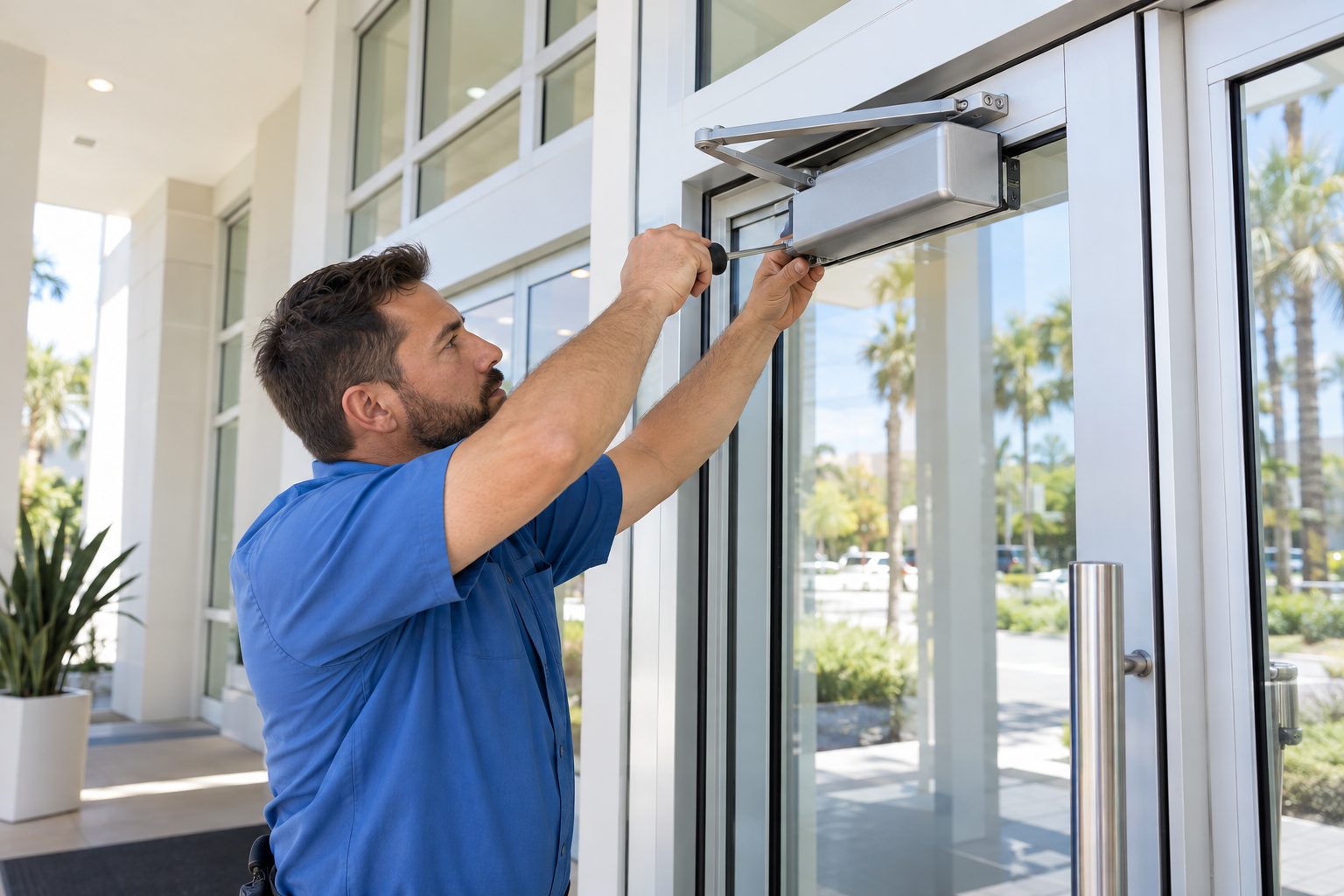
At a home, a door is often a slab, a hinge set and a deadbolt. At a business, the same opening may carry hundreds of uses a day, have to close automatically and let people leave quickly in an emergency. Each part has its own job. The door leaf carries the weight. The hinges let it swing. The closer controls the swing and shuts it. The lock or exit device holds it closed. The strike or latch receiver on the frame accepts the bolt.
When one part is weak, the others pay for it. A worn hinge lets the door sag, which makes the latch drag on the strike, which makes the lock work harder and the closer struggle. A closer that slams puts shock into the latch and frame. A lock that binds causes staff to force it, damaging the cylinder. Many service calls that begin as a lock problem turn out to be an alignment or closer problem.
Thinking in terms of a system helps you decide what to repair first. A technician looking at a sticking door will usually check how it hangs, how it closes and how the bolt meets the strike before replacing the lock. In Orlando, humidity and heat add stress, since doors swell and frames shift through the seasons, and the hardware has to tolerate some movement.
Commercial locks are commonly described by grade, a rating system developed by industry standards groups to indicate durability and strength. In general, Grade 1 is the most robust, Grade 2 is a medium duty level and Grade 3 is lighter duty, which is the level of much residential hardware. The grade reflects how well the lock holds up to repeated use, force and testing, rather than how it looks.
For a business, the grade should match the traffic. A busy storefront or a school door benefits from Grade 1 hardware because it will be used constantly and may be abused. A private office door that opens a few times a day might be fine with a lower grade. Using residential locks on a commercial door often leads to early failure, loose handles and cylinder wear. Our guide on deadbolt grades explained goes deeper into how the ratings work.
Grade is only one factor. A high grade lock on a weak door or a loose frame will not protect much. Also, the grade says little about how well the lock resists picking or bumping, which depends on the cylinder. For doors that matter, consider high security cylinders as well. See our page on high security locks for the options.
Hinges carry the full weight of the door and keep it aligned. Commercial doors typically use heavier hinges than residential ones, often with ball bearings that reduce friction on doors that swing constantly. The number of hinges matters too. Taller or heavier doors need three or four instead of two, to spread the load and limit sagging.
Signs of hinge trouble are easy to spot once you know them. A door that rubs on the top corner of the strike side, a latch that no longer lines up with the strike, a gap that is wider at the top than the bottom or a squeak with every swing all suggest worn or loose hinges. Tightening screws can help for a short time, but if the screw holes in the frame are stripped, longer screws or a repair to the frame may be needed.
Security is part of the hinge picture too. On outswinging doors, hinge pins sit on the outside and can be removed unless they are protected. Security hinges or a set screw prevent that. Our guide on door frame and hinge security explains how to look for weak points. Do not attempt to remove hinge pins on a heavy door without help, since the door can fall and cause injury.
A door closer is a hydraulic or spring mechanism, usually mounted at the top of the door, that pulls it shut after someone passes through. It does more than save effort. It makes sure the door latches, which matters for security, for fire protection and for energy efficiency. A door that does not close fully is an open invitation and a drain on air conditioning.
Closers have adjustments for the speed of the main swing, the final latching speed and sometimes a delay. If a door slams, the closer needs adjustment. If it closes too slowly, or stops short of the latch, it also needs adjustment. If oil is leaking from the body, the unit is failing and should be replaced. Do not ignore a leaking closer, since it can stain the door and eventually stop working.
Closers need to be sized for the door. A wide or heavy door needs a stronger closer than a light interior door. In Florida, wind and pressure differences between inside and outside can make exterior doors harder to close or open, and a closer must be set to cope. Our pages on door closer adjustment and door closer repair describe what a visit involves.
An exit device, often called panic hardware or a push bar, lets people leave a building by pushing a bar across the door. It is designed so that anyone inside can exit quickly without knowing how the lock works, even in a crowd or an emergency. It is required in many public and assembly settings by building and fire codes, and the specific rules depend on the type of occupancy and local authorities.
There are several designs. Rim devices latch onto a strike on the frame. Vertical rod devices latch at the top and bottom of the door and are common on double doors. Mortise devices fit inside the door edge. Some devices include a key cylinder on the outside for entry and an option to dog the bar down so the door stays unlatched during business hours. Others work with electric strikes or magnetic locks for controlled entry.
Never block, chain or disable an exit device to prevent exit, even to deter theft. Doing so can be dangerous and unlawful. If a device is worn or sticking, have it serviced promptly. Our page on panic bar and push bar service and the page on fire door and exit hardware explain what we can help with, and your local fire authority can answer code questions.
The strike is the metal plate in the frame that receives the latch or bolt. It looks like a minor part, but it decides how securely the door stays shut. A strike held by short screws into soft frame material can be defeated by a hard kick. Longer screws that reach the wall stud, or a reinforced strike, make a big difference. Our page on strike plate reinforcement covers this upgrade.
Commercial frames are often made of hollow metal, which is strong but can bend or corrode. Wood frames, common in older shops and small offices, can split or rot, especially near the bottom where moisture collects. A cracked or soft frame cannot hold hardware properly, and repairing the frame is sometimes the real fix for a lock that keeps failing.
Alignment is the quiet detail. The latch should enter the strike smoothly with the door closed and no pushing. If you have to lift or shove, something is out of line. Possible causes include sagging hinges, a shifted frame or a worn strike. A technician can adjust the strike, shim the hinges or repair the frame. These small corrections often restore smooth operation without replacing the lock.
Many businesses want some doors to open without a key for authorized people. An electric strike replaces the ordinary strike and releases the latch when it receives a signal, such as from a keypad or card reader. A magnetic lock holds the door shut with an electromagnet and releases when power is cut. Each approach has different safety considerations, especially around emergency exits and power failures.
Electric strikes work well with a regular latch and are often fail secure, meaning they stay locked if power is lost, while the inside handle still lets people exit. Magnetic locks are often fail safe, meaning they unlock when power fails, and they need careful design so that people can always leave. Local requirements govern how exit doors with electronic locks must work, so plan with a professional who knows them.
Our pages on electric strikes and maglocks and the guide on access control vs traditional keys help with the choice. In general, keep a mechanical backup, document how the door behaves in a power outage and test the system regularly. Florida storms mean power loss is a real scenario that deserves a plan.
| Part | What it does | Common problem |
|---|---|---|
| Lock or lockset | Holds the door closed and controls entry | Binding, loose handle, worn cylinder |
| Hinges | Carry the door weight and keep it aligned | Sagging, squeaking, loose screws |
| Door closer | Controls swing and pulls the door shut | Slamming, leaking, not latching |
| Exit device | Lets people leave quickly without a key | Sticking bar, worn latch, misaligned strike |
| Strike and frame | Receives the latch and anchors the door | Soft frame, short screws, misalignment |
Routine care avoids many emergencies. Inspect doors regularly, ideally monthly. Open and close each one and listen for rubbing or slamming. Check that the latch engages without pushing and that exit devices work smoothly. Look at hinge screws, closer arms and strike plates for looseness. Wipe dust and debris from tracks and latches, and apply a suitable lubricant to moving parts according to the maker's guidance, avoiding oils that attract grit in locks. See lock lubrication and maintenance for details.
Humidity and storms are the local factors. Moisture gets into cylinders, frames and exposed hardware, and the salt air near the coast speeds corrosion. After a storm, check that doors still close and latch correctly. Heavy rain can swell wood and shift frames. If a door drags, do not force it, since that can damage the lock or the closer.
When something needs attention, describe the door, what it does and what you have already tried. Quotes are given by phone, and more complicated jobs may need an on site visit, with a service call charge explained before dispatch. A technician can inspect the full opening instead of only the lock, and recommend a repair that lasts. When you are ready, call and tell us about the door.
Commercial hardware is built for heavier use, with stronger materials, higher grades and parts such as closers and exit devices that suit public buildings. Residential hardware is lighter and often fails early on a busy business door. Match the hardware to the traffic and the risk.
Grade is a durability and strength rating. Grade 1 is the heaviest duty, Grade 2 is medium and Grade 3 is lighter, similar to many home locks. It does not describe pick resistance, which depends on the cylinder. Choose a grade that fits how heavily the door is used.
The closer is probably set too fast or needs adjustment. Closers have speed screws for the main swing and the final latching stage. If oil is leaking or the arm is loose, the unit may be failing. A technician can adjust or replace it.
That depends on your type of business, occupancy and local fire and building rules. Many public and assembly spaces require it. Ask your local building department or fire authority, and consult a locksmith experienced in commercial hardware before making changes.
The cause may be the door, not the lock. A sagging door, worn hinges, a misaligned strike or a damaged frame can make any lock bind and wear out. A technician should inspect the whole opening, not just the lock, to find the real problem.
Yes, many commercial locksmiths adjust and repair closers, service exit devices and align strikes. Call and describe the door and the symptoms. Simple work may be quoted by phone, while complicated jobs need an on site visit with a service call charge explained before dispatch.
Describe the situation by phone and we will tell you what the job involves. Quotes are given by phone. Jobs that cannot be quoted without seeing them need a technician on site, and the service call charge is explained on the phone before anyone is dispatched.
When a business renovates, someone usually produces a hardware schedule, a list showing every door and the hardware planned for it. It names the lock function, the hinges, the closer, the exit device and the finish. Reading it before the work starts helps you catch problems, such as a storeroom door that was given a classroom function by mistake. Do not hesitate to ask why a certain function was chosen. Understanding the intention behind each door makes it easier to see when something has been specified incorrectly.
Lock functions describe how a lock behaves. A storeroom function stays locked from outside but always lets people out, while an office function can be locked from inside by a button or key. Matching function to purpose matters for both security and safety, and codes may limit some choices on exit routes. Pay attention to doors that serve as exit routes. They often have rules about how they must release, and a lock that traps people inside creates real safety trouble. A technician familiar with commercial work can explain what applies, though final code questions may belong to your local building authority.
A locksmith can review the schedule with you, point out items that look unusual, and explain how the parts fit together. This conversation is best held before ordering, since changing hardware after delivery can mean delays and extra work. Keep the schedule once the job is done. Having a record of what was installed, with finishes and model details, makes future repairs and replacements simpler, especially when a part is discontinued and an equivalent must be found. Highlight any door where the schedule and the actual use seem to disagree, such as a busy entry shown with light duty hardware.
Changing commercial hardware often means a door is out of service for some time. Planning matters most for entrances and exits. For a front door, the work may be scheduled before opening or after closing, and a temporary arrangement may be needed so the space is secure overnight. Weigh the cost of disruption against the benefit of speed. Working during business hours may be faster but affects customers, while after hours work protects trade yet may require a different arrangement. Keep a spare copy of the plan at the site so the crew and the manager are looking at the same page.
Tell the technician about your hours, your busiest days and any doors that must stay usable. They can propose an order of work, doing the less critical doors first, or splitting a job into stages. Having spare parts on hand, like cylinders and strikes, reduces the chance that a surprise delays the finish. Think about security during the gap. If a door cannot be locked for a time, a temporary lock, a watchful employee or a barrier may be needed. The technician can suggest options and explain them clearly before work begins, so that you can choose the approach you prefer.
Make sure someone with authority is available to approve the scope and receive the new keys. Record the key count and who receives each key. A short walk through at the end, testing every door, confirms the work matches what was explained at the start. Confirm in advance who will pick up the new keys and sign for the work. Surprises at the end of a job, like a missing authorized person, can leave a door in a half finished state. A simple phone call the day before keeps things on track.