A panic bar has exactly one job that outranks every other feature it might have: someone on the inside pushes it, and the door opens. No key, no code, no remembering which way a lever turns in the dark during a fire alarm. That single requirement, egress without a key, a tool, or particular knowledge, under any condition, every time, is written into life-safety code precisely because it's the one thing that cannot be traded away for convenience or extra security on the outside.
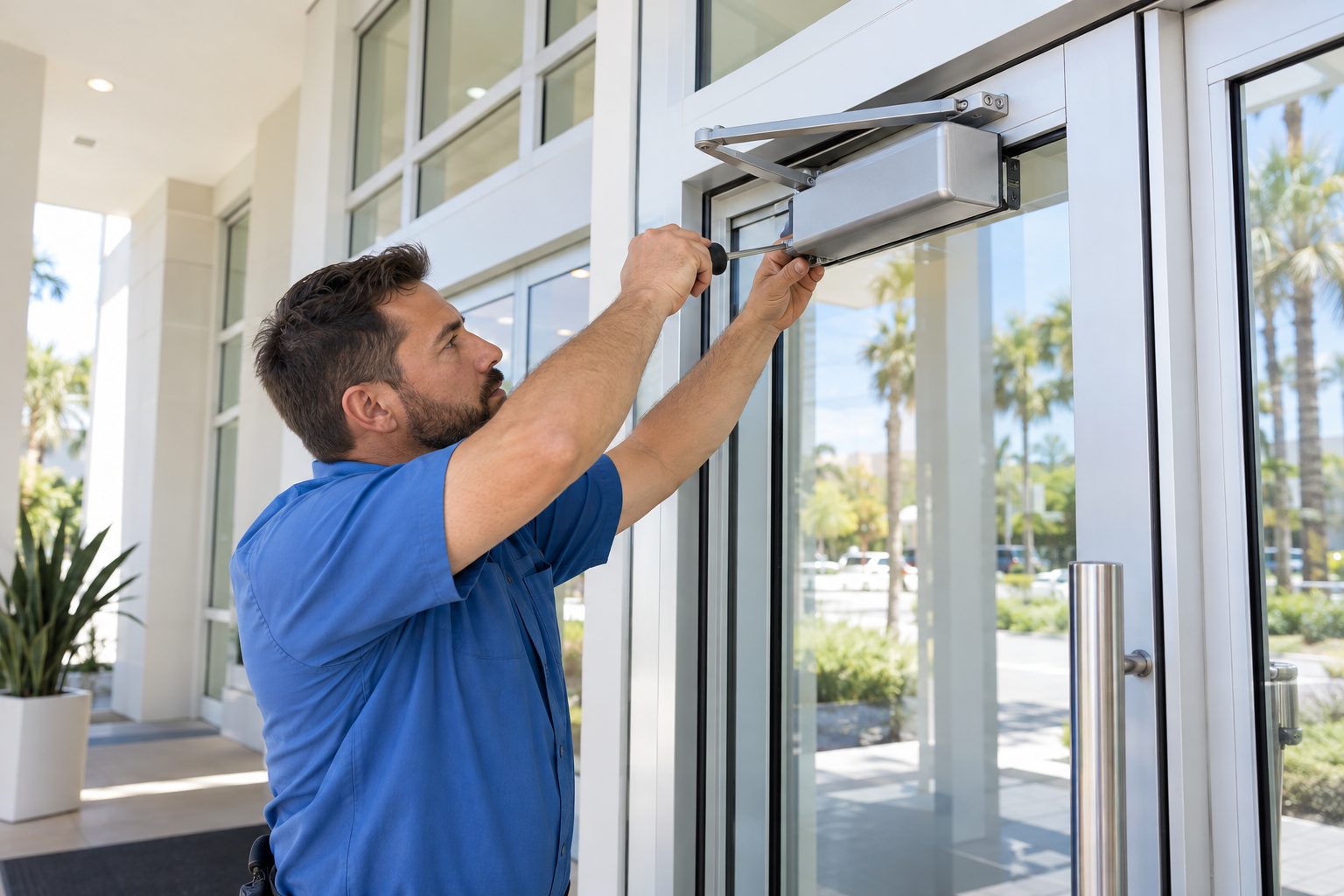
Everything else about this hardware exists underneath that requirement, not alongside it. The mechanism, the dogging option, the trim on the outside, all of it gets designed and serviced in a way that never puts a key between a person and the door they need to get through.
A push bar or crossbar runs the width of the door and connects to a latch mechanism through internal rods, vertical rods running to the top and bottom of the frame on a two-point device, or a single lateral latch on a rim-mounted version fixed near the strike jamb. Pressure on the bar retracts the latch instantly through direct mechanical linkage, not through anything electronic that could fail or delay. That mechanical simplicity is deliberate: the fewer parts standing between a push and an open door, the fewer ways the device can fail exactly when it matters.
Dogging holds the latch retracted so the door stays unlocked and swings no-obligation on a push, which many retail entrances use during open hours so customers aren't fighting a latch on every entry. A cylinder dog or hex-key dog engages a small mechanism inside the device to hold it in that state, and it gets released at closing so the door locks again from the outside. What dogging never does, and never should, is anything that limits how the bar responds to pressure from the inside, the moment dogging starts interfering with that, it's no longer a business-hours convenience, it's a code violation waiting for an inspection.
The trim on the exterior face, a lever, a knob, or a pull with a key cylinder, controls whether someone can get back in from the outside once the door has swung shut. That's the only thing it controls. A key operates the outside trim to allow entry, or to lock it against entry after hours, but it is never wired or linked into the interior push-bar mechanism in a way that requires a key to get out. The two sides of the door do genuinely different jobs, and confusing them is the most common mistake made when panic hardware gets installed by someone unfamiliar with the code behind it.
An inspection of exit hardware isn't a glance at the door from across the room. An inspector pushes the bar directly to confirm it releases the latch smoothly under reasonable force, checks that dogging isn't defeating that release, verifies no supplemental lock, chain, or add-on hardware has been installed that would require a key from the inside, and confirms exit signage and any required delayed-egress or alarm features are functioning as designed rather than disabled or bypassed. A device that looks correct from six feet away can still fail on the details an inspector puts hands on.
A busy storefront entrance takes hundreds of pushes a day, and the internal latch and rod mechanism wears from that cycle count long before its finish shows any age. A bar that's started to feel loose, that doesn't fully retract the latch on a normal push, or that rattles when the door closes is usually worn internally rather than cosmetically damaged, and that wear is exactly the kind of thing that shows up as a failed release during the one moment it can't afford to fail.
Panic hardware is judged on one moment it may never actually see, which is exactly why it can't be left to chance. Call us for installation, repair, or dogging adjustment on exit devices that need to be right every single time, not most of the time.
Can a panic bar ever be locked so it doesn't open from inside?
No. That defeats the entire purpose of the hardware and fails inspection immediately. Locking control belongs only to the outside trim, never the interior release.
What's the difference between dogging and locking the door?
Dogging holds the latch retracted so the door swings freely on a push during business hours. It never restricts the interior release, it just removes the need to fully depress the bar every time.
Does a glass storefront door need different panic hardware than a metal one?
The mounting and trim style often differ, but the core requirement doesn't change, the interior release still has to work without a key regardless of what the door is made of.
Panic hardware comes in several configurations, and choosing the right one depends on the door, the frame, and whether the opening is a single door or a pair.
Double doors raise a design question. Each door needs something to latch into. One approach uses a removable center mullion, a post between the two doors that each leaf latches against with a rim device. The mullion can be taken out with a key when a wide opening is needed for deliveries or equipment. The other approach uses vertical rod devices so each leaf latches into the top of the frame and the floor with no center post.
Mullions tend to be simpler to maintain and more secure against prying between the doors, but they leave a post in the middle of the opening. Vertical rods give a clear opening but depend on the top and bottom latches staying aligned. Bottom rods in particular get knocked out of adjustment by carts, floor cleaning machines, and sand or debris in the floor strike. When a pair of doors will not latch reliably, the bottom rod is often the culprit.
The outside trim decides what someone outside can do. Common functions include:
Choosing the right function avoids common frustrations, such as staff propping a back door open because there is no way to get back in without a key, or a front entrance that stays locked from outside when customers are expected.
Exit devices on fire rated doors, such as stairwell doors and certain corridor doors, must be labeled for that use. Fire exit hardware generally does not allow mechanical dogging, because a fire door must latch every time it closes to hold back smoke and flame. If you want a fire rated door to stay unlatched during business hours, that requires an electrified approach tied to the fire alarm so the door latches automatically when the alarm activates. Installing a standard panic device with dogging on a fire rated door is a common mistake. If you are not sure whether a door is fire rated, look for a label on the hinge edge of the door or on the frame, or ask your building manager.
Business owners often have a legitimate worry about emergency exits: employees or customers slipping out the back with merchandise, or a back door being propped open for smoke breaks and left unsecured. The answer is never to chain or padlock an exit. Instead, there are code compliant options:
Delayed egress systems have specific requirements and need approval from the local fire authority, so they are not a do it yourself change. Alarmed exit devices, on the other hand, are a simple and widely used option for back doors in retail stores and restaurants.
Some exit devices can be connected to an access control system. With electric latch retraction, a card reader, keypad, or push button can pull the latch back remotely, which is handy for entrances that need to open for employees with badges, or doors with automatic operators for accessibility. The mechanical push bar on the inside still works regardless of power or the control system. Electrified hardware needs a power supply and wiring through the door and frame, so it is a larger project than a mechanical installation. Our electric strikes and maglocks page covers related access control hardware.
Exterior exit doors in Central Florida face heat, humidity and heavy rain, and that shows up in the hardware. Steel doors on the sunny side of a building expand in the afternoon, and a latch that caught easily in the morning may start to drag. Bottom rod latches collect sand and grit blown in from parking lots. Back doors behind restaurants get hosed down and exposed to grease, which gums up the mechanism. Periodic cleaning and a light lubricant on the latch and rods, following the manufacturer's guidance, keeps the device releasing smoothly.
During hurricane season, exit doors need to stay secure against wind while remaining usable as exits. Vertical rod devices with weak top latches can let a pair of doors rattle or open under pressure. Checking that top and bottom latches engage fully before a storm is worth adding to your building's preparation list. Never block or secure an exit in a way that prevents it from opening from inside, even temporarily during a storm, unless the building is fully unoccupied and your local authority's guidance allows it.
Panic hardware should be easy to operate for everyone, including people with limited hand strength and people using mobility aids. Touchpad style devices, with a flat pad instead of a round bar, are easy to operate with a hip or forearm. The force needed to open the door also depends on the door closer and any air pressure difference, not just the device. If people struggle to open an exit, look at the whole opening rather than the bar alone.
Many exit devices can be repaired with replacement parts: latch bolts, springs, dogging mechanisms, and rods. If the device is old, its parts are no longer available, or it is the wrong type for the door, replacement makes more sense. When replacing, make sure the new device matches the door's width, the door type, the fire rating if any, and the trim function you actually need. It also helps to standardize on one brand across a building, so parts and keys are consistent.
Business owners and property managers do not need particular training to catch most exit hardware problems early. Once a month, walk each exit and do the following. Push the bar at normal walking pressure and confirm the latch fully retracts and the door swings open. Let the door close on its own and make sure it latches without being pushed. Pull on the door from outside to confirm it is secure when it should be. If the device is dogged during business hours, undog it and repeat the test, then dog it again. Look for anything stored in front of the door or along the path to it, such as boxes, carts, or trash bins, and move it. Note any rattling, loose screws, or a bar that sits lower on one end than the other. Writing the date and results on a simple log gives you a record to show an inspector and helps you spot a device that is getting worse before it fails.
Train closing staff as well. The person who locks up at night should know how to undog each device, how to confirm the door has latched, and never to add a chain, bar or padlock to an exit while anyone is still inside the building. A short walkthrough with new managers prevents most of the mistakes that show up during inspections.
More commercial door work is covered on our commercial locksmith and storefront door repair pages.
Searching locksmith near me in Orlando for a house lockout? We are mobile across metro Orlando and quote the price before we come out. Call us.
ZIP codes we cover in Orlando: 32801, 32803, 32804, 32805, 32806, 32807, 32808, 32809, 32810, 32811, 32812, 32814, 32817, 32818, 32819, 32820, 32821, 32822, 32824, 32825. City services: Orlando Official Website.
Describe the situation by phone and we will tell you what the job involves. Quotes are given by phone. Jobs that cannot be quoted without seeing them need a technician on site, and the service call charge is explained on the phone before anyone is dispatched.