Move into almost any home in metro Orlando and the same question tags along: who else still has a key. A previous owner. A property manager. A contractor who never turned one in. A former roommate, a past tenant, an ex who moved out but not entirely. Residential locksmith calls start there more often than they start with a broken lock, the hardware on the door is usually working fine. What's unclear is who can still open it.
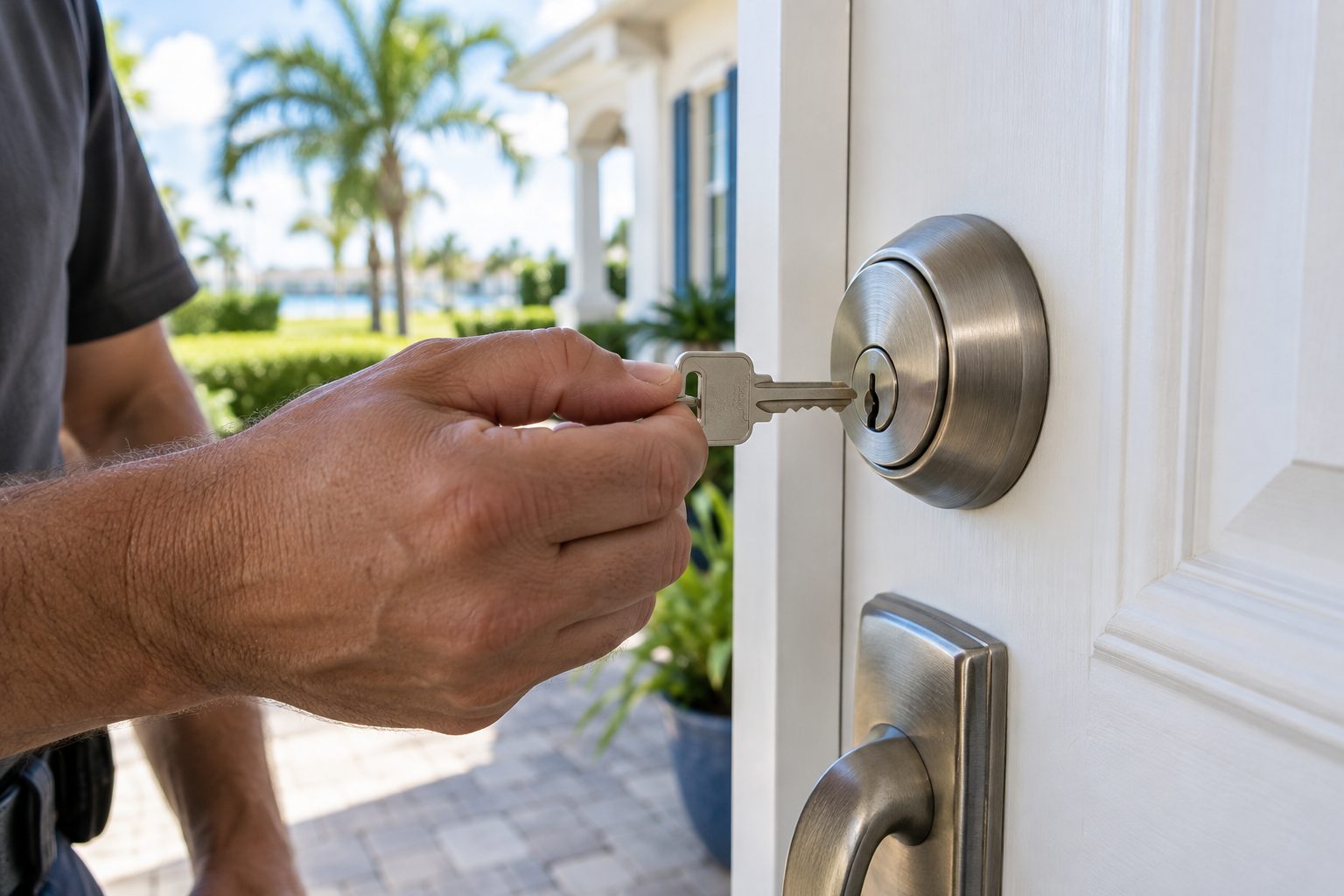
The doors themselves are just as varied. A mortise lock set into a 1920s Winter Park bungalow, a builder-grade tubular deadbolt from a 1980s Pine Hills tract house, a battery-powered latch on a new build in Lake Nona, three different mechanisms separated by decades, sitting a few miles apart. What holds a door shut in Baldwin Park is not what holds one shut in Winter Garden, even when both look like an ordinary deadbolt from the street.
The single most common reason a homeowner calls isn't a mechanical failure, it's uncertainty. Closing on a resale home means inheriting however many keys the previous owner cut over the years. Ending a lease, ending a relationship, letting a housekeeper or contractor go, each one leaves a key unaccounted for. The fix in almost every one of these cases follows the same logic even when the hardware differs: change what the key opens, not necessarily the hardware itself.
That distinction, changing a lock's internals to reject old keys versus tearing out the whole unit, matters because it's usually the low-cost and faster path when the existing hardware is sound. It stops being the right call only when the lock itself is worn out, mismatched to the door, or a grade below what the homeowner actually wants going forward.
Orlando's housing stock didn't arrive in one wave, and neither did its hardware. Older homes built before the 1980s often carry mortise locks, a rectangular pocket cut into the door edge, not the round bore most people picture, in doors that have swollen or shrunk with decades of humidity cycles until nothing sits quite square anymore. Mid-century and late-20th-century tract homes standardized on the bored cylindrical lock most people know, but builder-grade hardware from that era is frequently a step below what a homeowner would choose on purpose, sized to the code minimum of the day.
New construction brings its own mismatch: doors pre-drilled at the factory for a 2-3/8" or 2-3/4" backset, hardware boxes swapped between trades, and smart-lock installs where the electronics were never checked against the actual door thickness or strike alignment. None of this is visible from the sidewalk. It shows up when a key won't turn smoothly or a deadbolt binds halfway through its throw.
Heat and humidity aren't background noise here, they're a maintenance schedule of their own. Wood doors and jambs swell during the wet season and shrink back in the dry months, which is why a deadbolt that threw smoothly in February can bind by August. Aluminum sliding doors near the coast or any body of water start showing corrosion in the track and latch hardware years before the glass or frame shows any wear. None of that means the lock is broken. It usually means the lock and the door have drifted out of alignment with each other, which is a different repair than a straight replacement.
Residential work under this category covers everyday hardware, rekeying, lock installation, deadbolt repair, and situations that need more specific knowledge. Sliding and patio doors fail differently than a standard entry door and get their own page for exactly that reason. Smart locks and keyless entry introduce battery life and stale user codes as failure points a mechanical lock never had. Safes get handled differently depending on whether the problem is a lost combination or a forced-entry attempt. High-security locks suit a homeowner who wants a restricted keyway rather than a standard one. Mailbox and cluster box locks come with their own rules about what a locksmith is and isn't allowed to open in the first place.
Residential locksmith work in Orlando comes down to two questions: who can still get in, and does the hardware on the door actually match the door it's mounted on. Call us and describe the door, its age, its location, what isn't working right, and the correct service among the eight below follows from that.
Is rekeying enough, or do I need new locks?
It depends on the hardware already on the door. If the existing lock is a reasonable grade and mechanically sound, rekeying it to reject every old key is usually the right call. If it's worn, mismatched to the door, or below the grade you actually want, replacement makes more sense, something evaluated on the door itself, not guessed at over the phone.
Can every door on my property use the same key?
Often, yes. Matching multiple exterior doors to one working key is a common request on a single-family home and gets handled as part of a rekey or a new install rather than as a separate service.
A house lockout is the most urgent residential call, and people often worry that getting back in means a ruined lock or a broken door. In most cases it does not. The usual methods, roughly in order of preference, are:
While you wait, it is fine to check whether any other door or a sliding door is unlocked. It is not worth climbing onto a porch roof, squeezing through a small window or forcing a screen. Falls and cuts from those attempts are more common than people realize, and a damaged window frame costs more than the lockout.
Once you are inside, think about why the lockout happened. If you were locked out because a lock that used to work has started to fail, it is a good moment to repair or replace it. If it was a lost key, consider whether that key could identify your address. A key ring with a tag, a car fob or mail in the same bag might mean someone could find the house. In that case, rekeying the same day is sensible.
In a lot of Orlando homes, the garage is the main way in and out. That makes it a weak point worth attention. Three details matter most:
Old garage door remotes are also worth thinking about. If you bought the house, clear the opener's memory and reprogram your own remotes and keypad, so remotes left in previous owners' cars no longer work. The steps are in the opener's manual, usually by holding a learn button on the motor unit.
Florida homes have a lot of glass, and window hardware gets far less attention than door locks. Single-hung and sliding windows use simple sash locks or latches that wear, bend or get painted over. A latch that no longer pulls the window tight lets in water during summer storms and offers little resistance to prying. Replacing worn window latches is inexpensive. For sliding windows, a small pin or a secondary stop in the track keeps the window from being slid or lifted open from outside.
Many homes also have accordion or roll-down hurricane shutters with keyed locks. Those keys get used once or twice a year, and when a storm is on the way, they are nowhere to be found. Before storm season, find every shutter key, test the locks, and put a lock lubricant in the ones that turn stiffly. If a shutter lock has seized or the key is gone, it can usually be opened and a new key cut or the lock replaced. That is much easier to arrange in May than the day before a hurricane makes landfall, when everyone is trying to do the same thing.
A few simple habits prevent most residential key problems:
Many Central Florida homes sit empty for stretches: seasonal residents who spend summers up north, families traveling for weeks, owners between tenants or waiting to sell. An empty house needs a slightly different setup:
When you come back, check that every door still latches and locks. Humidity and heat in a closed-up house with the air conditioning set high can cause doors to swell and bind, and it is better to find that on your first day back than on the night you are locked out.
Once a year, maybe when you change the smoke detector batteries, spend ten minutes on the locks:
Anything that fails that check is worth fixing before it becomes a lockout. A lock that is starting to drag is almost always easier and low-cost to handle with now than after it fails.
Sometimes a lock change is not about hardware at all. A relationship ends, a family member moves out on bad terms, or someone who had a key is no longer welcome. In those situations, speed and discretion matter. Rekeying every exterior door, changing keypad codes and garage codes, and reprogramming garage remotes can usually all be handled in one visit. We still need to confirm that you live at the address, which is the same check that protects everyone. If you have a safety concern, tell us when you call so we can plan the visit around it, and if you are in immediate danger, call 911 first.
Residential security does not stop at the house walls. In many Orlando neighborhoods the side yard gate is the path to the back of the house, the pool area and the sliding doors, and it is often held shut with nothing more than a gravity latch anyone can lift from outside. A keyed gate latch, or a padlock through a latch designed to take one, keeps casual visitors out of the back yard and slows anyone who wants privacy to work on a back door. Pool service and lawn crews usually need to get through that gate, so a combination padlock with a code you can change is often more practical than a key.
Backyard sheds deserve the same thought. Tools, bikes, ladders and lawn equipment stored in a shed are useful to someone trying to get into the house, and a ladder in particular is an invitation to an upper window. A solid hasp mounted with carriage bolts or hidden screws and a weather resistant padlock does most of the work. Keep the shed padlock on the same key as the house if you can, so you are not hunting for a separate key every weekend.
The quickest residential visits start with a good description. Tell us the kind of door, such as a front entry door, a slider, French doors or a garage side door. Let us know how many locks are on it and whether they are keyed, keypad or smart. Tell us roughly how old the house is, and what exactly is happening: locked out, key lost, lock sticking, bolt not reaching, or keys unaccounted for. A photo of the lock and the edge of the door helps us bring the right parts the first time.
Searching locksmith near me in Orlando for a house lockout? We are mobile across metro Orlando and quote the price before we come out. Call us.
ZIP codes we cover in Orlando: 32801, 32803, 32804, 32805, 32806, 32807, 32808, 32809, 32810, 32811, 32812, 32814, 32817, 32818, 32819, 32820, 32821, 32822, 32824, 32825. City services: Orlando Official Website.
Describe the situation by phone and we will tell you what the job involves. Quotes are given by phone. Jobs that cannot be quoted without seeing them need a technician on site, and the service call charge is explained on the phone before anyone is dispatched.