Managing doors for other people means every lock is both a security device and a record. A property manager needs rekeys done between tenants, keys that can be traced to a unit, and a locksmith who confirms who authorized the work. This page explains how that service is organized in Orlando.
A homeowner who calls a locksmith usually has one door and one problem. A property manager has a portfolio: a few single-family rentals in Conway and Azalea Park, a small apartment building near Mills 50, maybe a handful of condo units downtown or townhomes in Waterford Lakes. Each door has a history, a tenant, an owner, and sometimes a lease clause that says who may change the locks and when. The work is less about a single emergency and more about keeping a pattern of access under control.
That pattern matters because most lock problems in rentals are not caused by clever intruders. They come from ordinary turnover. A tenant moves out and keeps a key. A contractor was handed a key last spring and nobody remembers to ask for it back. A former employee of the management company still has a ring that opens six properties. None of this requires a break-in to become a security problem; it only requires that nobody knows who holds which key.
A mobile locksmith who works with property managers should therefore think in terms of records, sequences and repeatability. The technician arrives at a door, confirms who is asking for the work, does the work, labels the keys, and leaves the manager with enough information to answer a question months later: which cylinder is in this unit, how many keys exist for it, and when did it last change.
Everything in the sections below follows from that idea. Some of it is simple housekeeping, and some of it needs a conversation on the phone before anyone is dispatched. The pricing for any of it is given by phone, because a single unit rekey and a forty-door building project are different jobs.
The standard property manager call is a turnover rekey. The previous tenant has left, the unit is empty, and before the next tenant receives keys the cylinders are changed so that old keys no longer work. Rekeying keeps the existing lock hardware and replaces the internal pin arrangement, so the new key fits and the old key does not. It is usually faster than replacing locks and keeps the look of the door consistent across a building.
A turnover visit typically covers more than the front door. A thorough technician will ask about the deadbolt, the knob or lever, any secondary entry such as a back door or a sliding glass door, a garage entry door, a mailbox if the unit has its own, and sometimes a utility closet or storage cage. A common oversight is leaving one exterior door on the old key, which defeats the purpose of the visit.
Rekeying can often be set up so that one new key works every lock in a unit. That cuts down on loose keys and reduces the chance of a tenant carrying the wrong one. If the property uses a building master system, the rekey has to fit that system, which is a planning question covered further down and in the page on master key systems.
Timing matters too. Many managers schedule rekeys on the day the previous tenant returns keys or on the morning before a move-in. Because a mobile technician comes to the property, the work happens at the unit and the keys are tested on the actual door before the technician leaves. Ask on the phone about scheduling your batch of units so the visits can be planned together, and be ready to describe how many doors each unit has. For a full explanation of how the process works, see lock rekeying.
A reputable locksmith will not change or open a lock for someone who cannot show they have the right to authorize it. That can feel like friction when you are a property manager in a hurry, but it protects you as much as anyone. A locksmith who opened a unit for anyone who sounded confident would also open it for a tenant's angry former roommate or a person pretending to be the manager.
Expect to be asked about the property address, your relationship to it, and how you can show it. For a management company that might be a management agreement, a letter from the owner, or a work order that names the unit. For a person acting for the owner, it may be the lease or a written authorization. The technician may also ask for photo identification of the person on site. If a tenant is present and asks for a lockout service, the locksmith will usually want identification showing the tenant lives there, such as a lease or a utility bill, as well as photo identification.
Florida landlord and tenant rules about lock changes and access are set out in statute, and a locksmith is not a lawyer. A technician will not give legal advice about whether you may change a lock during a tenancy or enter a unit. If you are unsure, ask your attorney or the relevant state resource before calling. The locksmith's role is to do the physical work once the authority question is settled, and to decline when it is not.
This is also why a vague request such as can you just let me in to a tenant's apartment may get a polite no. If a tenant is locked out, a manager can usually arrange the visit properly. The related page on apartment lock service covers the tenant-side version of that situation.
The most valuable thing a locksmith can leave behind after a visit is not a lock; it is information. A simple record for each unit means that the next person who handles a turnover does not have to guess. A good record lists the address and unit, the date of the work, which doors were rekeyed, how many keys were cut, the key blank or keyway type, and any master or restricted key arrangements.
Labels on keys should never carry the full street address. A key tag that says 214 Maple Court Unit 5 is a map to the door if the ring is lost. Instead, use a coded tag that only your office can interpret, such as a number that matches a log. Keep the log in a place with limited access, and keep backups. A paper binder in a locked cabinet works for a small portfolio; a spreadsheet with limited sharing works for a larger one.
Count keys when they go out and when they come back. At move-in, record how many keys the tenant received. At move-out, record how many were returned. If a key is missing, you know immediately and can rekey before the next tenant arrives. That count is simple discipline and prevents most of the disputes that later turn into liability questions.
When a technician works on your properties repeatedly, ask for the notes to be kept consistent from visit to visit. A pattern such as the same key series on every unit in a building makes a later master key system much easier to create. It also helps if you ever switch to a different locksmith, because the record travels with you rather than staying in a technician's memory.
Once a portfolio grows beyond a few doors, the question of how many keys a manager carries becomes real. A master key system lets one key open several locks, each of which also has its own individual key. The manager or maintenance lead carries a master; each tenant has a key that opens only their own unit. Done well, it cuts the weight of the ring and the number of places keys can go missing.
Done poorly, a master key system creates a single point of failure. If a master key is lost, every lock it opens may need attention. That is why a locksmith will ask who needs access to which doors, how many people will hold masters, and how the master keys will be tracked. A system with several tiers, such as a master for maintenance, a master for a building, and a grand master for the manager, requires planning so that the combinations do not allow keys to open doors they should not.
Master systems are not the right answer for every property. A small portfolio of scattered single-family rentals may be better served by simple rekeys with a labeled key log, plus a lockbox with a code that changes between tenants. A single building with shared hallways and a laundry room may be better served by a master arrangement for common areas only. A locksmith who recommends the largest possible system before understanding your properties may not be thinking about your needs.
Discuss options by phone before any work starts. The guide on master key planning explains the planning process in more detail and applies to rental portfolios as well as businesses.
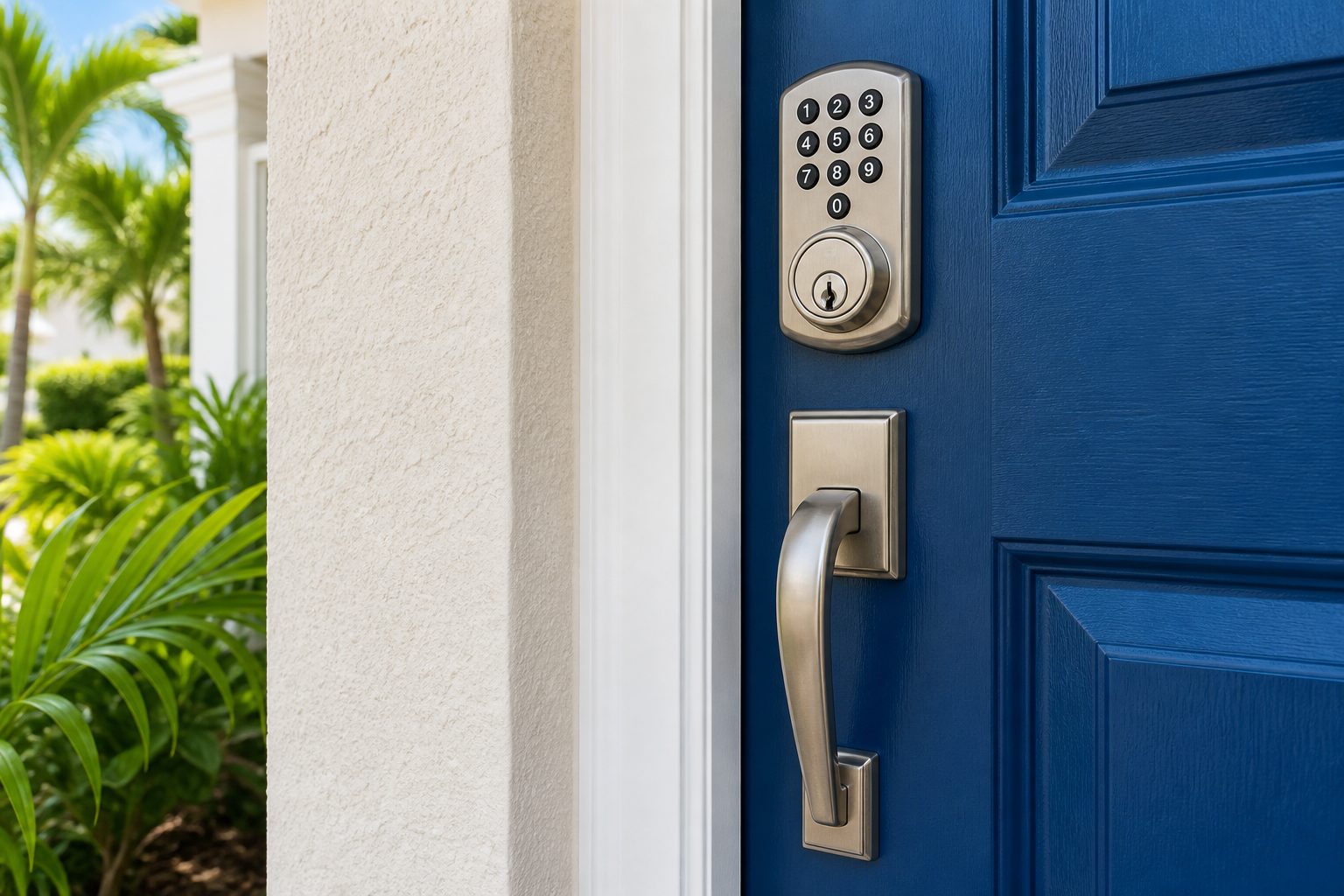
Keypad deadbolts and smart locks are attractive to managers because they remove physical keys from the turnover routine. Instead of rekeying, the manager changes a passcode. Some systems allow time-limited codes for contractors or showings. Others report which code was used and when, which can be useful for resolving disputes about entry.
They also introduce new tasks. Batteries need to be checked and replaced. Firmware and app accounts need to be managed. A smart lock that is tied to a personal phone account becomes a problem if the person who set it up leaves the company. Decide who owns the account, and use a shared management account instead of a personal one wherever possible. Keep a mechanical key option available on the lock, since a dead battery should not become a lockout.
Tenants also need a clear explanation of how the lock works and who can see its activity. Some tenants like the convenience; others worry about privacy. Check your lease language, and consider the Florida rules about notice and entry before choosing a system that logs access.
A locksmith can install and set up the hardware, walk through the first code change with you, and test the lock from the inside and outside. For deeper background, see the pages on smart locks and keyless entry and keypad deadbolt installation. If a smart lock keeps failing, the unit still needs an actual door that can be secured, so do not leave a failed lock unaddressed over a weekend.
Portfolios generate unplanned calls. A tenant is locked out at night. A contractor reports a door that will not latch. A break-in leaves a frame damaged and a lock compromised. If a person is in danger or a crime is in progress, call 911 first and let the locksmith wait until the scene is safe.
For a lockout or damaged lock where no one is in danger, call and describe the situation clearly. Give the property address, the unit, who you are, and what the technician should find on arrival. Tell the dispatcher if the door is an exterior entry, if there is a second lock such as a deadbolt, and if the tenant is present. A technician arrives prepared when they know whether the lock is a standard knob and deadbolt or a mortise lock on an older building, and whether the door is metal, wood or fiberglass.
After a break-in, the sequence matters. First, the police report. Second, the owner and insurer. Third, securing the opening, which may mean a temporary board-up from another contractor and a locksmith for the hardware. Photograph the damage before anything is changed, and keep the broken parts if the insurer or police may ask for them. The page on lock change after a break-in explains what the locksmith will check and why the strike plate and door frame are as important as the lock itself.
No locksmith can promise a technician at every hour in every location, and this site does not make that promise. When you call, you will be told what is available and what the service call involves before anyone is sent.
A tenant has moved out and returned only one of two keys. The manager has the second key count wrong in the file. The solution is a rekey before the next tenant, plus a note in the record about what happened. No blame is needed; the system simply notices a missing key and acts.
A building has a shared mailroom with cluster boxes. A resident reports a lost mailbox key. The manager needs a locksmith who can open and rekey the individual box without disturbing the others and without removing the whole unit. Details are in the page on mailbox and cluster box locks.
A property has a pool gate or amenity door that is used by dozens of residents and has become sticky and unreliable. The solution is usually hardware replacement or adjustment, not another key. See pool gate lock service for the types of hardware involved and the safety considerations for gates around water.
A single-family rental has a tenant whose lease is ending in dispute and who says they have lost all keys. The manager has authority to rekey, but needs to be careful about timing and notice. The locksmith will do the physical work and will not make legal judgments.
A rental house has a contractor who needs weekly access for a month. Rather than cut a key and hope it is returned, the manager installs a keypad deadbolt or a lockbox with a code that is changed when the project ends. The cost of the hardware is small compared to the cost of an unknown number of copies.
The quickest calls come from managers who have the facts organized. Before you call, gather the property address and unit, the number of doors, the type of lock if you know it, and whether the property has a master system. If you have prior records of work on the unit, have them nearby.
Have your authority ready. If you are the manager, that may be a management agreement, a work order or your company identification. If you are acting for an owner, have a way to show that. If a tenant is on site, make sure they can show identification and a lease or other proof of residence.
Decide in advance what you want. Is this a rekey, a replacement, a repair, or an assessment? Do you want all doors on the same key? Do you want extra keys for maintenance? Do you want a master arrangement? If you do not know, say so; a good locksmith can explain options and describe what an on-site visit would involve.
Ask for the quote by phone. The price depends on the number of doors, the hardware, the schedule and whether a service call applies. Larger projects such as a full building rekey or a master key system need an on-site visit before a final quote, and the call-out charge for that visit is explained on the phone before dispatch. Nothing on this website lists prices, because a published price would be a guess.
When you are ready, call and describe the property. The person on the phone will tell you what is possible, how the visit will work, and what the technician will need from you on site.
Often yes, when the visit is planned in advance. Tell the dispatcher how many units, how many doors per unit, and whether any are on a master system. Larger batches may need an on-site walkthrough first so the quote and the key plan are accurate. The details, including any call-out charge, are explained by phone before anyone is dispatched.
Yes, most reputable locksmiths will. Expect to show a management agreement, work order, owner letter or similar document, plus photo identification. This protects owners and tenants from unauthorized changes. If a tenant asks for the work, the technician will usually want proof of residence as well as identification.
Rekeying is usually enough when the hardware is in good condition, because it makes old keys useless without changing the look of the door. Replacement makes sense when the lock is worn, damaged, outdated or when you want a different grade or a keypad. A technician can assess the door and explain the choice.
A master key system can be arranged, but it should be planned. The locksmith will ask who needs access, how masters will be tracked and what happens if one is lost. For smaller portfolios, simple rekeys with a labeled key log may be a better fit. The right answer depends on your properties and staff.
Never write the full address on a key or tag. Use a coded label that matches a log kept in your office. If a ring is lost, a finder cannot connect it to a door. Count keys out at move-in and in at move-out, and record any difference immediately.
They can, especially for turnover and contractor access, because a passcode can be changed instead of rekeying a cylinder. They also bring batteries, accounts and tenant privacy questions. Use a shared management account, keep a mechanical key option, and check your lease terms. Call to discuss which hardware fits the property.
Describe the situation by phone and we will tell you what the job involves. Quotes are given by phone. Jobs that cannot be quoted without seeing them need a technician on site, and the service call charge is explained on the phone before anyone is dispatched.