A keypad deadbolt replaces the key you keep losing with a PIN you can change whenever you like. Fitting one is a precision job: the door, the bore holes, the frame and the batteries all have to agree. Here is how the installation works and what to prepare before the technician arrives.
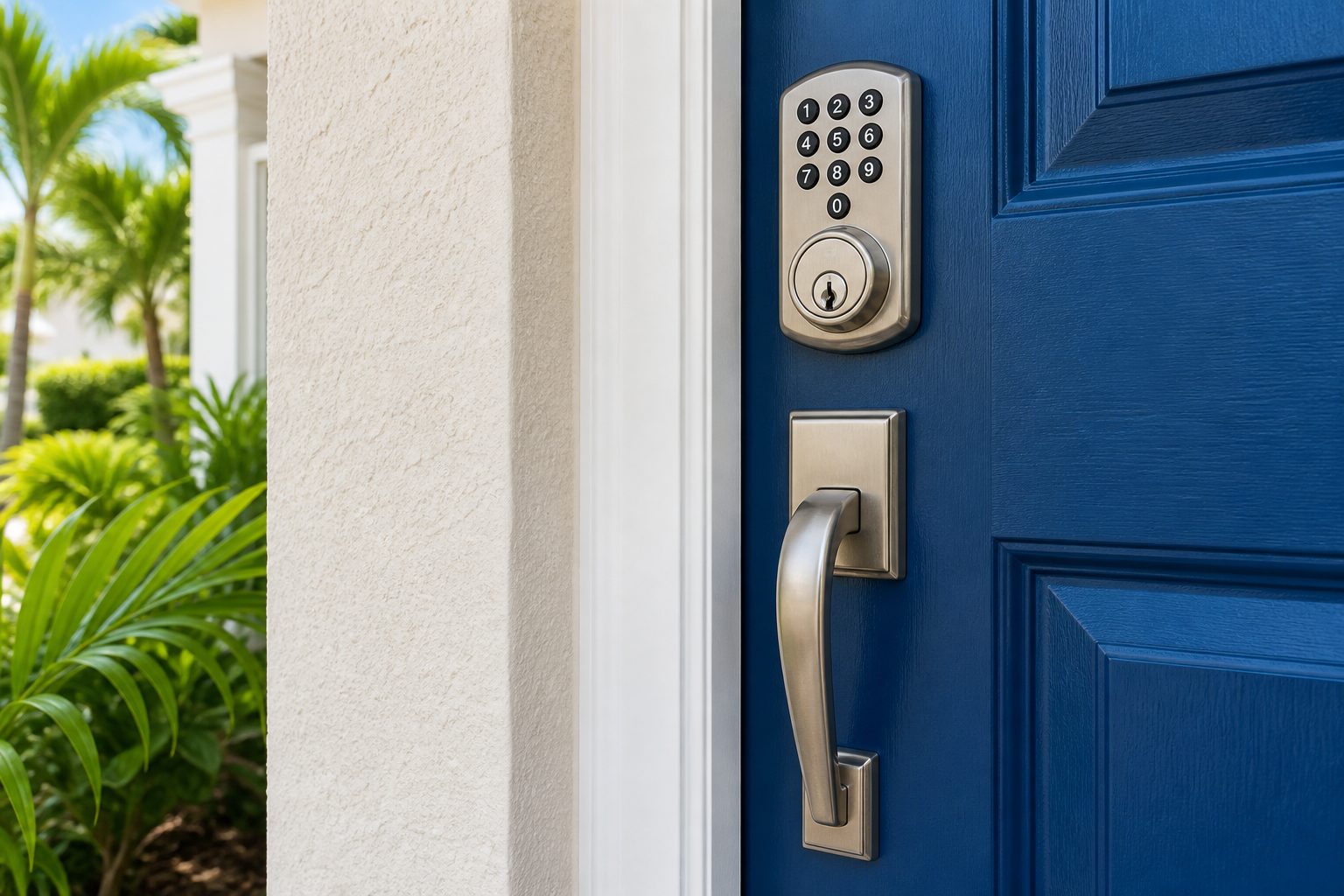
A keypad deadbolt is a standard deadbolt with a battery powered pad on the outside. You type a PIN, a small motor inside the housing retracts the bolt, and the door can open. On the inside there is almost always a plain thumb turn, so leaving the house never requires a PIN. Most models also keep a keyed cylinder on the outside as a backup, which matters when the batteries finally run flat.
The important thing to understand is that the keypad is only the interface. The part that resists a kick or a pry is still the bolt, the strike plate and the door frame. A keypad on a weak frame is still a weak door. That is why a good installation starts with the door itself, not with the box that came from the store.
Keypad deadbolts differ from the larger family of smart locks. A basic keypad model does one job: it accepts a PIN. A smart model adds phone pairing, scheduled access and activity logs. If you are not sure which you want, the page on smart locks and keyless entry covers the wider options, and the keypad versus key fob versus smart key guide compares them in plain terms.
Many Orlando households choose a keypad lock for a practical reason: families with kids who lose keys, landlords who turn over units, and anyone who has stood on a porch in a thunderstorm patting empty pockets. The convenience is real, but only if the lock is installed square and set up sensibly.
The calls we see for keypad deadbolts fall into a few recognizable groups. Families with teenagers want to stop copying keys that disappear. Short term and vacation rental hosts want to change an access PIN between guests without a handoff. Property managers like being able to remove one person from access without re-keying a whole building. Older homeowners often like not having to find a small key in the dark.
Orlando also has a lot of second homes, rental properties and homes occupied by seasonal residents. For these, a keypad means a cleaner way to let a cleaner, a pool service or a contractor in without leaving a hidden key under a planter, which is the first place anyone looks.
Before anything is installed, a technician looks at the door as a system. Is the door solid core, hollow core, metal or fiberglass? Is the existing bore the standard size for modern deadbolts? Is the backset, the distance from the door edge to the center of the hole, the common two and three eighths or two and three quarters inches? A mismatch here is the reason a lock that looks right in the box fits badly on the door.
Next comes the edge bore and the latch plate. The bolt must slide into the strike without scraping, and the door must close without forcing. If the door has dropped on its hinges, which is common in older Florida homes after years of humidity swelling the wood, the bolt will bind and a motorized lock will struggle or burn through batteries. The honest fix is to adjust the door or frame first.
The technician also looks at the door thickness, since keypad housings need enough room on the inside for the battery pack and wiring. Doors with a decorative glass insert near the hardware, or doors with an unusual stile, may limit which models fit. Those details are part of why a phone conversation comes first. Telling the dispatcher the door material, whether there is already a deadbolt, and the brand of any existing lock helps choose an appropriate model before anyone arrives.
On a door that already has a standard deadbolt hole, the work is straightforward but not hurried. The old deadbolt is removed, the bore is cleaned and checked for damage, and the new latch is set at the correct backset. The exterior keypad is mounted with its connecting cable passed through the door, and the interior assembly is fastened with matched screws.
The sequence after mounting is where care shows. The bolt is thrown and retracted by hand to feel for binding. The door is closed and the bolt is tested against the strike with the door held tight and with it slightly pulled, since real doors flex. Only then are batteries installed and the lock programmed.
Every deadbolt, keypad or not, depends on the frame around it. A factory strike plate is usually fastened with short screws that bite only into the thin jamb trim. A hard shove can split that trim and the bolt goes right through. A technician will often recommend longer screws that reach the framing behind the jamb, and in some cases a reinforced strike.
This is not an upsell for its own sake. If you are putting an electronic lock on a door, it is reasonable to ask that the frame is checked at the same time. We explain what reinforcement does and does not protect against on the strike plate and door frame reinforcement page. It is worth reading before you decide how much work the door needs.
In a humid climate like Orlando, wood jambs can swell in summer and shrink in the drier months, and a bolt that slid smoothly in July may bind in February. A technician who sets the bolt with a little tolerance, rather than a tight rub, is building in that seasonal movement.
A keypad is only as secure as the numbers you choose. The factory default is meant to be changed immediately, and the technician will walk you through that. Avoid sequences like a repeating digit, an ascending run, a birth year or the last digits of your street address. Those are the first guesses anyone makes.
Think about who actually needs access. Most keypad locks hold a master PIN and several user PINs. Give the household a master PIN that only adults know, and give guests, cleaners and contractors their own user PINs so one can be deleted without disturbing the others. Our digital lock PIN best practices guide goes deeper on rotation, shared access and what to do when someone leaves.
Wear on a keypad is also information. If the same four buttons are visibly shinier than the rest, anyone who looks closely can narrow the combinations. Some owners handle this by choosing a longer PIN when the lock allows it, or by changing it on a regular schedule. A technician can tell you how many digits your specific model accepts.
Most keypad deadbolts run on standard alkaline batteries and give a warning, usually a beep or a flashing light, well before they die. Treat that warning seriously. Replace all the batteries together with fresh ones from a reputable brand, and write the date on the inside of the door or in your phone.
A power outage does not affect a battery lock, which is one reason they perform well during Florida storm season. The keyed backup is the other safety net. Many people install a keypad and then throw away the key, which defeats the point. Keep a spare key somewhere you can reach, and not hidden outside the house. If the keyed cylinder gets stiff in the salt and humidity common here, the maintenance guidance on the humidity and lock longevity guide will help.
If the lock stops responding altogether, the troubleshooting page for smart lock repair describes common causes such as misaligned bolts and weak batteries, and how a technician tells the difference. Do not try to force a motorized bolt by hand if it is binding, since that can strip the internal gears.
A keypad is just as useful on a back office door or a storage room as on a front door. Small businesses use them to avoid handing out physical keys to seasonal staff. The trade off is that a keypad does not log who entered unless the model is specifically built to do so, so a business that needs an audit trail should look at access control rather than a stand alone keypad lock.
For a home, the front door is the usual choice, but also consider a garage entry door, a side gate entrance or a back door that family members use frequently. The garage entry door locks page addresses the particular problems of the door between a garage and a house, which is often the weakest door in the property.
Apartment tenants should check their lease and ask the landlord or property manager before changing hardware, since most leases require the original lock or a key to be provided. A technician can only change a lock for someone who can show they are authorized to do so.
Keypad installation is quoted by phone, never by a form or a price list. The dispatcher will ask about the door, the lock you have now, how many doors you want fitted and whether you already bought a lock or want the technician to supply one. A straightforward installation on a standard door can often be priced after that conversation. A door with damage, rot, an odd bore or a frame that needs work will need an on site visit to be assessed accurately. A service call charge applies and is explained before anyone is dispatched.
The technician will ask you to show that you live at or manage the property, which protects you and the locksmith both. You do not need to be present for the entire job, but someone authorized should be available to approve the work and learn the PIN setup.
If you have already bought a keypad lock, bring the box, the paperwork and any spare parts. Some budget models have loose tolerances and thin metal that a technician may not recommend fitting to a primary entrance. A candid opinion at the door is part of the service. Read more about how these visits run in the what to expect on a locksmith call guide.
Once the lock is installed, a few habits keep it dependable. Test it from outside after each battery change. Clean the keypad with a soft cloth rather than a spray, since cleaning chemicals can creep behind the buttons. Keep the door and frame adjusted so the bolt continues to slide in without effort.
Pay attention to small warning signs. A bolt that sounds labored, a keypad that needs repeated presses, or a door that has begun to stick are all signs something has shifted. Catching these early usually means a quick adjustment instead of a replacement. If the door itself has become hard to latch, the door hardware repair page explains what a technician looks at.
When you are ready to arrange an installation or ask whether your door is suited to a keypad deadbolt, call and describe what you have. A clear conversation up front keeps the job simple, the quote accurate and the lock working for years.
Most standard residential doors accept one, because they share a common bore size and backset. The technician checks the bore, the door thickness, the edge hole and whether the door closes true before choosing a model. Doors with damage, unusual cutouts or very thin stiles may need extra work, which is why details about the door help when you call and describe what you have.
A good keypad lock warns you well in advance with a beep or light. If the batteries do run out, many models keep a keyed backup cylinder or have terminals for an emergency power source. Replace all the batteries at the same time and keep a spare key somewhere reachable but not hidden outside the house.
Yes, that is one of the main benefits. The technician shows you how to add, change and delete PINs on your specific model before leaving. You can then rotate access when a guest leaves, a worker finishes a job or you simply want to refresh the numbers. Keep the master PIN private and record who has which user PIN.
Security depends on the quality of the hardware and the door around it. A well built keypad deadbolt on a sound frame can be as strong as a keyed one, since the bolt is the same part doing the work. A weak model on a split frame is not secure either way. The technician will tell you plainly if a model is not suited to your entrance.
Pricing is given by phone only, after the dispatcher understands the door and the lock. Simple installations on standard doors can often be quoted on the call. Doors needing repair, frames needing reinforcement or unusual hardware may need an on site visit. A service call charge applies and is explained before a technician is sent.
Many people can, and some do. The common problems are a wrongly measured backset, a bolt that binds in the strike, and a cable pinched during mounting. A technician brings the right tools, tests the bolt against the frame and sets up PINs correctly. If you try it yourself and the bolt will not move smoothly, stop and call rather than forcing it.
Describe the situation by phone and we will tell you what the job involves. Quotes are given by phone. Jobs that cannot be quoted without seeing them need a technician on site, and the service call charge is explained on the phone before anyone is dispatched.