A deadbolt only does one thing: extend a solid bolt at least an inch into the frame with no spring behind it, so it can't be forced back by pressure alone the way a spring latch can. Everything about a good deadbolt, the grade of the cylinder, the length of the strike screws, how it's mounted, exists to support that one inch of throw. Everything about a bad deadbolt install undermines it without anyone noticing until the door gets kicked or the bolt won't turn.
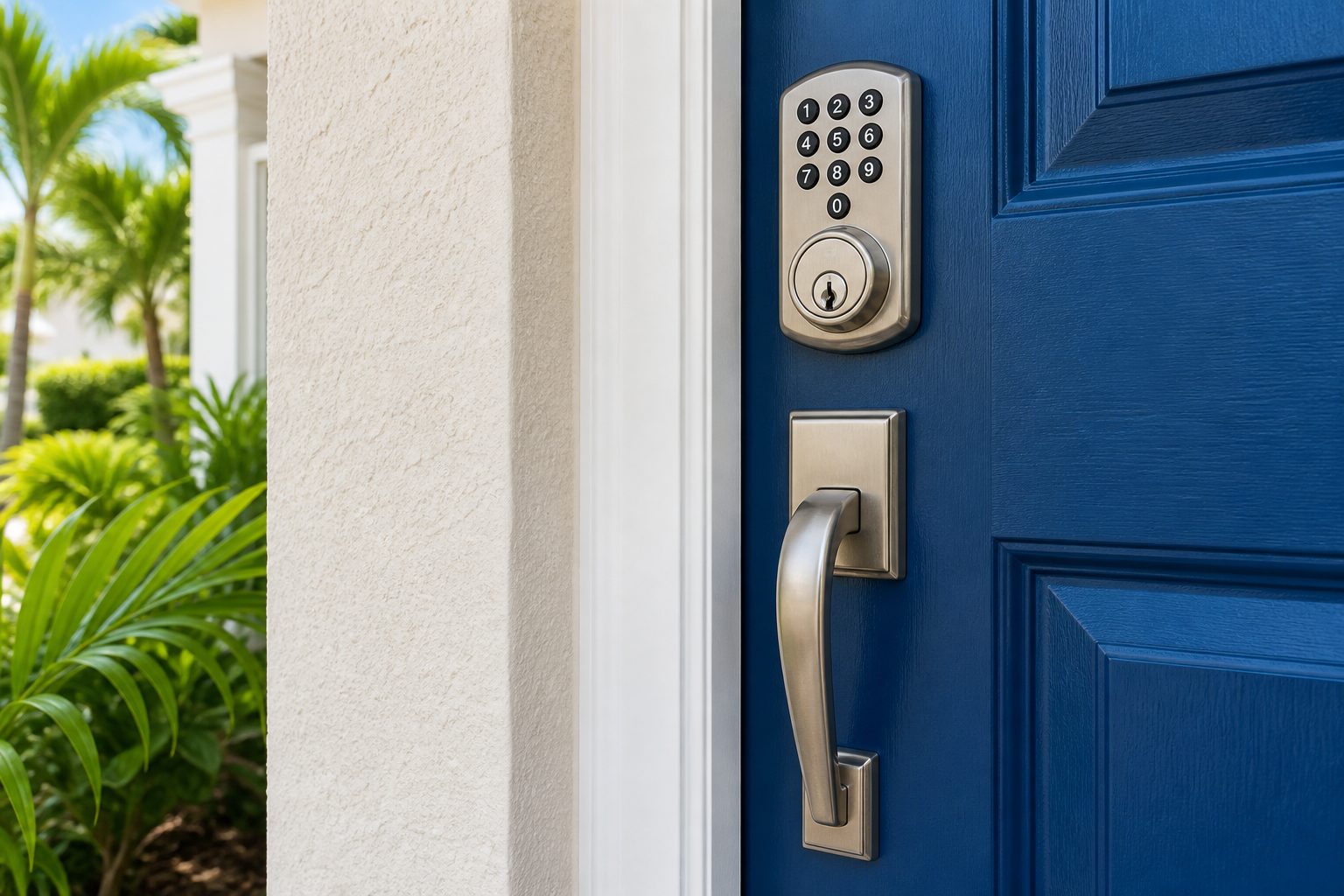
In Orlando, the failure that shows up most isn't a break-in attempt. It's a deadbolt that threw smoothly all winter and starts binding by July, because the door and jamb have swollen just enough to throw the alignment off by a fraction of an inch. That's a different repair than a worn-out lock, and it's worth knowing the difference before paying for the wrong fix.
ANSI/BHMA grading for deadbolts is a lab test, not marketing language. Grade 3 is the residential minimum, tested for a lower cycle count and a lighter impact strike. Grade 2 steps up the cycle testing and the force the bolt and strike have to withstand before failing. Grade 1, typically found on commercial doors but increasingly chosen for residential front doors, is tested to withstand more strike force and more open-close cycles than most homes will ever put on it.
The grade doesn't change what the deadbolt looks like on a showroom wall. It changes what's inside, the thickness of the bolt itself, the hardness of the cylinder housing, how the strike box is reinforced, which is why two deadbolts that look identical can perform very differently under a shoulder against the door.
A one-inch bolt is only as strong as what it's throwing into. Most deadbolt strike plates ship with short screws meant to bite into the jamb trim, not the framing behind it. A proper install swaps at least the top and bottom screws for 3-inch versions that pass through the jamb and reach the stud, the actual structural lumber the door frame is nailed to. Skip that step and the whole deadbolt, no matter its grade, is only as strong as a thin strip of jamb material that can split away from a solid kick.
Wood doors and jambs move with the seasons here. During the wet months, moisture works into the door slab and the frame around it, and both swell, sometimes only a sixteenth of an inch, which is enough to change how the bolt lines up with the strike hole. A deadbolt that threw freely in February can start requiring a shoulder against the door to turn the key by August, and by the dry months it may loosen back up on its own. That cycle repeats every year on a lot of older Orlando homes, and it's frequently mistaken for a failing lock when the lock itself is fine, the strike position just needs to be adjusted, or the strike plate mortised slightly deeper, to match the door as it currently sits.
A deadbolt that sticks, binds, or needs extra force to throw is usually a repair: realigning the strike, adjusting the mortise depth, or lubricating a cylinder that's gone stiff. A deadbolt that's been forced, has a cracked housing, or has worn internals rattling loose inside the bolt mechanism is a replacement, because those failures don't come back from adjustment. The visible symptom, a key that's hard to turn, can point to either one, which is why the diagnosis has to happen at the door, not over the phone.
A single-cylinder deadbolt has a key on the outside and a thumbturn inside; a double-cylinder version requires a key on both sides. Double-cylinder deadbolts are sometimes chosen for a door with a nearby glass panel that could otherwise let someone reach in and turn a thumbturn, but they also mean a key is required to exit, which some local fire codes and insurance policies restrict on doors used for egress. That's worth confirming before installing one, not after.
A deadbolt earns its keep on the one inch it throws and the screws holding its strike to the frame. Call us and describe what the deadbolt is actually doing, sticking, hard to turn, not fully latching, and whether it needs adjustment or replacement gets sorted out at the door.
Why does my deadbolt only stick in the summer?
That's almost always seasonal swelling in the door or jamb changing the strike alignment slightly. It usually isn't a sign the lock is failing, it's a sign the strike needs to be adjusted for the door as it sits now.
Is a higher ANSI grade worth it on a front door?
For a primary entry, most homeowners find the step up from Grade 3 to Grade 2 or Grade 1 worthwhile, since that door takes the most use and the most risk. Grade also affects how the bolt and strike hold up if the door is ever struck with force.
Can a deadbolt be repaired instead of replaced?
Often, yes, if the housing and internals are sound and the problem is alignment, mortise depth, or a stiff cylinder. Damage to the bolt or a cracked housing usually means replacement makes more sense.
Before a new deadbolt goes on, three measurements decide what will fit. The backset is the distance from the edge of the door to the center of the bore hole, usually 2-3/8 or 2-3/4 inches on residential doors. The bore is the large round hole through the face of the door, typically 2-1/8 inches. Door thickness on most exterior residential doors is 1-3/4 inches, but older homes and some custom doors run thicker or thinner. Most quality deadbolts ship with an adjustable latch that handles either common backset, but a thick door may need an extension kit, and an oversized bore from an older lock may need a reinforcement or a trim plate to cover the gap.
These details matter because a deadbolt forced to fit a door it was not made for will bind, rub or leave the bolt short of its full throw. That is one of the most common reasons a deadbolt installed by a homeowner never quite works right.
Plenty of Orlando homes still have doors with only a knob lock, especially the door from the garage into the house, older back doors, and doors added during renovations. Adding a deadbolt is one of the most effective security improvements you can make to a home. The job involves marking the correct height, usually about six inches above the knob, boring the face hole and edge hole cleanly, chiseling a mortise for the bolt faceplate so it sits flush, and cutting the strike pocket in the jamb deep enough for the bolt to throw its full length.
The strike side is where most of the work is. The hole in the jamb has to line up exactly with the bolt, go deep enough for full extension, and sit behind a strike plate secured into the framing. A deadbolt whose bolt cannot extend fully because the strike hole is too shallow may look locked while offering far less resistance than it should.
When a deadbolt is replaced or added, most homeowners want it to match the knob or handleset below it, both in finish and in key. Many manufacturers sell combo packs with a deadbolt and entry lock keyed alike, and a locksmith can rekey a deadbolt from one brand to work with the key of another brand only if they share a keyway, which is not always the case. If your house uses one brand throughout, staying with it keeps things simple. If the house has a mix, a locksmith can often convert cylinders so every exterior lock runs on one key.
Front entry handlesets, the tall decorative grips with a thumb latch, are often paired with a matching deadbolt. Replacing only the deadbolt on a handleset door can leave the two pieces mismatched in finish or style, so check whether a matching deadbolt is available in the same line before buying.
Electronic deadbolts install in the same bore as a standard deadbolt, but they are less forgiving of alignment. A motorized bolt has limited power, and if the bolt rubs on the strike or the door has to be pushed to line up, the lock may fail to fully extend, drain batteries quickly, or report a jam. Getting the strike perfectly aligned is even more important for a smart lock than a mechanical one.
A few points to weigh when choosing one:
Seasonal swelling is the most common deadbolt complaint in Orlando, but it is not the only one. Other repairs come up regularly:
Each door material handles a deadbolt differently. Solid wood holds screws well and can be mortised cleanly, but it moves the most with humidity. Fiberglass doors are popular in Florida because they resist moisture, but they have a foam core and a thin skin, so bore holes need a sharp cutter and the lock's edge area relies on an internal wood or composite block for screw strength. Steel doors resist impact well, but a steel skin can dent around the bore if the lock is overtightened, and some hollow metal doors need particular reinforcement to hold a deadbolt firmly.
On any material, the frame is still the weak point. A strong deadbolt in a strong door that closes into a thin pine jamb will fail at the jamb. That is why long strike screws and, on some homes, a metal jamb reinforcement kit matter more than the price tag on the lock.
Many Central Florida front doors have decorative glass inserts or sidelights. The concern with a thumbturn near glass is that someone breaks the pane and reaches in. Options besides a double-cylinder deadbolt include installing security film or laminated glass, mounting the deadbolt higher on the door beyond arm's reach from the glass, and adding a secondary lock at the top of the door. Some thumbturns can also be removed or locked with a key when the house is empty and restored when someone is home, which keeps the quick exit available when it matters.
A single deadbolt on a pair of double doors only locks one door to the other. The inactive leaf has to be secured to the frame with flush bolts at the top and bottom, and those bolts need to seat fully into the header and threshold. In a strong wind, a pair of doors without working flush bolts can flex inward as a unit even with the deadbolt thrown. Checking flush bolts before storm season, and adding a surface-mounted bolt where the flush bolts are worn or missing, is simple and worthwhile.
A new deadbolt comes with its own key, which means your house may now have two different keys. Most homeowners prefer to rekey the new deadbolt to match the existing house key, or rekey everything to a new key at the same time. It adds only a few minutes to the visit and avoids the common situation of a key ring with one key for the knob and another for the deadbolt on the same door.
A deadbolt needs very little care, but what it needs matters in a humid climate. Once or twice a year, spray a small amount of dry graphite or PTFE lubricant into the keyway and work the key in and out a few times. Avoid household oils and general-purpose sprays, which leave a sticky film that catches dust, pollen and sand. While you are at it, check that the screws holding the interior half of the lock are snug, that the strike plate screws have not backed out, and that the bolt slides fully into the strike without scraping.
Watch the key as well. A key that has been used daily for years wears down, and a worn key eventually wears the pins in the cylinder along with it. If the key has rounded cuts or has to be wiggled, have a new one cut from the lock's code rather than copying the worn one. A fresh key often cures a stiff lock on its own.
Landlords around Orlando often ask whether to replace deadbolts between tenants or simply rekey them. If the deadbolts are sound, rekeying is quicker and keeps the hardware consistent across the property. Some owners of several units use interchangeable core deadbolts, where a small core can be pulled with a control key and swapped for a different one in seconds. That makes turnover fast and lets an owner keep a rotating stock of cores instead of calling for a rekey each time. Whatever approach you choose, keep a record of which key combination is installed at each property.
Some Florida homes have exterior doors that swing outward, which helps keep wind-driven rain out but leaves the hinge pins on the outside. A strong deadbolt does little if someone can pop the pins and lift the door off the hinge side. Security hinges with a non-removable pin, or hinge studs that lock the door to the frame when closed, solve that problem and are simple to add during a deadbolt installation.
Searching locksmith near me in Orlando for a house lockout? We are mobile across metro Orlando and quote the price before we come out. Call us.
ZIP codes we cover in Orlando: 32801, 32803, 32804, 32805, 32806, 32807, 32808, 32809, 32810, 32811, 32812, 32814, 32817, 32818, 32819, 32820, 32821, 32822, 32824, 32825. City services: Orlando Official Website.
Describe the situation by phone and we will tell you what the job involves. Quotes are given by phone. Jobs that cannot be quoted without seeing them need a technician on site, and the service call charge is explained on the phone before anyone is dispatched.