Rekeying changes how a lock responds to keys while keeping the hardware. Replacing swaps the hardware itself. Both can solve a lost key or a new tenant, but they suit different situations. This guide gives you a simple way to decide based on the lock's condition, your security goals and how you want to spend.
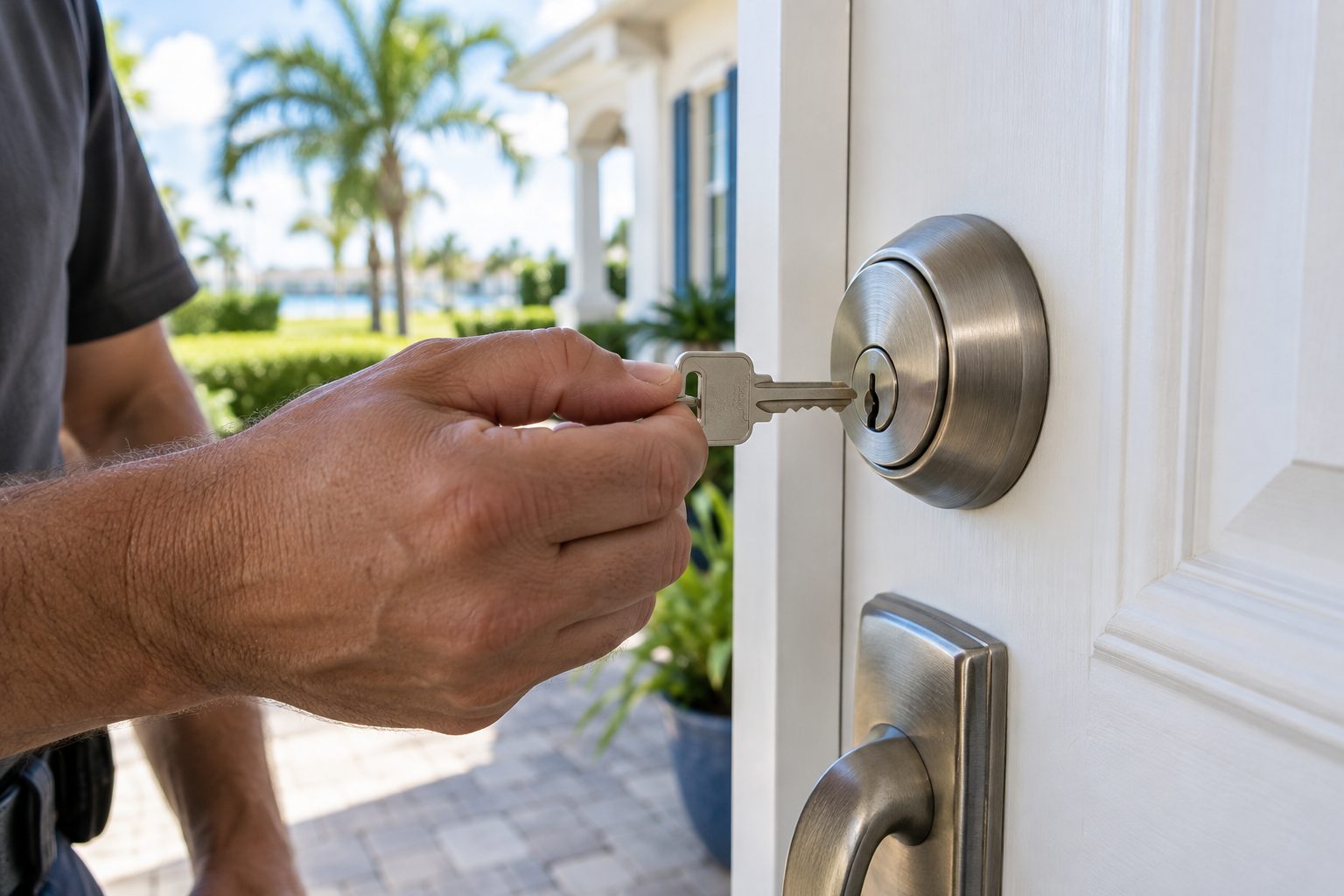
Rekeying is the process of changing the internal arrangement of a lock cylinder so that a new key works and the old keys no longer do. The lock body, the knob or deadbolt, and the visible hardware stay the same. Inside the cylinder, small pins are replaced or rearranged to match a new key pattern. The result is a lock that looks identical but responds to a different key.
Replacing means removing the existing lock and installing a different one. That might be an identical model, a stronger deadbolt, a different style of handle or a smart lock. The new lock comes with its own keys, and the old lock and its keys are no longer relevant.
Both approaches protect you from someone holding an old key. The difference is what else you want to change. If the existing hardware is in good condition and you just need new keys, rekeying is often the efficient route. If the hardware is worn, outdated or does not meet your needs, replacing may be the better choice. The rest of this guide helps you tell which is which.
Rekeying fits best when the lock itself is sound and the concern is who holds keys. A common example is moving into a new home. You do not know how many keys the previous owner, contractors, relatives or neighbors had. Rekeying every exterior lock gives you a fresh start without replacing perfectly good hardware.
It also suits situations where you want several doors to work with one key. A technician can rekey the front door, back door, garage entry and side gate so they all open with the same key, which is more convenient than carrying a ring of different ones. That is a common reason homeowners choose rekeying even without a security concern.
Another good case is the loss of a key or the departure of someone who had one, such as a former tenant, an ex-partner, a roommate or an employee. If the locks are in good condition and match the style you like, rekeying removes the old key from circulation. It can also be a sensible response after a break-in where the lock itself was not damaged, though you should consider the door and frame as well.
Replacement makes sense when the lock itself is the problem. If a deadbolt is loose, difficult to turn, corroded or visibly damaged, putting a new key pattern into it simply gives you a new key for a failing lock. In Orlando, humidity, summer storms and occasional salt exposure can wear hardware faster than many people expect, especially on exterior doors that face the weather.
Replacement is also the better route when you want a different level of security or convenience. Upgrading from a basic knob lock to a stronger deadbolt, adding a second lock to a door, or installing a keypad or smart lock all involve new hardware. Similarly, if a lock is very old, has a discontinued design or is a type for which parts are hard to find, replacing it avoids future headaches.
After a break-in or an attempted entry, the lock, the strike plate and the door frame may have been damaged. In that case, replacement and reinforcement are usually more appropriate than just rekeying. A technician can look at the door and recommend whether the frame needs attention. Security is only as strong as the weakest part, and a new key pattern does not help if the frame can be forced.
To decide, ask yourself three questions in order. First, is the lock in good working condition? Does the key turn smoothly, does the bolt extend and retract fully, and does the door close and latch without force? If not, replacement is likely to be the better path, or at least repair should be discussed.
Second, does the lock meet your security and convenience goals? If you simply want new keys, rekeying fits. If you want better resistance, a different type of lock or keyless entry, replacement is the answer. Third, is the situation about keys or about the door? If the concern is a lost or unaccounted-for key, rekeying solves it. If the concern is that the door or frame was forced, you need to address those too.
If the answers point in different directions, there is nothing wrong with doing both on different doors. Many properties end up with some doors rekeyed and some upgraded, depending on use and condition. A technician can help sort this out, and the quote by phone can cover each option so you can compare.
| Question | If the answer is yes | If the answer is no |
|---|---|---|
| Does the lock operate smoothly and look sound? | Rekeying is a strong candidate | Replacement or repair is likely better |
| Do you only need new keys or fewer keys? | Rekeying fits | Consider replacement for new features |
| Do you want a different type or higher security level? | Replace with the new type | Rekeying may be enough |
| Was the door or frame damaged? | Repair or reinforce too, and likely replace the lock | Rekeying may be sufficient |
| Is the lock old or hard to find parts for? | Replacement avoids future problems | Rekeying is practical |
Rekeying removes the old keys from use. It does not make the lock stronger, since the hardware is the same. If a lock is of basic quality, it will remain of basic quality after rekeying. That may be perfectly acceptable for an interior door or a low-risk location, but for exterior doors it is worth thinking about the overall level of protection.
Replacing gives you the opportunity to improve. You might choose a deadbolt with a higher grade, a lock with better resistance to common forms of attack, or a model with restricted keys that cannot be copied casually. If you are interested in understanding how lock grades work, our guide on deadbolt grades explains the categories in plain terms.
Security also depends on the whole door system. A strong lock in a weak frame, held by short screws in a thin strike plate, is not much protection. Reinforcing the strike plate, using longer screws that reach the wall stud, and checking the hinges all add real value. When you talk to a locksmith, ask what they see around the lock as well as the lock itself.
People often ask which option costs less. The honest answer is that it depends on the number of locks, the type of hardware and the condition of the doors, and any figure on a web page would be a guess. We give quotes only by phone, after you describe your situation, so that the number reflects what you actually need.
In general terms, rekeying avoids the cost of new hardware, which can make it attractive when the locks are sound. Replacement involves the cost of the new lock and installation, and it can be a sensible investment when it also solves a durability or security problem. A quick fix that has to be repeated is not really a saving, and a better lock that lasts is not necessarily an extravagance.
To make the discussion productive, tell the dispatcher how many doors, what kind of locks you have if you know, what you are trying to achieve and any budget limits. A good locksmith will present options, explain the tradeoffs, and let you decide. There is a service call charge to dispatch a technician, which is explained before anyone is sent, and complicated jobs may need an on-site look first.
For landlords and property managers, rekeying between tenants is a common practice. It prevents former occupants from retaining access and allows a clean record of who holds keys. Because rekeying is quicker and uses existing hardware, it suits turnover well. Keep a log of dates and keys issued so you have documentation if questions arise.
Tenants should check their lease and local rules before changing locks themselves. In many arrangements, the landlord controls the locks, and changes should be coordinated. If you have a safety concern, such as a former partner with a key, raise it with the property manager and consider contacting local resources. Do not assume you can change locks without permission.
For businesses, rekeying helps when an employee leaves or a key is missing, and it can be combined with a master key system so that different staff have different levels of access. Replacement may be better when a business is upgrading to access control or when doors have exit hardware that requires compatible parts. The right choice depends on how the building is used.
A family buys a house in a Winter Park neighborhood. The locks are older but work smoothly, and the deadbolts are in good shape. They want to be sure no former key can open the house. Rekeying all exterior doors to one key fits the goal without unnecessary replacement.
A tenant in an apartment finds that the deadbolt sticks in humid weather and the key has begun to bend. The hardware is worn, and rekeying would not fix the stiffness. Replacement of the deadbolt, with permission from the landlord, solves both the key and the function.
A shop owner discovers that a former employee never returned a key, and the front door lock is a basic knob. The owner wants a stronger lock and a new key. Replacement with a deadbolt, plus rekeying other doors to match, addresses both concerns. In each of these cases, the reasoning follows the same questions: the condition of the lock, the goal and the surrounding door system.
You do not have to decide alone. A good locksmith can look at a lock, tell you whether it is worth keeping and explain your options in plain terms. Describe your situation, the number of doors and your priorities, and ask for the pros and cons of each path.
If you are unsure, start with a phone call. Explain what happened, what you want and any concerns about the door or frame. Expect to hear how the quote works and whether the job is a straightforward one or needs an on-site visit. When you are ready, call and we will walk through rekeying and replacement for your doors before anyone is dispatched.
Rekeying makes old keys stop working, which solves the problem of unknown keys. It does not make the lock itself stronger. If the existing hardware is sound and of good quality, rekeying is a perfectly reasonable choice. If you want better resistance or features, replacing the lock gives you that opportunity.
Many common pin tumbler locks can be rekeyed, including most residential knobs and deadbolts. Some very inexpensive or damaged locks are not worth rekeying, and certain specialty or electronic locks follow different procedures. A technician can inspect your lock and tell you whether rekeying is practical or whether replacement is wiser.
It is a widely recommended step, because you cannot know how many keys exist from previous owners, contractors or guests. Rekeying exterior doors gives you a clean start and often lets you use a single key for several doors. If any lock is worn or damaged, replacement may be better for that door.
Usually not. If the sticking comes from worn parts, corrosion, a misaligned door or a damaged latch, a new key pattern will not solve it. In humid climates like Orlando, moisture and wear are common causes. A technician can diagnose the cause and advise whether cleaning, repair or replacement fits.
It depends on the number of locks, their condition and what you want to achieve. We give quotes only by phone after you describe the situation, since a general figure would not be reliable. There is a service call charge, explained before dispatch, and complicated jobs may need an on-site look first.
Only if it was damaged or is weak. After a forced entry or attempted entry, the strike plate and frame may be compromised, and a stronger lock will not help if the frame gives way. A technician can inspect the area around the lock and tell you whether reinforcement is advisable.
Describe the situation by phone and we will tell you what the job involves. Quotes are given by phone. Jobs that cannot be quoted without seeing them need a technician on site, and the service call charge is explained on the phone before anyone is dispatched.
The choice between rekeying and replacing often turns on a quick inspection. Start by operating the lock several times with the door open. The bolt should slide fully and cleanly, the key should insert and withdraw without grinding, and the cylinder should not feel loose in the door. Then close the door and see whether the bolt lines up with the strike plate without lifting or pushing. A lock that works in the hand but binds in the frame may point to door alignment rather than to the lock, which changes what the right fix is.
Look at the finish and the body. Pitted, flaking or green corroded metal suggests that moisture has been working on the lock, a common story in humid Central Florida where sprinklers and storms hit exterior doors. A lever that sags, a knob that wobbles or a thumb turn that spins freely are signs that internal parts have worn. Rekeying changes only the pins that match the key, so it cannot cure mechanical wear elsewhere. If the housing is in good shape and everything moves smoothly, rekeying remains a sensible option.
Also check compatibility. Not every lock can be rekeyed to a given key style, and some budget or very old models have parts that are hard to service. Mixed brands on a single property may be worth unifying on one key, which can influence the decision. Take note of how many doors you have and which ones matter most. Describe all of this on the call, and the scope and quote are explained before work begins, so you can choose to rekey some doors and replace others with a clear understanding of the reasons.
When a cylinder is rekeyed, its internal pins are rearranged so that a new key operates it and the old keys no longer do. The old keys are not destroyed, they simply stop working in that lock, and many people keep them as spares for other doors or recycle them. It is worth testing each old key after the work to confirm it has been turned into a dead key. That small test gives real peace of mind, particularly when the reason for the change was a lost key or a former tenant.
When a lock is replaced instead, the new hardware arrives with its own keys, usually a set of two, and you can decide how many copies to make. Some people ask for new locks to be keyed alike so that one key opens the front, back and garage doors. That is convenient but concentrates risk in a single key, so consider keeping a separate key for a shed, a gate or a guest entry. The trade is convenience against exposure, and there is no universal right answer, only the one that suits your household.
Keep track of the keys afterward. Label the new set, store a spare somewhere dependable but not obvious, and record how many exist. If any copy is made, note who received it. For rentals and businesses, a short log pays for itself the next time access must change. We explain what will be done and what you will hold when finished, so there is no mystery about the number or type of keys. Treat the transition as the moment to reset your key habits along with your locks.