Three kinds of calls land under lock installation, and they aren't the same job. Someone just closed on new construction and wants the builder-grade hardware swapped for something they picked out themselves. Someone converted a garage, a shed, or a Florida room into livable space and the door leading into it never had real hardware to begin with. Someone added a security door, a gate, or an interior office door and needs a lock mounted where there's currently just a hole, or nothing at all.
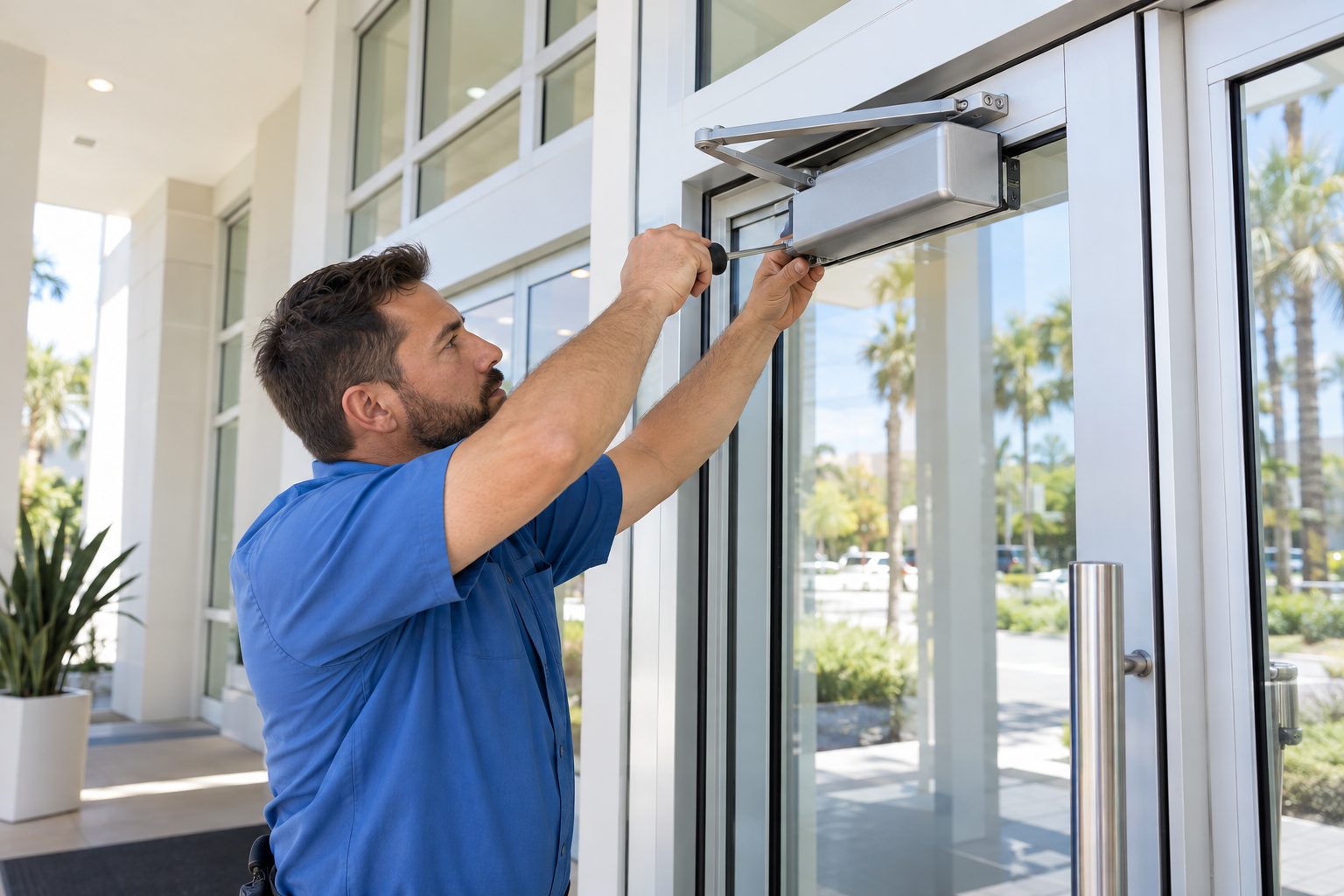
What ties those together is that installing a lock correctly is a measuring problem before it's a mechanical one. Backset, bore diameter, door thickness, and strike alignment decide whether the hardware you bought actually fits the door in front of it. Get one of those wrong and the lock still turns, still looks installed, and still binds, drags, or fails to latch within a few months.
Builder grade isn't an insult, it's a spec. Production homebuilders buy hardware in volume at whatever meets code and looks acceptable on a walkthrough, typically ANSI/BHMA Grade 3, the lowest residential grade, on both the knob or lever and the deadbolt. The faceplates are thin, the strike box is small stamped metal instead of a reinforced box strike, and the mounting screws are often shorter than what the door and jamb can really use. None of that fails an inspection. It just means the hardware is built to a price, not to outlast the house.
Swapping it out isn't about vanity. A homeowner who wants a heavier-grade lever set, a smoother deadbolt, or matching finishes throughout the house is also, usually without asking for it, getting a lock body with a longer bolt throw and thicker strike plate than what shipped from the factory.
The backset is the distance from the edge of the door to the center of the bore hole, almost always 2-3/8" or 2-3/4" on residential doors, and the two are not interchangeable without adapting the lock or redrilling the door. The bore itself is typically a 2-1/8" hole through the face of the door for the lock body, with a smaller crossbore on the edge for the latch or bolt. A lock spec'd for one backset mounted against a door drilled for the other sits crooked, and the latch tongue won't center in the strike no matter how the plate is shimmed.
Door thickness matters just as much and gets overlooked more often. Standard interior doors run 1-3/8" thick; exterior doors are usually 1-3/4". A deadbolt sized for an exterior door, sold as a universal fit, still needs its cylinder-to-thumbturn spindle cut or adjusted to the actual thickness in front of it, or the assembly won't seat flush on both faces.
New construction doors arrive pre-bored from the factory, which sounds like it removes the guesswork, and mostly it does, until the trades on site swap doors between openings, order the wrong backset for a subset of units, or hang a door that was bored for a knob-in-lever combo when the plan called for a separate deadbolt. None of that shows up on a walkthrough. It shows up when the new deadbolt doesn't seat, or seats with the bolt hitting wood instead of the strike opening.
Converted spaces are the other common call, a Florida room turned into a bedroom, a shed turned into a home office, an interior pocket door that needs to actually lock for the first time. These jobs start from a bare door with no bore at all, which means picking backset and bore size based on the door's actual thickness and swing rather than matching existing hardware. It's more work than a swap, but it also means there's no old, wrong prep to correct for first.
A lock can be bored and mounted perfectly and still fail at the strike plate. The strike has to line up with the latch or bolt both horizontally and vertically, and doors settle over time, humidity swelling the slab, hinges sagging under weight, a house shifting slightly on its foundation. On a fresh install, the strike gets set to match the door as it sits that day, not to a factory template. Deep-throw mortise strikes and adjustable lip strikes exist specifically to correct for a door that isn't perfectly square, which in an older Orlando home is closer to normal than the exception.
Lock installation done right starts with a tape measure, not a catalog. Call us with the door's location and age, and whether it currently has a lock at all, and the backset, bore, and strike work gets sorted out before hardware ever gets mounted.
Can I just buy a lock at a hardware store and have it installed on any door?
Most residential locks are sized for the two common backsets and standard bore, so they'll physically fit a lot of doors. Whether it fits your door well depends on its actual thickness, backset, and how square the opening still is, worth confirming before hardware is purchased rather than after.
Do I need to replace the whole lock, or can the existing hardware be reused?
If the bore is already correctly sized and positioned, a new lock body can often go into the existing prep. If the backset or bore doesn't match what's being installed, the door needs to be redrilled or a different lock chosen.
Is builder-grade hardware actually unsafe?
It's not unsafe in the sense of being defective, it meets code. It's just the minimum grade, with a shorter bolt throw and lighter strike than Grade 1 or Grade 2 hardware, which is why it's often the first thing homeowners upgrade after moving in.
Hardware catalogs list locks by function, and picking the wrong function is one of the most common mistakes people make when they buy hardware themselves. The function describes what the lock does from each side of the door, and each door in a house usually calls for a specific one.
A walk through the house with a list of each door and the function it needs saves a lot of returns. When we install hardware for a whole house, we build that list first.
Knobs work the same on any door, but levers and handlesets have a direction. The lever has to point toward the hinge side of the door so it does not catch clothing or bump the frame, and a lever that is installed backward will look wrong and may not return to level properly. Most modern residential levers are reversible, which means the lever can be flipped to suit a left hand or right hand door during installation. Some are not, and have to be ordered for the correct handing. Mortise locks and many commercial locks also have to be set for the door's handing, and some require an internal adjustment to reverse the latch direction.
Keypad and smart deadbolts usually need to learn which way the door swings as well. Many run a calibration when the batteries first go in, throwing the bolt to find out which direction is locked. If that step is skipped or the door is not closed during calibration, the lock may report locked when it is not, or strain against the strike. Following the setup steps carefully, with the door closed and the bolt moving freely, avoids most early complaints about electronic locks.
Most homeowners want every exterior lock on one key. Whether that is simple depends on the keyway, the shape of the slot the key slides into. Each lock maker uses its own keyway, and a key cut for one brand will not fit a lock from another brand even if the cuts are the same. If the front door has one brand and the new back door lock you bought is a different brand, those two cannot share a key without changing a cylinder.
A few practical tips:
Orlando's humidity, afternoon rain and strong sun are hard on hardware finishes. The finish you choose affects how the lock looks in a few years:
For a door that gets direct sun and rain, it is worth spending a bit more on the finish. The lock mechanism will usually outlast a low-cost finish by many years.
Mounting a lock is more than putting the pieces through the holes. A careful install on an existing door generally follows these steps:
The bolt hole in the frame deserves a particular mention. A deadbolt that cannot extend its full length because the hole behind the strike is too shallow is a very common installation fault. The bolt looks locked, but it may not be deadlocked, which means it can be pushed back in. A proper install drills the hole deep enough for the full throw.
You are welcome to buy your own locks and have us install them. That makes sense when you have a specific style or finish in mind, or when you are matching hardware already in the house. Before you buy, measure the door or send us photos of the door edge and the current lock, and tell us the door's thickness. We can tell you whether the model you like will fit and whether any extra parts, such as a different strike or a longer spindle, will be needed.
If you would rather not shop, we can recommend and supply hardware suited to the door and your budget. Either way, the manufacturer's warranty on the product comes from the maker, so keep the packaging and receipt for any lock you buy.
If you rent, check your lease before installing a new lock. Most leases require landlord approval and a copy of the key. In a condo, the association may control what hardware can go on unit doors, especially if the building uses a master key system for emergency access. In an HOA community, the rules may govern the style and finish of hardware visible from the street. A few minutes with the rules before you buy can save you from installing a lock you later have to remove.
Lock installation is not only about exterior doors. Some interior locks make daily life easier or safer: a keyed lock on a home office that holds work equipment or files, a lock on a closet where medications or firearms are stored, a keyed entry lock on a room you rent to a roommate or a long-term guest, and a lock on the utility room where the water heater and pool chemicals live if you have small children. Interior doors are often hollow core, so a lock installed on them is about controlling casual access rather than stopping a determined person. For items that truly need protecting, a proper safe or a locking cabinet is the better tool.
Sometimes a door has been through several locks, a forced entry or years of wear, and the edge around the latch is split, patched or chewed up. Installing a new lock into weak wood gives it nothing solid to hold. There are a few ways to handle that short of replacing the whole door. A wrap-around door reinforcer is a metal plate that covers the edge and both faces of the door around the lock, holding the damaged area together and giving the new lock a solid mounting surface. Filling and re-drilling works on smaller damage. On a door that is badly split, or a hollow door that has been drilled too many times, a new door slab is honestly the better use of money, and the new lock goes into fresh, correct prep. We will tell you which one your door needs when we see it, rather than mounting good hardware on a door that cannot hold it.
If you are painting, replacing doors, installing new weatherstripping or remodeling, try to schedule the lock work after the doors are hung and painted but before you move furniture back in. Paint on a strike or in a latch hole causes sticking, and new weatherstripping can change how firmly a door has to be pushed to latch, which affects where the strike should sit.
Searching locksmith near me in Orlando for a house lockout? We are mobile across metro Orlando and quote the price before we come out. Call us.
ZIP codes we cover in Orlando: 32801, 32803, 32804, 32805, 32806, 32807, 32808, 32809, 32810, 32811, 32812, 32814, 32817, 32818, 32819, 32820, 32821, 32822, 32824, 32825. City services: Orlando Official Website.
Describe the situation by phone and we will tell you what the job involves. Quotes are given by phone. Jobs that cannot be quoted without seeing them need a technician on site, and the service call charge is explained on the phone before anyone is dispatched.