Locks that keep strangers out can also keep small children in, or keep them from getting out when they must. Families in Central Florida have an extra concern, water. This guide covers inside latches, escape routes, pool access and what a locksmith can and cannot safely do.
Parents want two things from door hardware that do not always fit together. They want a child to be unable to wander out of the house, onto a road or toward water, and they want that same child, and every adult, to be able to get out quickly in a fire or other emergency. A lock that is perfect for the first goal can be dangerous for the second. The whole subject of lock safety in a family home is about choosing hardware that serves both goals at once, or arranging the house so that each goal is handled by a different door.
The most important principle is simple: never trade away a fast, quick escape from the inside of the house for a security feature. The main exits and every bedroom should be operable from inside without a key, without a passcode that must be remembered, and without prior knowledge. A toddler cannot do that, but an older child and any adult should be able to, in the dark, in a panic. Fire safety guidance in general is consistent on this point, and local rules in many places reinforce it.
The second principle is that locks are one layer among several. Locks do not replace supervision, fences, alarms and habits. In particular, a lock should never be the only barrier between a child and a pool. We return to that below. If you read one point on this page, let it be that lock choices for a family should be made with safety and escape in mind first, and convenience and security second.
Young children are tall enough to reach most knobs and lever handles by about the age of two, and they are very good at imitating what adults do. A standard deadbolt thumb-turn at adult chest height is usually out of reach for a toddler, but it will be within reach of a six-year-old. That is fine if the six-year-old understands how to use it, and it is a reason to teach your children how the front door works at an early age.
Many families add a second, higher latch to the exterior door: a chain, a slide bolt or a high-mounted deadbolt out of a young child's reach. These add a layer of protection against wandering. Make sure any added latch can be opened quickly by an adult from the inside without a key. Avoid keyed-both-sides deadbolts on primary exits. A lock that needs a key on the inside can trap everyone in a fire if the key is not where it should be.
Door knob covers, the plastic sleeves that are hard for small hands to turn, are a popular low-tech option for interior doors, such as those leading to a garage, a laundry room or a bathroom. They are not a security product and should not be used on exits. Lever handles can be fitted with simple devices that make them harder for small children to operate. If you are not sure what suits your doors, call and describe the layout and the ages of your children, and a technician can suggest hardware that will not interfere with escape.
Inside the house, children sometimes lock themselves into bedrooms or bathrooms by accident. Most interior privacy locks are designed with a small hole on the outside so that an adult can open the door with a thin tool in an emergency. Knowing where that emergency release is and how to use it is valuable. The hardware that came with your home usually has this feature, and the manufacturer's instructions can tell you which tool fits.
If a young child is locked in a room and is in distress, or if you believe a person inside is in danger, treat it as an emergency. Call 911 first if there is any sign of medical trouble, smoke, or immediate danger. If the situation is only an accidental lock-in with a calm child, talk to the child through the door, and use the emergency release that comes with the lock. We do not publish step-by-step methods for defeating locks, and a technician will not describe them in an article, but a locksmith can fit or replace interior hardware so that this situation is easier to handle.
For families with toddlers, consider replacing interior privacy locks on children's bedrooms with simple passage latches that do not lock at all, and keeping lockable doors for the adult bedroom and bathroom, where you can supervise. Some families choose bathroom hardware that can be unlocked from the outside with a flat coin-style tool. These details are small, but in the moment they make the difference between a minor incident and a stressful one.
Water is a serious risk for young children in Central Florida, where pools are common in single-family homes, townhome communities and condominiums, and where many properties have ponds and canals. Drowning can happen quickly and silently. Safety organizations stress that layers of protection are needed: constant supervision, a fence that separates the pool from the house and yard, self-closing and self-latching gates, door alarms, and swimming skills.
Doors that open to a pool area are a key layer. Many families fit an alarm on each door that leads to the pool, so that it sounds when the door is opened. Some use a latch mounted high on the door, out of a young child's reach, that adults can operate easily from the inside. Others use door hardware with a delayed release. Whatever you choose, it should add a barrier and a warning without blocking a quick exit by an adult or older child in a fire.
Gates deserve extra attention. A pool gate should close by itself and latch by itself, with the latch mounted high enough to be out of reach of small children, on the pool side of the gate where possible. A latch that sticks, a hinge that has sagged or a closer that has weakened can leave a gate unlatched without anyone noticing. Our service page on pool gate lock service explains how a locksmith can repair or replace gate hardware. Local rules for pool barriers vary, and your municipality or permit office can tell you what applies to your property.
Hardware helps, but children learn from routines. By the time they are three or four, most children can learn that the front door stays closed, that they do not open it without a grown-up, and that keys are not toys. Make these rules consistent, and repeat them calmly. Praise the behavior you want rather than only scolding.
For older children who come home alone, think carefully about how they enter. A child who wears a house key around the neck on a visible cord is advertising that no one is home. A child who hides a key under a mat teaches the neighborhood where it is. Alternatives include a keypad lock with a passcode the child memorizes, a small lockbox with a combination, or a trusted neighbor with a spare. Our page on spare key storage goes through the trade-offs. Remind children to never share the passcode and never open the door for someone they do not know, even if the person says they are delivering something or reading a meter.
Practice an emergency exit plan with every child old enough to understand. Show them how to open the front door and the back door from the inside, where to meet outside, and what to do if they are alone. A short drill every few months works better than a long lecture once. Include babysitters, grandparents and other regular visitors in the plan, since they will be the ones in charge when something happens.
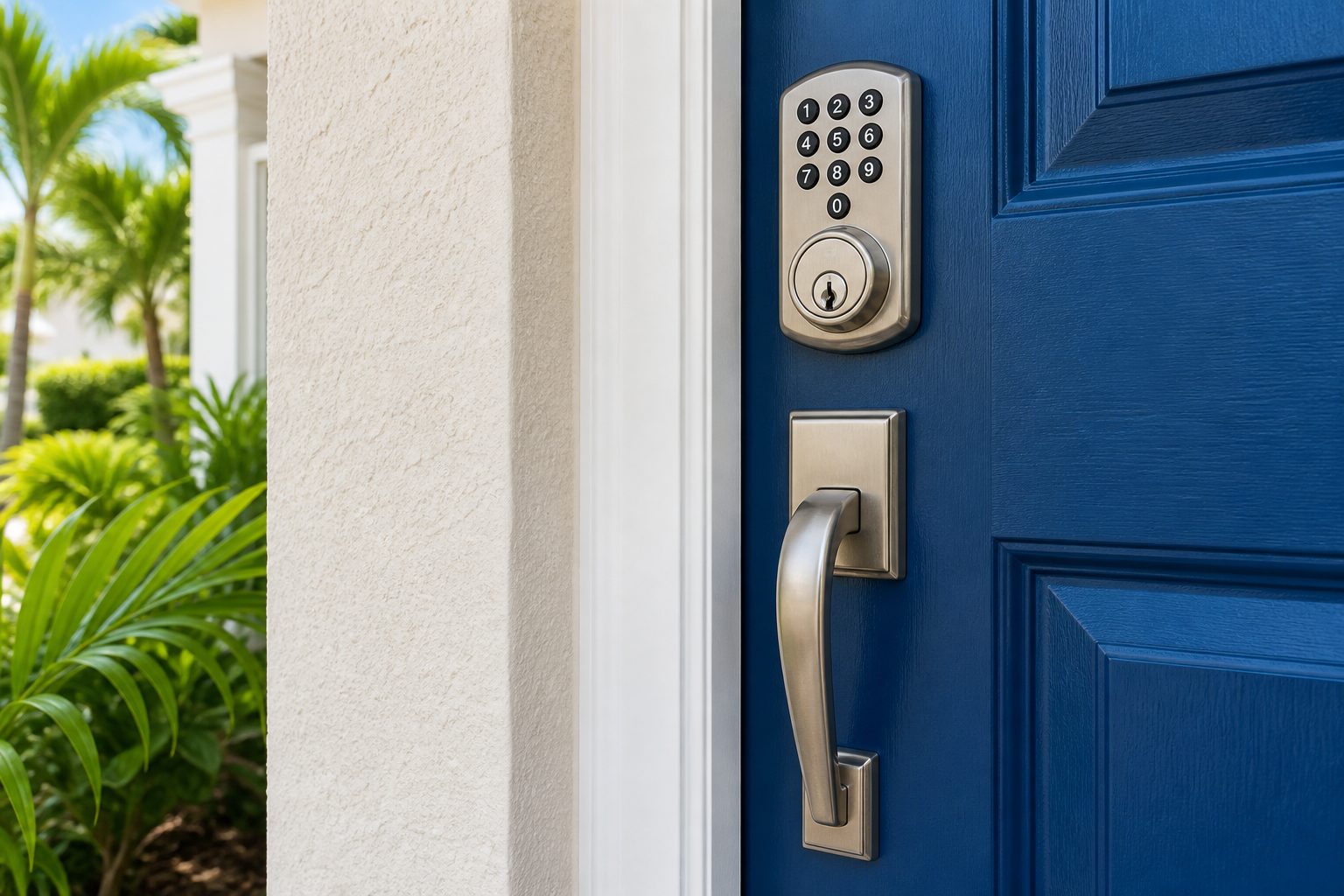
Keypad and smart locks suit families because a child does not need to carry a key. They also bring choices. A passcode that is easy for a child to remember is easy for others to guess, so avoid obvious combinations such as birthdays or repeated digits. Many locks allow several user passcodes, so each family member and regular caregiver can have their own, and you can remove one without disturbing the others. Our guide on digital lock passcode habits covers this.
Some smart locks send alerts when a particular user passcode is entered, which lets a parent know when a child has arrived home. Others lock automatically after a set time, which helps if a child forgets to turn the thumb-turn. Auto-lock is useful, but make sure the household knows about it, because a door that locks behind you can leave a child or visitor outside without a key. Always keep a mechanical backup way in, such as a key stored securely.
Check what happens in a power failure. Most keypad locks run on batteries and signal low power well in advance, but a child may ignore a warning chirp. Replace batteries on a schedule that you set, for instance when you change the clocks. If the lock has a mechanical override, make sure at least one adult knows where the key is. For more on selection, see smart locks and keyless entry.
Windows and sliding glass doors are a bigger concern for young children than front doors in some homes. A sliding door with a simple latch can be opened by a toddler who learns to lift and slide. A window within reach of a piece of furniture can be opened by a child who climbs. Falls from upper windows are a known danger, and screens do not hold weight.
Window stops and limiters that restrict how far a window opens are a standard solution. They must allow for emergency escape: in a bedroom, the window is a fire exit, and hardware that blocks it entirely can be dangerous. Choose a limiter that adults can release quickly. For sliding doors, consider a secondary lock mounted high, or a bar in the track, with the same rule that adults must be able to open it fast. See our pages on sliding patio door locks and window lock repair.
Move furniture away from windows, keep cords from blinds out of reach, and keep chairs and toys from becoming stepping stones. Walk through your home at a child's height, or crawl through it, to see what a young child sees. You will notice things that are invisible from an adult's eye level.
A child can be harmed by cars in more than one way. Children sometimes lock themselves in a parked car by pressing a power lock button, and in Florida heat a closed car becomes dangerous quickly. If a child is locked inside a vehicle, call 911 immediately. Do not spend time waiting for a locksmith when a child is in the car, because emergency crews are the right first response. After the emergency is handled, a locksmith can help with the vehicle.
Keep car keys and fobs out of reach of small children, who may press the panic button, unlock the car, or start a vehicle with a push-button ignition if the fob is inside. Do not leave fobs in a place where a child can play with them, and do not leave them in the car. Keyless vehicles have their own habits: the car may stay running if the fob leaves with someone. Learn how yours behaves.
Teach children never to play in or around parked vehicles, and consider keeping the garage door closed so that they are not tempted. Our page on lockout prevention habits includes routines that reduce the chances of getting locked out with children in the car or at the door, which can be very stressful.
A locksmith can assess your doors, suggest hardware that serves both safety and security, install latches, alarms, gate hardware and keypad locks, rekey locks after a babysitter or tenant has left with a key, and replace interior hardware that has failed. They can also advise on which locks are suited to which doors, and flag anything that looks like an escape hazard.
A locksmith cannot, and should not, install anything that prevents a quick escape from the inside of the home, and a responsible technician will tell you so. They are not a substitute for a fence contractor, a fire safety inspector or your local pool barrier rules. Where building or safety rules apply, it is best to check with your local permit office and follow what they say.
If you want to talk through a particular door or situation, call and describe your home, the ages of the children and what is worrying you. Quotes are given by phone only. Jobs that depend on seeing the doors need an on-site visit, and there is a service call charge that is explained on the phone before dispatch. Have a short list ready: which doors, what the current hardware is, and what you want to prevent. Then call, and we can go from there.
On a main exit or a bedroom, it is generally not recommended, because the key may not be at hand in a fire. A thumb-turn that adults can open quickly is the safer design. Keyed-both-sides hardware may be allowed on some secondary doors, but local rules vary. Call and describe the door so a technician can advise.
Add a second latch mounted high, out of the child's reach, that adults can open easily without a key. Combine it with an alarm and consistent household rules. Avoid anything that needs a key or prior knowledge to open from inside, since everyone must be able to leave quickly in an emergency.
No. Safety guidance calls for layers: close supervision, a fence, a self-closing and self-latching gate, alarms on doors that lead to the pool, and swimming skills. Locks and latches are one part of that. A locksmith can fix gate hardware, but your local pool barrier rules should be checked as well.
Call 911 right away, especially in warm weather. Emergency crews are the correct first response when a child is in a closed vehicle. Once everyone is safe, a locksmith can help with keys and car locks. Do not wait for a locksmith to arrive when a child is inside.
They can be, because there is no key to lose, and many allow separate passcodes for each family member and alerts when someone arrives. Choose passcodes that are not obvious, keep a mechanical backup, replace batteries on a schedule, and make sure everyone knows how the auto-lock feature works.
Quotes are given by phone only. Describe the doors, the ages of the children and what you want to prevent. If the work depends on seeing the doors, an on-site visit is needed, and a service call charge applies that is explained before dispatch. Call when you are ready, and we can talk through the options.
Describe the situation by phone and we will tell you what the job involves. Quotes are given by phone. Jobs that cannot be quoted without seeing them need a technician on site, and the service call charge is explained on the phone before anyone is dispatched.