Handing over the keys at closing or lease signing does not mean you hold every key. Previous owners, tenants, agents, contractors and neighbors may all still have access. This guide walks through the order that makes sense: take stock, change who can get in, then reset every system the last occupant touched.
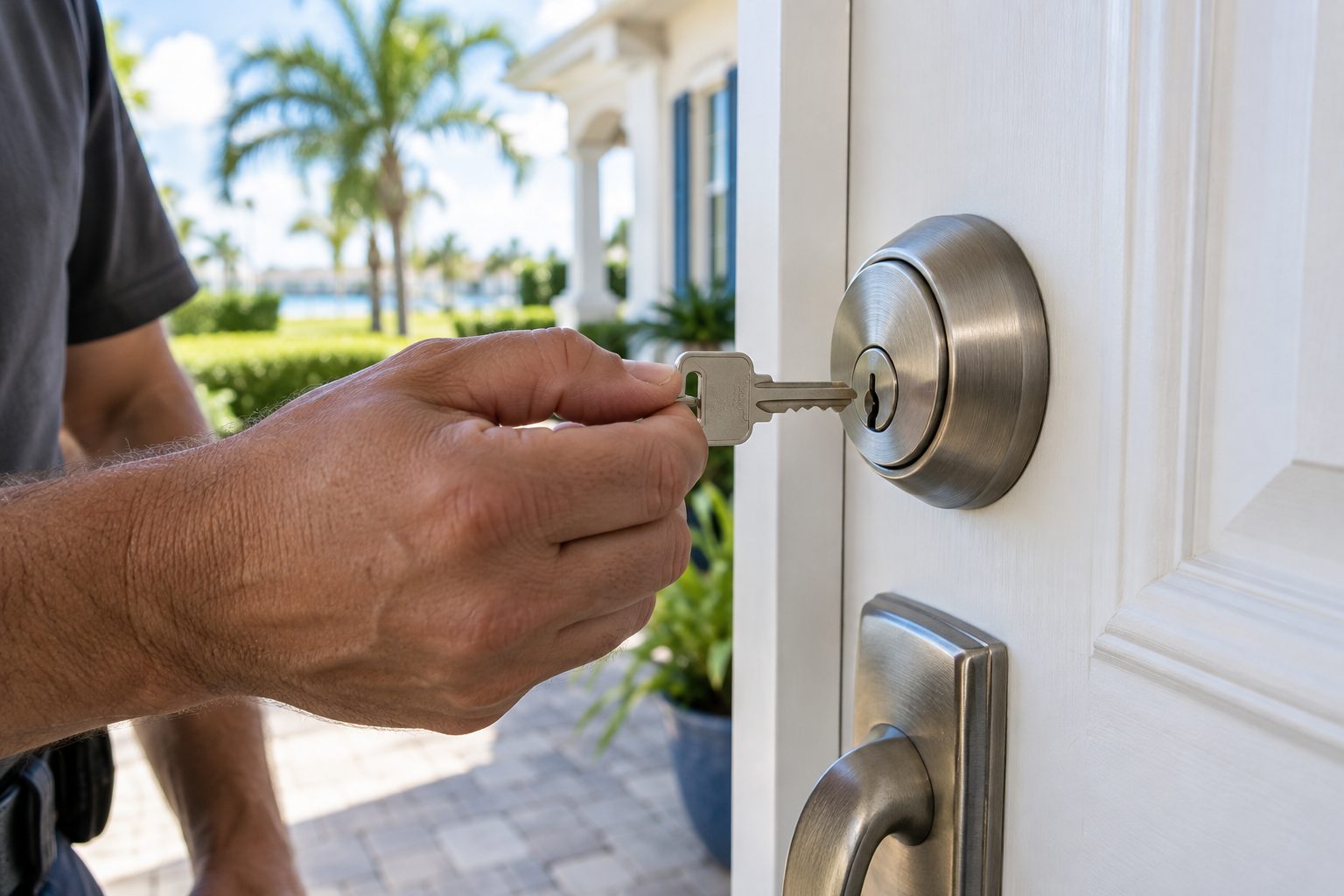
When a home changes hands, the paperwork transfers ownership but nothing transfers control of the physical keys. The sellers had keys. Their relatives may have had keys. A cleaning service, a lawn crew, a real estate agent who held a lockbox, a contractor who did a pre-sale repair, and a neighbor who watered plants may all have carried a copy at some point. Nobody is necessarily acting in bad faith, but you have no way to know how many copies exist or where they ended up.
The same is true of rentals. A tenant who moved out may have kept the key, a property manager may have shared a copy with a vendor, and an earlier tenant's copy may never have been collected. In a metro area with a lot of turnover, rentals, vacation homes and condos, a home can pass through many hands in a few years, and the lock stays the same unless somebody changes it.
The first week is the right time to handle this because you are already unpacking, you are home often, and you are not yet in a routine that makes a lockout or a late repair inconvenient. It is also when you can do things in a sensible order instead of reacting to a problem. The steps below are arranged that way: find out what you have, decide what to change, then handle the systems that quietly remember the previous owner.
Before you call anyone, walk the property with a notepad and list every opening that can be locked or unlocked. People usually remember the front door and forget the rest. A typical Central Florida single-family home has a front entry, a back or lanai slider, a garage entry door from the house into the garage, the overhead garage door itself, possibly a side door, windows with latches, a gate to the backyard, a mailbox, and sometimes a shed, pool gate or detached workshop. Condos add a unit door, a building entry, a mail slot and sometimes a storage cage or bike room.
For each opening, note what kind of hardware it has and what you were given. Count the keys you received and compare that to the number of locks. If you received two keys and the house has five keyed locks, some of them are keyed alike and some are not, or you are missing keys. Write that down. A locksmith can often tell by looking at the cylinders whether several doors share one key, which is a good thing to know before you decide what to change.
Your closing paperwork, lease or handover checklist often answers questions you have not thought to ask. Ask the seller, the listing agent, or the property manager how many keys exist, who has had one, whether a lockbox was used and whether it has been removed, whether the locks were ever rekeyed, and whether there are smart locks, keypads or app-connected devices that were set up under someone else's account.
It is also worth asking about the less obvious holders. Did a cleaning company work on the house regularly? Did a lawn or pool service have a gate key or garage keypad PIN? Did a relative have a key for emergencies? A good answer is a list of names. A vague answer is a reason to assume the worst and plan to change the locks. You are not accusing anyone by doing so. Changing the locks after a move is a routine precaution, the same as changing your address with the bank.
You have two realistic options for each lock. Rekeying changes the internal pins of the existing cylinder so that old keys no longer work and new keys do. Replacing swaps the whole lock or deadbolt for new hardware. Both stop previous keys from working. The difference is what you are left with afterward.
Rekeying makes sense when the hardware is sound, the finish looks fine, and you simply want control of who has keys. It is also the practical way to make several doors work with one key, which is handy when you move in and would rather carry a single key than five. Replacing makes sense when a lock is worn, loose, corroded by humidity, a low grade, or when you want to upgrade to a stronger deadbolt, a keypad or a smart lock. Florida's moisture and salt air shorten the life of low-grade hardware, so a lock that is already stiff or discolored is usually better replaced than rekeyed.
A technician can tell you which route fits each door once they see the hardware. If you want a deeper comparison, the guide on rekeying versus replacing locks goes through it, and the page on lock rekeying explains how the service works from the moment you call.
| Situation | Usually better option | Reason |
|---|---|---|
| Newer lock in good shape, unknown key holders | Rekey | Keeps good hardware, cancels old keys |
| Worn, loose or corroded lock | Replace | Hardware is at end of life |
| Want one key for several doors | Rekey to match | Matches cylinders to a single key |
| Want keypad or app access | Replace | Needs different hardware |
| Front door has only a basic knob lock | Replace and add a deadbolt | A knob lock is a weak point on its own |
| Lock was damaged in a break-in | Replace | Damage may be hidden inside |
While you are focused on keys, look at what the lock is attached to. A strong deadbolt in a weak door frame is only as good as the frame. Open the door and look at the strike plate, the metal piece on the frame that the bolt slides into. If it is held on by short screws that only reach the thin trim, the frame can split under a hard kick no matter how good the lock is. Longer screws that reach the stud behind the frame, or a reinforced strike, make a real difference. The service page on strike plate reinforcement covers what that involves.
Check the hinges too. On outward-opening doors the hinge pins are exposed and need to be non-removable. Look at the gap between the door and the frame: a large gap suggests a warped door or a worn latch. Check that the door closes and latches without lifting or pushing. A door that only locks if you pull it up is a door that will fail someday at an awkward hour.
Finally, check any glass near a lock. A deadbolt on a door with a pane of glass beside it can be defeated by breaking the pane and reaching in. If the lock can be reached through glass, a double cylinder lock may be tempting, but it creates a fire safety problem because you need a key to leave. Ask a technician about options before you buy hardware that trades one risk for another.
The garage is often the least secured entry on a property and the one the previous occupant used most. Walk through what exists. There may be remotes clipped to visors in cars that were sold with the house or left behind, a wall button, an exterior keypad with a PIN the old owner chose, and a built-in opener in a vehicle that no longer belongs to them. Any of these can open the door.
Reset the keypad PIN to something new that is not a birth date or the street number. Most openers also have a way to erase all learned remotes and then reprogram the ones you want to keep. That step is in the opener manual, and doing it means any stray remote stops working. If the opener is old and does not support rolling codes, which change with every use, consider replacing it, since older fixed-signal openers are easier to copy.
Do not forget the door between the garage and the house. It is often a flimsy hollow door with a basic lock, because the garage was assumed to be a protected zone. Rekey or upgrade it like any exterior door. The page on garage entry door locks explains the usual fixes.
If the home came with an alarm panel, a video doorbell, cameras, a smart thermostat, a smart lock or a garage opener linked to an app, assume each is tied to an account that belongs to someone else until you prove otherwise. This matters because a smart lock that still lists the previous owner's phone as an authorized user is a door the previous owner can open from anywhere.
For an alarm, call the monitoring company named on the panel or yard sign, confirm that the account is being transferred or closed, and have them reset every user PIN. Do not rely on the old PINs being forgotten. For smart locks and cameras, perform a factory reset according to the manufacturer's instructions, then register the device under your own account. If the device cannot be reset or the previous owner will not release it, replace it.
A smart lock with a battery that is already dead or a keypad with worn buttons is a good candidate for a refresh at this stage. The smart lock buying guide and the article on digital lock PINs help you decide what to buy and how to manage who has access.
If you are moving into a unit rather than a house, the rules about what you can change are different. A landlord or association may require that they hold a key to your unit, may restrict who can rekey, and may own the lock hardware. Read your lease and association documents before changing anything. In many cases the right move is to ask the property manager to rekey the unit and confirm in writing that old keys were collected or cancelled.
In a condo you own, you generally control your own unit door, but the building controls the lobby, mail room, gates and common areas. You can change your unit lock, though some associations ask to be given a key or want to approve hardware that is visible from the hallway. A call to the management office settles it. For rental guidance see the article on landlord lock responsibilities, and for high-rise specifics see the condo and high-rise lock guide.
Whatever the arrangement, keep the paperwork. If you ever need to show that locks were changed on a particular date, a receipt or a message from the property manager is useful.
Once the locks are sorted, decide how you will manage keys. A single key that works on every exterior door is convenient, but it also means losing that one key affects everything. Many households choose two sets: one that works on the front and garage entry, and one for the back and side doors, with duplicates kept for each adult.
Make a record of how many keys exist and who holds each. A simple note on your phone or a page in a binder works. When a contractor needs access, give them a copy that you can later track, or better, let them in yourself. When the job ends, ask for the key back. If you ever suspect a key has gone missing, rekey. It is a short job, and it removes the question from your mind.
Think about spare keys now rather than during a lockout. A neighbor you trust, a family member nearby, or a small lockbox with a PIN you change regularly all work. Hiding a key under a mat or a fake rock does not, because those are the first places anyone looks. The guide on spare key storage ideas covers the options in more detail.
Humidity, salt air near the coast, afternoon storms and the occasional hurricane all affect hardware here. If you are moving into a home that has stood vacant, check each lock for stiffness, corrosion and swelling. A key that grinds or a deadbolt that needs a shoulder shove to engage is giving you an early warning. Lubricating a lock with a suitable graphite or dry lubricant helps, but a lock that is already corroded inside is better replaced.
Think about storm season while the boxes are still around. Know where the shutters or impact protection are kept, make sure the doors that lead to the garage and lanai latch fully, and decide where you will store documents and spare keys if you have to leave in a hurry. The article on hurricane season door and lock preparation goes through it step by step.
If you are relocating from another state, do not assume locks here work like the ones you are used to. Many Orlando homes have sliding lanai doors, pocket doors and multiple entry points on one level, which means more openings to account for than in a typical northern house.
When a locksmith comes to a newly purchased home, the visit usually starts with a walkthrough. The technician looks at each exterior lock, asks which doors you want to match or separate, checks the condition of the hardware and frame, and tells you what they recommend. If a job is simple, such as rekeying three locks, they can often quote it by phone once you describe the hardware. If it involves replacing a door, a frame or an opener, they may need to see it first.
Quotes are given by phone. A service call charge applies to dispatch and is explained before anyone is sent, and complicated jobs are assessed on site before work begins. Ask the dispatcher what to have ready, which is usually the number of doors, the brand if you know it, whether you want keys matching, and any particular hardware such as a smart lock.
Have some form of identification and proof that you live there ready, such as a closing statement or lease. A reputable technician may ask for it before doing work on a lock, since they should not change locks for someone who has no right to the property. Do not be offended by the question. It is a good sign.
If you want a short version of everything above, the order below works for almost any move. You can do much of it in a day, and none of it requires you to be an expert. The aim is that by the end of the first week, nobody who was not given access by you can open any door, gate or garage.
If something does not fit your situation, skip it, but do not skip the first three items. Most break-ins at newly occupied homes involve an old key, a forgotten door or an unchanged PIN.
You do not need to know the hardware brands or whether you want a rekey or a replacement before you call. Describe the property, how many exterior doors and gates you have, and what you were handed at closing or move-in. A dispatcher can explain the options, give a quote over the phone where that is possible, and arrange a visit if the job needs one.
Doing this in the first week, before the house feels settled, is the easiest time to get it done. Call when you are ready, and a mobile technician can come to the home so you do not have to spend a day driving anywhere with boxes still piled in the hall.
It depends on the hardware. If the locks are in good condition, rekeying cancels every old key at a lower cost in time and materials than new hardware. If they are worn, corroded, loose or a basic grade, replacing gives you something sturdier. A technician can assess each door on arrival, and the quote is given by phone once you describe the setup.
Yes, as a routine precaution. The issue is not that the sellers are untrustworthy. It is that nobody knows how many copies exist or who holds them. Agents, cleaners, contractors and relatives may all have had a key. Rekeying removes that unknown for every door at once and is a normal step after any move.
Treat them as belonging to someone else until you reset them. Contact the alarm company to transfer the account and change all user PINs, then factory reset smart locks, cameras and doorbells and register them under your own account. If a device cannot be reset, replace it, because an old account may still be able to control it.
Check your lease first. Many landlords require that they approve or perform any lock change and may require a key for themselves. Often the better route is to ask the landlord or property manager to rekey the unit and confirm in writing that the old keys no longer work. Do not alter hardware without permission.
Enough for each adult in the household plus one or two kept in a safe place, and no more. Every extra key is another one that can be lost. Keep a note of who holds each key. If you later find a key is missing, rekeying again is a short, simple job that resets the situation.
Not really. Hiding places such as mats, planters and fake rocks are the first spots anyone checks. A better option is a trusted neighbor or relative, or a lockbox with a PIN you change from time to time. Better still is a smart lock or keypad where you can issue and cancel access without handing out metal keys.
Describe the situation by phone and we will tell you what the job involves. Quotes are given by phone. Jobs that cannot be quoted without seeing them need a technician on site, and the service call charge is explained on the phone before anyone is dispatched.