A mobile locksmith brings the shop to you. Instead of towing a car or taking a lock apart at a counter, a technician drives a stocked vehicle to your door. This guide explains the equipment, the dispatch process, the questions you will be asked and what to expect on arrival.
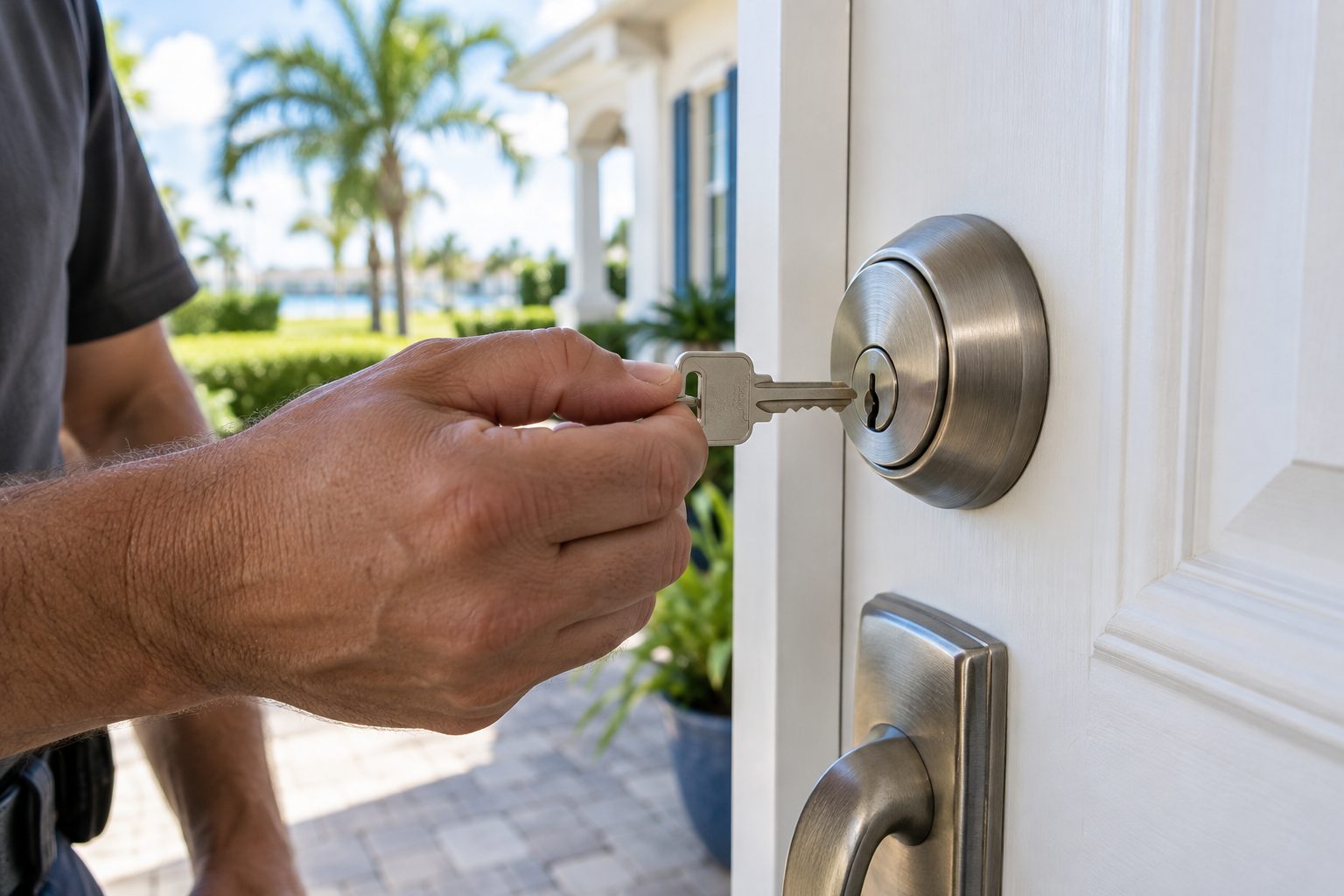
A mobile locksmith works from a vehicle, usually a van or a similar service vehicle, rather than from a storefront. The vehicle carries the tools, parts and key blanks needed for common jobs, and the technician travels to the customer. For a lockout in a parking lot, a rekey at a house, a broken key in a door or a car key that needs cutting and programming, the work is done where the problem is.
That model fits a metro area like Orlando well. The region is spread out, with neighborhoods, suburbs, apartment communities, resort areas, theme park lots and commercial corridors spread over many miles. People who need a locksmith are often stranded, away from home or at work. A car that will not start in a hotel lot or a front door that will not open in a quiet subdivision is not something you can carry to a shop.
Mobile service has limits, and being honest about them is part of good service. A van cannot carry every part for every vehicle and every lock. Some keys need to be ordered, some high-security systems need specialized equipment, and some jobs need a second visit. A good technician will tell you what can be done at your location and what cannot. This guide describes how the process typically works, so you can recognize a straightforward operation and ask the right questions.
The inside of a locksmith's vehicle is organized like a small workshop. There are drawers of lock cylinders, deadbolts, knobs, levers and strike plates in common finishes, and key blanks for a wide range of residential and automotive keys. There is a key cutting machine, often powered from the vehicle, for cutting keys on site, and tools for rekeying cylinders, which include pin kits, plug followers and key gauges.
For vehicles, the van typically carries programming equipment that communicates with a car's computer to add or remove keys, along with transponder chips, remote shells and fob blanks. The exact range depends on the technician and the focus of the business. Some work mainly on homes and businesses, others mainly on cars, and many do both. Ask about your specific vehicle or lock type when you call.
There is also the less visible equipment: a computer or tablet with key and code reference data, a phone for communication, a payment terminal, safety gear such as gloves and eye protection, and paperwork for identification and authorization. Mobile locksmiths do not carry everything, and they will not have every possible part. Parts for an unusual lock or a particular car may have to be sourced, which is why the first phone call matters: the more accurately you describe the lock or vehicle, the better prepared the technician can be.
Service starts with a phone call, and that call does real work. The person who answers will ask where you are, what has happened, and what lock or vehicle is involved. For a house or a business, they will want to know the type of door and lock if you can describe it, whether anyone is inside, and whether there is any danger. For a car, they will ask the make, model and year, whether you have any key, and whether the vehicle has a push-button start.
These are not formalities. The answers shape what the technician brings and how long the job is likely to take. A key for one vehicle is very different from a key for another, and a house deadbolt differs from a commercial lock. If you give accurate information at this stage, the visit is smoother, and the quote you receive is more reliable.
You will also be asked for your name, a callback number and a safe location. If anything makes you feel unsafe, such as a suspicion that someone is nearby or inside, tell the call-taker. In an emergency involving injury, fire or a person at risk, call 911 first. A locksmith is not an emergency service, and the first call in an emergency belongs to the people who are. For tips on assessing whether a company is real, see how to choose a locksmith and how to spot locksmith scams.
A reputable service gives you a quote on the phone, before anyone is dispatched. Quotes are given by phone only, not in advertisements, not in articles and not in text on a website. The reason is simple: the cost of a job depends on details that need to be discussed, such as the type of lock, the number of locks, the vehicle, the condition of the hardware and the time and place of the visit. A single advertised figure cannot cover those differences honestly.
There is a service call charge for the technician to travel and attend. It is explained on the phone before dispatch, so you know what it is and what it covers before you agree. Simple jobs can often be quoted completely on the phone. Complicated jobs may need an on-site look before a firm quote can be given, and in that case the technician will explain what they see, what the options are and what each would involve before any work starts.
You are entitled to ask questions and to say no. If the quote changes dramatically when the technician arrives, without a clear reason, you can decline and the service call charge you were told about still applies, but you are not obliged to proceed with the work. For a more detailed explanation, see how a phone quote works. And be wary of any company that refuses to discuss cost on the phone or that will only say that the price depends and will be explained when they arrive.
Once you agree to the quote and the service call charge, the job is dispatched. Depending on how a business is organized, the call-taker may be the technician themselves, or an office that passes the job to a technician. You should be told the name of the business and, where possible, the name of the technician or a way to confirm who is coming.
We do not promise arrival windows. Travel in the Orlando area depends on distance, traffic, weather, the technician's current job and many other factors, and a promise we cannot keep would not help you. What we will do is tell you what we know, keep you informed if something changes, and be honest if we cannot help. If you need to be somewhere, say so on the call, and we will talk through the options, including whether another approach would serve you better.
While you wait, stay in a safe, visible place. If you are in a car or on a street, stay where there are people and light. If you are at home, keep your phone near. The technician may call from the road to confirm the address. Be wary of anyone who arrives unannounced and says they were sent. Confirm that they are who you called by asking for the business name and the name you were given on the phone.
When a technician arrives, expect to be asked for proof that you have the right to have the lock opened or changed. For a home, that may be a driver license or other identification showing your address, a utility bill, a lease or a piece of mail. For a car, it is typically a driver license plus the registration or the title or insurance card showing your name and the vehicle. For a business, it may be a business license, a lease or an authorization from the owner or manager.
This is a good sign, not an obstacle. A technician who opens a door without asking who you are is taking a risk and is putting you at risk, because a lock could be opened for the wrong person. Ownership checks are part of how the trade protects customers. If you cannot show proof on the spot, tell the technician honestly, and ask what other options exist. Do not be offended by the question. Be wary of anyone who skips it.
In turn, you can ask the technician for their identification and the business name. Check that the vehicle and the person match what you were told. You may photograph the vehicle or note the plate if it makes you more comfortable. Verifying credentials is something readers should do for any trade, and a reputable technician expects it. We make no claims here about licensing or other credentials of any company, and we encourage you to check with the relevant authorities and ask directly.
Once identity and ownership are confirmed, the technician assesses the situation and confirms the plan and the quote before starting. For a lockout, they work to open the door or vehicle with the least damage possible. We do not publish lock-opening instructions, and the methods used are a matter of professional training. For a rekey, they remove the cylinder, change the internal pins, cut new keys to match and test them. For a lock replacement, they remove the old hardware, fit the new lock, check the strike plate and test the operation. For a car key, they cut or program a key blank and test it in the ignition and doors.
A good technician explains what they are doing in plain terms and shows you what they find. They will point out worn parts, loose frames, misaligned strike plates and other issues that affect the work. If they find something that changes the plan, such as a damaged door, a rotted frame or a part that does not fit, they stop and talk to you before going further.
You are welcome to watch. Ask questions. Test the lock or key yourself before the technician leaves. Make sure every key works, in every lock, from both sides if applicable. Make sure the door closes and latches smoothly. For cars, test the remote functions, the doors and the ignition. It is far easier to fix a problem while the technician is there than after they have left.
At the end of the job, you will be asked to pay what was agreed. The amount should match the quote that was explained to you, with any change discussed and approved before the work was done. Ask for an itemized receipt showing the business name, the date, the work done and the amount. Keep it. It may matter for insurance, for a landlord, or for any problem that arises later.
Ask how payment can be made before the visit, since methods differ between businesses. Do not hand over payment before the work is done and tested, unless you agreed to a deposit for a custom-ordered part, and make sure the deposit terms are clear. We make no statement here about warranty terms on any work, and you should ask the business directly what, if anything, applies to your job, and get it in writing.
If you are unhappy with the work or the bill, say so politely at the time and ask the technician to explain. If you cannot resolve it, contact the business afterwards and, if necessary, your card issuer or local consumer protection office. Honest businesses prefer to hear about a problem and fix it. Keeping a record of the call, the quote and the receipt makes any later conversation easier.
Not every job finishes on the first visit. A car key for a less common model may need a part to be ordered. A high-security lock may require a key blank that is not stocked and must come from a supplier. A damaged frame may need a carpenter, and a safe may need specialized equipment. A technician who tells you this at the outset is being straightforward.
When a second visit is needed, ask what it involves, what it will take and what it will cost, in advance. Ask whether the first visit's service call charge is separate. Ask whether the lock will be secure in the meantime. If you cannot leave a door unsecured, the technician may fit a temporary solution, or advise you on short-term measures such as using a different door.
For vehicles, a second visit often involves programming a key after it arrives. Keep your paperwork handy. For commercial customers, a second visit may involve scheduling around business hours. Explain constraints on the call. Our service pages, such as emergency locksmith, residential locksmith and automotive locksmith, describe the types of work in more detail.
A few minutes of preparation help. Have your identification and proof of ownership ready. For a car, find the registration or insurance card and know the make, model and year. For a home, know what type of lock and door you have, and how many locks are involved. If you have photos of the lock, keep them handy. Move vehicles or items that block access to the door.
Know what you want. Do you need just a way in, or also a new key, a rekey or a better lock? Say so. If you are a tenant, find out whether you are allowed to change locks and who needs to approve. If the building has a manager, let them know a technician is coming. If you are at a business, have the owner or manager available.
Finally, keep your phone on and answer unknown numbers for a short while, since the technician may call. When you are ready, call, describe your situation and ask whatever questions you have. We will explain how the visit works, give a quote by phone and answer honestly. Call whenever you want to talk it through.
Typically lock cylinders, deadbolts, handles, strike plates, key blanks, a key cutting machine, rekeying tools and, for vehicles, programming equipment and transponder chips. The exact range varies, and no van carries everything, so describing your lock or vehicle accurately on the phone helps the technician prepare.
Because opening or changing a lock for the wrong person can cause real harm. A technician should ask for proof that you own or are entitled to access the property or vehicle, such as an ID with your address, a registration or a lease. It protects you, and a company that skips it is a concern.
The cost of a job depends on details such as the lock type, the number of locks, the vehicle and the situation. We discuss those on the phone and explain the service call charge before dispatch. Complicated jobs may need an on-site visit before a firm quote can be given.
No. Travel depends on distance, traffic, weather and the technician's other work, so any promise we made would be unreliable. We tell you what we know, keep you informed if anything changes, and are honest if we cannot help. If you have a deadline, say so on the call.
Some jobs need a part ordered, a key blank from a supplier or another trade such as a carpenter. The technician should tell you this early, explain what the second visit involves and what it costs, and suggest how to keep the property secure in the meantime.
Your location, what happened, the type of lock or the vehicle make, model and year, whether anyone is inside, and a callback number. Have identification and proof of ownership ready for the visit. Call when you are ready and we will walk you through how it works.
Describe the situation by phone and we will tell you what the job involves. Quotes are given by phone. Jobs that cannot be quoted without seeing them need a technician on site, and the service call charge is explained on the phone before anyone is dispatched.