A front door on a house gets used a handful of times a day. A front door on a storefront gets used hundreds of times before lunch. Commercial hardware doesn't wear out on a calendar, it wears out on a cycle count, and a door that's three years old with heavy foot traffic can be more worn than a house door three decades older. That single difference reshapes almost everything about how this category of work gets approached.
Call (407) 792-1378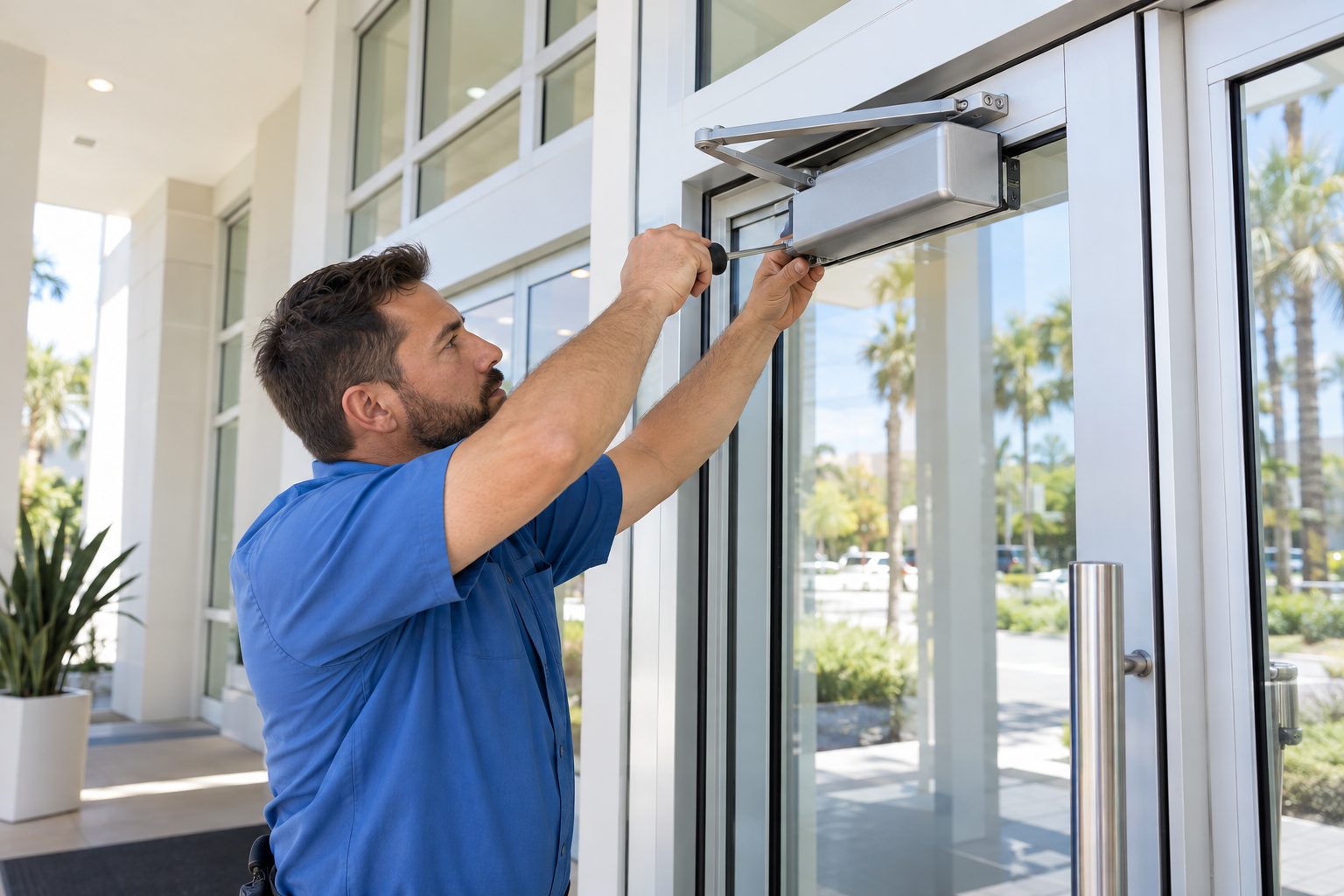
It also has to answer to people who aren't the business owner at all: a fire marshal, an insurer, a landlord. A fire marshal cares whether the door can be exited without a key, full stop. An insurer cares whether key control was ever actually documented. A landlord cares whether whatever gets installed matches the terms of the lease. Getting locked out of a break room is the least complicated problem a commercial door presents.
Life-safety code is blunt about one thing: a person inside a building has to be able to get out without a key, a code, or a tool, every single time, regardless of what's locked from the outside. That's the entire reason panic bars and push bars exist on doors that would otherwise use a standard deadbolt. It's also the first thing checked on a walkthrough, because a door that satisfies an owner's preference for security but fails this test isn't a security upgrade, it's a liability the business is carrying whether or not anyone's noticed yet.
A closer arm gets bent by a delivery cart wedging the door open. A panic bar's internal mechanism wears from thousands of pushes, not from age sitting idle. A storefront door's pivot hinges sag under repeated daily traffic until the door drags across the threshold and the deadlatch stops striking cleanly, at which point the lock gets blamed for a problem that's actually the door. None of these failures follow a calendar-based maintenance schedule. They follow one tied to use, which is why a busy retail entrance and a rarely opened back-office door age at completely different rates even when the hardware is identical.
Staff turnover is constant in most commercial settings, and every employee who leaves without turning in a key is a small, unresolved question about who can still get in. A master key system built with a real hierarchy, grand master, master, sub-master, change keys, solves this by controlling access at any level without rekeying the entire building every time someone quits. Without that structure, a business either rekeys constantly out of nervousness or slowly loses track of who holds what, and an insurer reviewing a claim after a loss will ask exactly that question.
A commercial lease usually says something about what hardware can be installed and whether it reverts to building-standard at move-out. An insurance policy may condition coverage on documented key control. A fire inspection walks the exits specifically, confirming panic hardware dogs correctly, that nothing requires a key from the inside, and that closers aren't propped open or disabled. None of these three parties cares about the same thing a business owner cares about day to day, and satisfying all of them at once is a large part of what this category of work is actually for.
Some of this is straightforward hardware service, rekeying after an employee leaves, repairing a storefront door that's started to drag, replacing a closer that's leaking oil instead of just tuning one. Some of it is a broader look at the property: walking every door, checking who holds keys to what, and flagging what's likely to fail first before it becomes a fire-code citation or an insurance problem. That broader look is its own service for exactly that reason, it's a different conversation than fixing one door.
Commercial hardware fails on a schedule set by how the door gets used, not by how long ago it was installed. Call (407) 792-1378 to talk through what's actually happening at the door, a dragging storefront entrance, a closer that's leaking, a key that's unaccounted for, or a full walkthrough before an inspection catches it first.
No, not in a way that requires a key or a code to exit. That's the entire point of the hardware, and it's checked on any fire inspection.
Either, depending on the key structure already in place. A property with a master key system can often have one door or one key level rekeyed without touching the rest.
Searching locksmith near me in Orlando for a house lockout? We are mobile across metro Orlando and quote the price before we come out. Call (407) 792-1378.
ZIP codes we cover in Orlando: 32801, 32803, 32804, 32805, 32806, 32807, 32808, 32809, 32810, 32811, 32812, 32814, 32817, 32818, 32819, 32820, 32821, 32822, 32824, 32825. City services: Orlando Official Website.