Most break-ins into a commercial space don't involve picking a lock. They involve a door that was already easier to get through than anyone realized, propped for a delivery and never checked again, a strike plate biting into softwood trim instead of the frame behind it, a key that left the building on a departed employee's ring eighteen months ago and was never followed up on. A commercial security assessment is a walkthrough built to find those specific things before they get found the hard way.
Call (407) 792-1378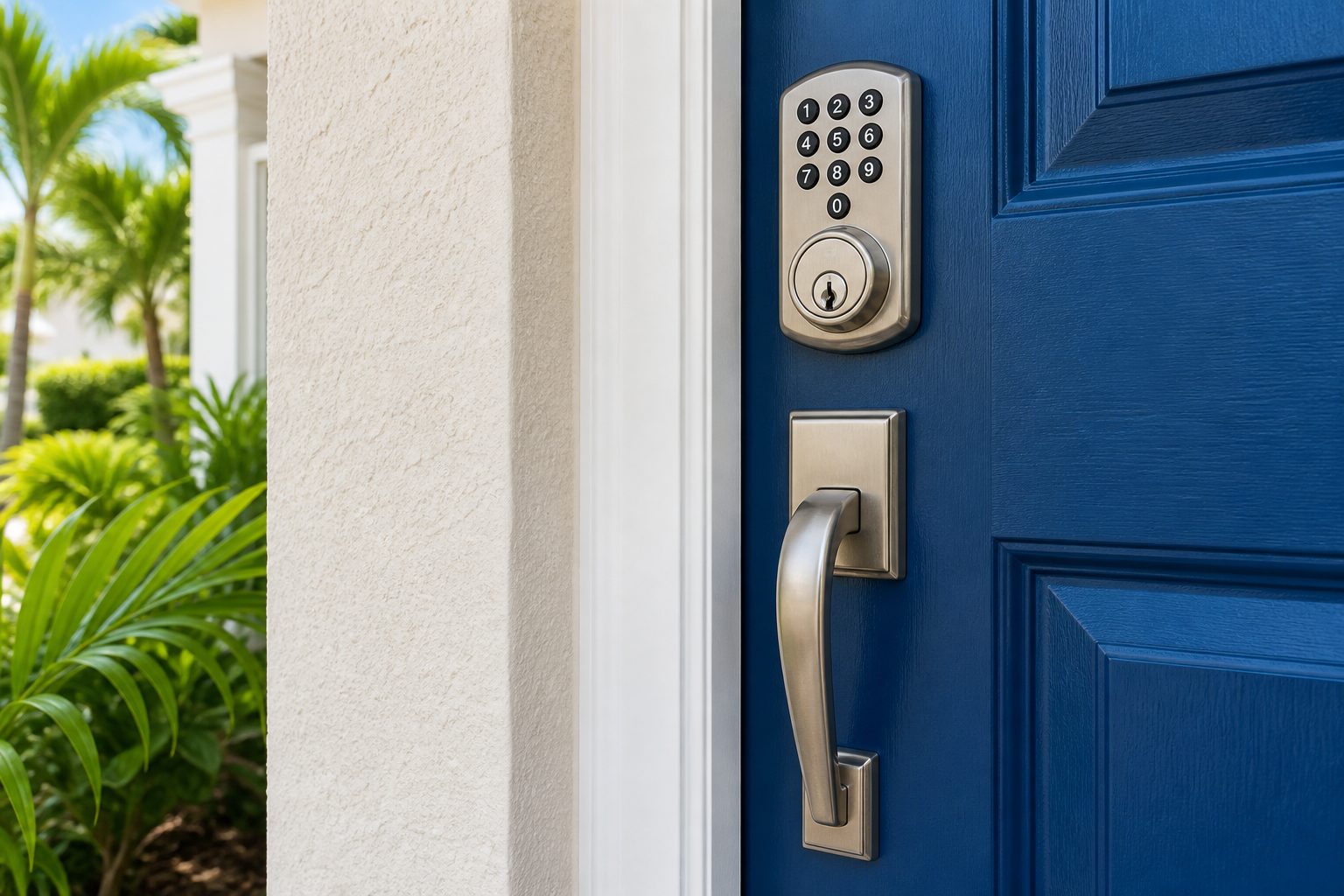
This is a door-by-door look at the physical hardware and who holds keys to it, not cameras, not alarm systems, not monitoring of any kind. Every finding is something you could, in principle, walk up and touch: a hinge, a strike screw, a key that's unaccounted for.
A back door wedged open for a delivery, a smoke break, or airflow on a hot day stops functioning as a locked door the moment it's propped, no matter how good the lock on it is. The habit tends to be invisible to whoever's inside it every day, it's just how that door has always worked during the shift, which is exactly why an outside walkthrough catches it and daily routine doesn't. A propped exterior door is consistently one of the first things flagged on a walkthrough, because it's one of the fastest to fix and one of the most overlooked.
Every business with any staff turnover accumulates keys it's lost track of, a former employee who never returned one, a vendor who was issued a copy for a one-time job years ago, a duplicate cut off a duplicate with no record of who has it now. None of that shows up by looking at the lock itself; it only surfaces by asking who currently holds a working key and comparing that against who should. That comparison is often the single most useful part of a walkthrough, because unlike a worn strike plate, it can't be fixed by tightening a screw, it usually points toward a rekey or a documented key structure going forward.
A strike plate is only as strong as what its screws bite into, and a walkthrough regularly finds short screws sunk into softwood trim or a thin metal liner instead of the structural framing behind it. From across the room the door looks secure, the lock throws, the plate is in place, but a shoulder against that door meets almost no resistance at the strike, because the plate can tear free of soft material with far less force than the lock itself was rated to withstand. It's a fix that's usually inexpensive and often gets missed for years because nothing about it looks wrong until it's tested.
A hollow metal door frame can spread at the strike jamb over years of the door being forced, slammed, or simply used at a heavy volume, widening the gap between the door edge and the frame just enough for a prying tool to get purchase where it couldn't before. It's a slow, structural failure rather than a hardware failure, and it's easy to miss because the lock and strike keep functioning normally right up until the gap becomes usable. A walkthrough checks that gap directly, at the jamb, rather than assuming a working deadbolt means a secure frame.
The assessment moves through every exterior door and every interior door that controls access to something worth protecting, stockrooms, server closets, cash-handling areas, checking hardware condition, strike anchoring, frame integrity, and whether the door is currently doing the job it's supposed to do or has quietly stopped. It ends with a straightforward list, ranked by what's most likely to fail first, so decisions about what to fix now versus later are based on what a walkthrough actually found rather than a guess.
The things that fail first on a commercial property are almost always physical and almost always overlooked because they still look fine from a distance. Call (407) 792-1378 to schedule a door-by-door walkthrough of hardware and key control before an inspector, an insurer, or someone less well-intentioned finds the gap first.
← All Commercial Locksmith servicesNo. This is door hardware, frames, and key control only, locks, strikes, hinges, and who holds keys to what. It doesn't touch cameras, alarms, or any kind of monitoring equipment.
It depends on the number of doors and the size of the property, since each one gets checked individually rather than sampled.
Yes, a list of what was found, door by door, so decisions about fixing it can be made with specifics rather than a general sense that something's off.
Most commercial exterior doors in Florida swing outward, which puts the hinges on the outside of the building. On a well-built door that is not a problem, because the hinges have non-removable pins or security studs that keep the door in the frame even if the pins are driven out. On older or cheaper installs, the pins can be tapped out with a screwdriver and a hammer, and the door lifted away from the hinge side while the lock stays perfectly locked.
During a walkthrough we look at every outswing door for three things: whether the hinge pins can be removed from outside, whether the door has hinge studs or a security hinge, and whether the gap along the hinge edge is tight enough to resist prying. When any of those are missing, the fixes are straightforward, such as replacement hinges with non-removable pins or hinge studs added to the existing door.
On an outswing door, the latch or bolt is visible in the gap between the door and the frame from outside. A thin tool slipped into that gap can sometimes push back a spring latch or pry the door far enough to slip the bolt. A latch guard, a steel plate bolted to the outside of the door that covers the gap, removes that opportunity. It is one of the most common recommendations on rear doors of retail and restaurant spaces around Orlando, and it is inexpensive compared to what it protects.
We check whether the lock on each exterior door is a true deadbolt or deadlatch, or only a spring latch that can be slipped. A spring latch alone on an exterior door is a finding worth fixing. A deadlatch with a working guard pin, or a deadbolt, is what should be there.
Aluminum and glass storefront doors are everywhere in Orlando's plazas and office buildings. They look similar from one property to the next, but they have their own weak points. The narrow stile deadlocks used on these doors have a short hook or swing bolt that depends on the door being aligned in its frame. When the pivots wear or the door sags, the bolt only partly engages, and staff get used to pushing the door to make it lock.
A walkthrough on a storefront door checks bolt engagement, the condition of the pivots and closer, whether the cylinder guard ring is present, and whether the door can be pulled open while locked. We also look at how the door is locked at night. Some businesses rely only on the cylinder deadlock, while others add a secondary lock or a security bar. The right choice depends on the business and on what staff will actually use every night.
A door that does not close all the way is not locked, no matter what hardware is on it. Closers wear out, leak oil and lose their adjustment, especially on heavy doors that see many openings a day. The door drifts shut and stops an inch short of latching. Staff walking out the back at close rarely look back to check.
Part of the walkthrough is simply opening each exterior door and letting it close on its own, then checking whether it latches. That test catches more unsecured doors than almost anything else. A closer adjustment or replacement is usually a small job with a large effect.
Security and safe exit have to work together. Exit doors need to open from the inside so people can get out in a fire or other emergency, and a security fix that blocks that is not a fix. We will not recommend chaining an exit, padlocking a panic bar or adding a lock that requires a key to leave. When a rear exit is a security concern, the answer is hardware that still opens easily from inside while being hard to open from outside: a proper exit device with a guarded outside trim, a latch guard, or an alarmed exit that sounds when opened.
If you are not sure what your local fire marshal requires for a particular door, ask them before making changes. We can install and adjust the hardware once the requirement is clear.
Warehouses, auto shops and contractor yards around Orlando depend on roll-up doors, chain link gates and outdoor containers. These are often secured with padlocks that are years old and a mixture of keys nobody fully tracks. A walkthrough covers:
Outdoor hardware in Central Florida weathers fast. Rust at the shackle, seized keyways and thinning chain links show up often, and the walkthrough flags hardware that is near failure before it gives out.
The perimeter gets most of the attention, but many losses happen from inside. Cash offices, safes, medication rooms, IT closets, records rooms and stock cages all deserve their own look. Common findings include an office door locked with a basic privacy lever that opens with a coin, a server closet with no lock at all, a key to the safe room hanging on a hook next to the door and a stock cage with a padlock whose key is on every employee's ring.
For these areas, we check the grade of the lock, whether it locks automatically when the door closes, and who has the key. An automatic locking function matters in busy workplaces, because a room that has to be locked by hand will be left open.
Some moments are especially good times for an assessment:
A walkthrough goes faster and finds more when the right person is on site and a few things are gathered in advance. Have a floor plan or a simple sketch showing every exterior door. Pull together any key log or list of key holders, even an incomplete one. Collect spare keys and any keys whose purpose is unknown. And schedule the visit when a manager can walk the space with us and answer questions about how each door is actually used during a shift. The way staff really use doors, which ones get propped, which ones are the smoke break door, which one the delivery driver uses, is often more important than the hardware itself.
The finished list ranks findings from most urgent to least. Some items take minutes to fix, such as a closer adjustment or longer strike screws. Others take planning, such as moving to a master key system or replacing a worn storefront deadlock. You decide what to do and when. We can handle any of the hardware work on the list, and many businesses choose to fix the urgent items the same week and schedule the rest. If the key control findings point toward a new structure, our master key systems and business lock rekey pages describe the next steps.
More Orlando businesses now use keypad locks, card readers or app-controlled locks on at least one door. The walkthrough is not an audit of those systems, but it does look at the physical side of them. Every electronic lock needs a way in when power or batteries fail, and that override is usually a plain mechanical cylinder. We check whether anyone knows where the override key is, whether the override cylinder has been keyed to the rest of the building, and whether the keypad codes include ones that belong to former staff. A keypad that still accepts a manager's code from two years ago is the electronic version of an unreturned key.
We also check what happens when the lock loses power. Some electric strikes and magnetic locks are set up to unlock on power loss, others to stay locked. Which one is right depends on the door and on exit requirements. The walkthrough notes how each door behaves so the choice is deliberate rather than accidental.
Companies with several sites around Central Florida often find each location has developed its own key habits. One store has a key log and the next has none. One manager rekeys after every departure and another never has. A walkthrough at each site, using the same checklist, gives the owner a consistent picture and makes it easier to set one policy that every location follows. It is also the point where a multi-site key system, where a district manager carries one key that opens every store, starts to make sense.
Every property is different, but some findings come up again and again across Orlando businesses:
None of these require a large budget to fix, which is the point of looking for them.
Many of them can be corrected on the same visit as the walkthrough if you want, since the parts involved, such as longer screws, hinge studs, latch guards and closer adjustments, are small and commonly stocked. Others are better planned, and the list makes that planning straightforward.
Searching locksmith near me in Orlando for a house lockout? We are mobile across metro Orlando and quote the price before we come out. Call (407) 792-1378.
ZIP codes we cover in Orlando: 32801, 32803, 32804, 32805, 32806, 32807, 32808, 32809, 32810, 32811, 32812, 32814, 32817, 32818, 32819, 32820, 32821, 32822, 32824, 32825. City services: Orlando Official Website.