An ignition that fights you is a breakdown in slow motion: the key sticks on Tuesday, needs a wiggle by Friday, and one morning refuses to turn at all. Orlando Mobile Locksmith repairs and replaces ignition lock cylinders at your location, so a car that cannot start never needs a tow to get fixed. We extract stuck and broken keys, rebuild worn cylinders, and match new ones to your existing key. Call (407) 792-1378, seven days a week.
Call (407) 792-1378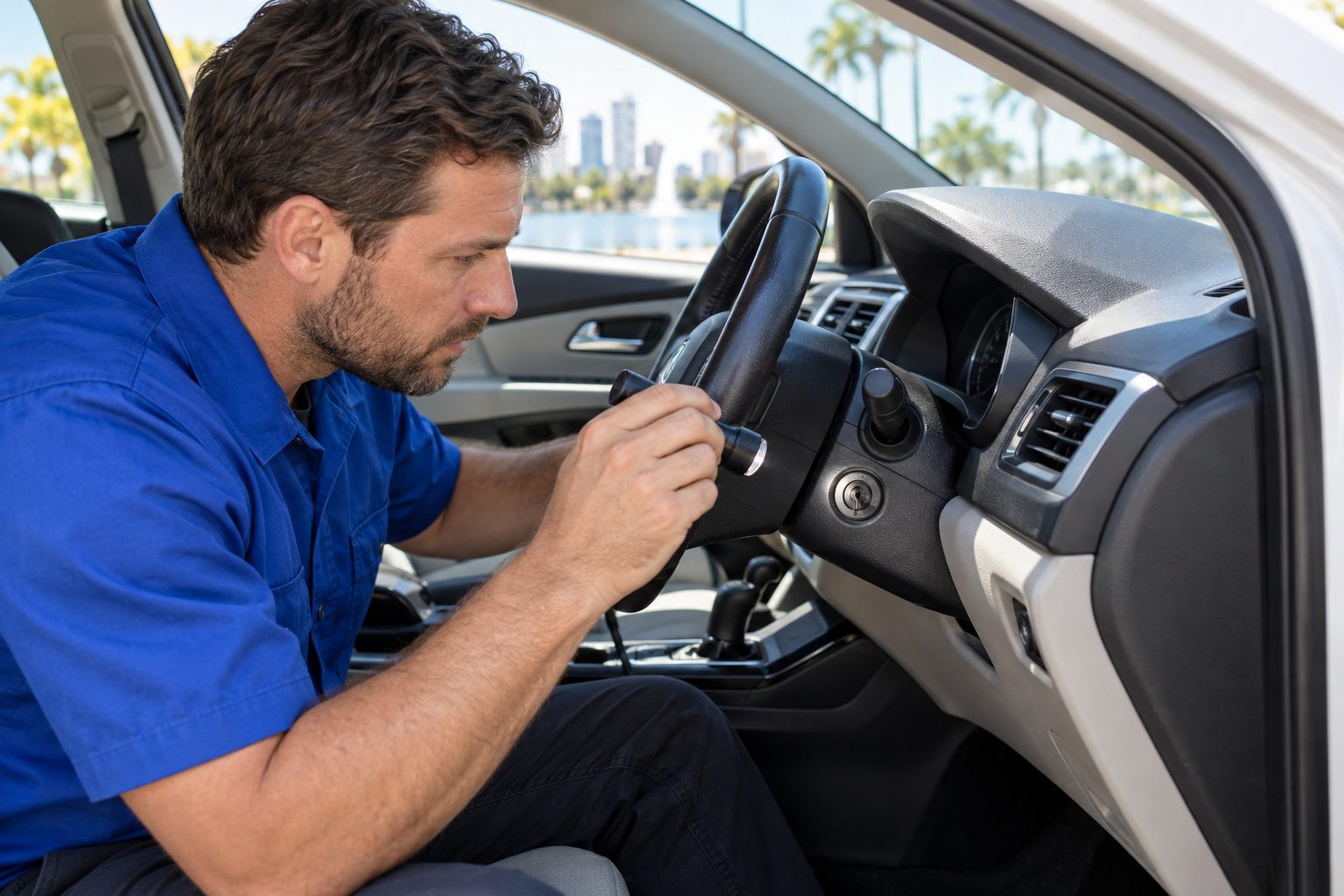
Ignition cylinders almost never die without notice. The early symptoms are easy to dismiss: the key needs a jiggle before it turns, it only cooperates at a certain angle, it catches halfway through the rotation, or it slides in roughly like the keyway is full of grit. Drivers adapt to these quirks for months, developing a personal ritual of wiggles and prayers, and the cylinder keeps wearing the whole time. The end state is a key that will not turn at all, usually in a parking lot, usually when you are already late. Catching it earlier changes everything, because a worn cylinder that still functions can often be serviced or swapped as a planned visit at your home or workplace instead of an emergency in a garage somewhere. There is also a diagnostic layer to this: not every no-start with a key problem is the cylinder. Sometimes the blame belongs to a worn key rather than the lock, a failing ignition switch behind the cylinder, or a steering-column issue. Part of what our technicians do on arrival is figure out which component is actually guilty, so you fix the real problem once instead of the wrong part twice.
A key stuck in the ignition has a few classic causes, and the first checks cost nothing. Steering-wheel lock pressure is the most common: if the wheel was turned as you shut the car off, the column lock binds the cylinder, and gently rocking the wheel while turning the key releases it. An automatic transmission not fully seated in park will also hold the key hostage on many models, as will a dying key-in-ignition sensor. When those simple explanations do not apply, the problem lives inside the cylinder, wafers hung up in the rotated position, debris packed into the keyway, or internal wear that has finally jammed the mechanism. Forcing it is how a stuck key becomes a broken key, and a snapped blade lodged in the ignition is a strictly worse situation, because now nothing turns and there may not be a spare. Our technicians extract broken blades with proper tools that grip the fragment without shoving it deeper, then evaluate whether the cylinder that broke the key needs service itself, since a healthy ignition rarely snaps a healthy key. If the broken piece was your only key, the same van cuts and programs its replacement before leaving.
An ignition cylinder is a precision mechanism that gets operated thousands of times a year, and every insertion drags metal across metal. The wafers inside wear down, the springs fatigue, and the keyway slowly opens up until the fit between key and cylinder gets vague. Heavy keychains accelerate all of it dramatically, a half pound of keys, tags, and souvenirs swinging below the ignition acts as a constant lever on the cylinder every time the car hits a bump, and Orlando drivers rack up plenty of stop-and-go miles for that pendulum to do its damage. Worn keys contribute from the other side, because a rounded, sloppy key beats up wafers with every use, and copies-of-copies made over the years drift further from the original cuts. Age and dust do the rest. High-mileage commuter cars, rideshare vehicles working the tourist corridor, delivery vehicles, and older trucks that have outlived several owners are the usual patients. The practical advice is unglamorous but real: strip the keychain down, retire badly worn keys by having fresh ones cut from code rather than copied, and take changes in how the key feels seriously. When wear has gone too far, that is where we come in.
Once the technician confirms the cylinder is the problem, there are two honest paths. Repair means disassembling the cylinder, cleaning out debris, replacing the worn wafers and springs, and reassembling a mechanism that works like it should, a good option when the housing is sound and wear is concentrated in replaceable parts. Replacement means installing a new cylinder, which is the right call when the old one is damaged, seized, or worn throughout. Here is the detail most people do not expect: a replacement ignition does not have to mean a new key. In many cases we can code the new cylinder to your existing key, so the one key in your pocket keeps operating the doors, trunk, and ignition together instead of the car splitting into a two-key arrangement. That step is easy to skip and annoying to live without, and off-the-shelf cylinder swaps at general repair shops skip it routinely. Where the vehicle design allows, we also preserve your transponder setup, since the chip pairing lives in the key and the immobilizer rather than the mechanical cylinder. You get a straight recommendation on repair versus replacement based on the actual condition of the parts, not a default upsell.
A car with a failed ignition cannot drive itself to the shop, which normally means paying for a tow before anyone even looks at the problem. The mobile model removes that entire step. Our van comes to the car, in your driveway in Winter Park, a hotel parking structure off International Drive, an office park garage in Lake Nona, an apartment lot near UCF, or a vacation-home driveway in Davenport where the family SUV chose the last morning of the trip to quit. The technician diagnoses on the spot, and because the vans carry extraction tools, cylinder stock for common applications, wafers and springs for rebuilds, and full key-cutting and programming equipment, the fix usually happens in the same visit as the diagnosis. Visitors get particular value from this: when a rental or road-trip vehicle refuses to start far from home, sorting it out in the parking lot beats arranging a tow in an unfamiliar city. Locals get their commuter car fixed at work without losing the day. Either way the sequence is the same, call (407) 792-1378, describe the symptoms and the vehicle, tell us exactly where it is parked, and let the problem come to us instead of the other way around.
Rock the steering wheel gently left and right while turning the key, a bound column lock is the most common cause and this releases it. Confirm the transmission is fully in park, and try a spare key if you have one, since worn keys fail before cylinders do. If none of that works, stop forcing it and call us before the key snaps.
Yes. Broken-key extraction is standard work, done with tools that grip the fragment without driving it deeper into the cylinder. Afterward the technician checks why it broke, because a healthy ignition rarely snaps a key, the cylinder may need service too. If that was your only key, we cut and program a replacement in the same visit.
Usually not, and avoiding that is something we specifically do. In many vehicles the new cylinder can be coded to match your existing key, so one key keeps operating the ignition, doors, and trunk together. Generic cylinder swaps often skip this and leave owners carrying two keys, tell us keeping one key matters and we will plan the job that way.
A useful clue is whether the key turns. If the key rotates normally but the car only clicks or stays silent, suspect the battery, starter, or electrical side. If the key physically will not turn or feels rough, sticky, or loose, the lock cylinder side is the likely culprit. Our technician confirms which it is on arrival before any parts are touched.
On most vehicles, no, the transponder pairing lives between the chip in your key and the immobilizer computer, not the mechanical cylinder. When we keep your original key or program a new one properly, the security system carries on as before. If a model does require additional programming after cylinder work, we handle that step on-site as part of the job.
Yes, that is the normal setting for this service, since a car with a dead ignition is stuck wherever it last parked. Garages, office lots, hotel decks near the attractions, and apartment complexes are all fine, we mainly need the vehicle's exact location, including the garage level, and enough room to work around the driver's side.
Searching locksmith near me in Orlando for an ignition problem? We are mobile across metro Orlando and quote the price before we come out. Call (407) 792-1378.
ZIP codes we cover in Orlando: 32801, 32803, 32804, 32805, 32806, 32807, 32808, 32809, 32810, 32811, 32812, 32814, 32817, 32818, 32819, 32820, 32821, 32822, 32824, 32825. City services: Orlando Official Website.