Nobody calls about a pivot hinge. They call because the key is hard to turn, or the door doesn't feel like it's latching, or the deadbolt seems to have gone bad overnight. On an aluminum storefront door, that complaint is right more often than it's wrong about something being broken, and wrong more often than not about what's actually broken. The lock is usually the last part in the chain to fail, not the first, and it's the part that takes the blame because it's the part someone touches with their hand.
Call (407) 792-1378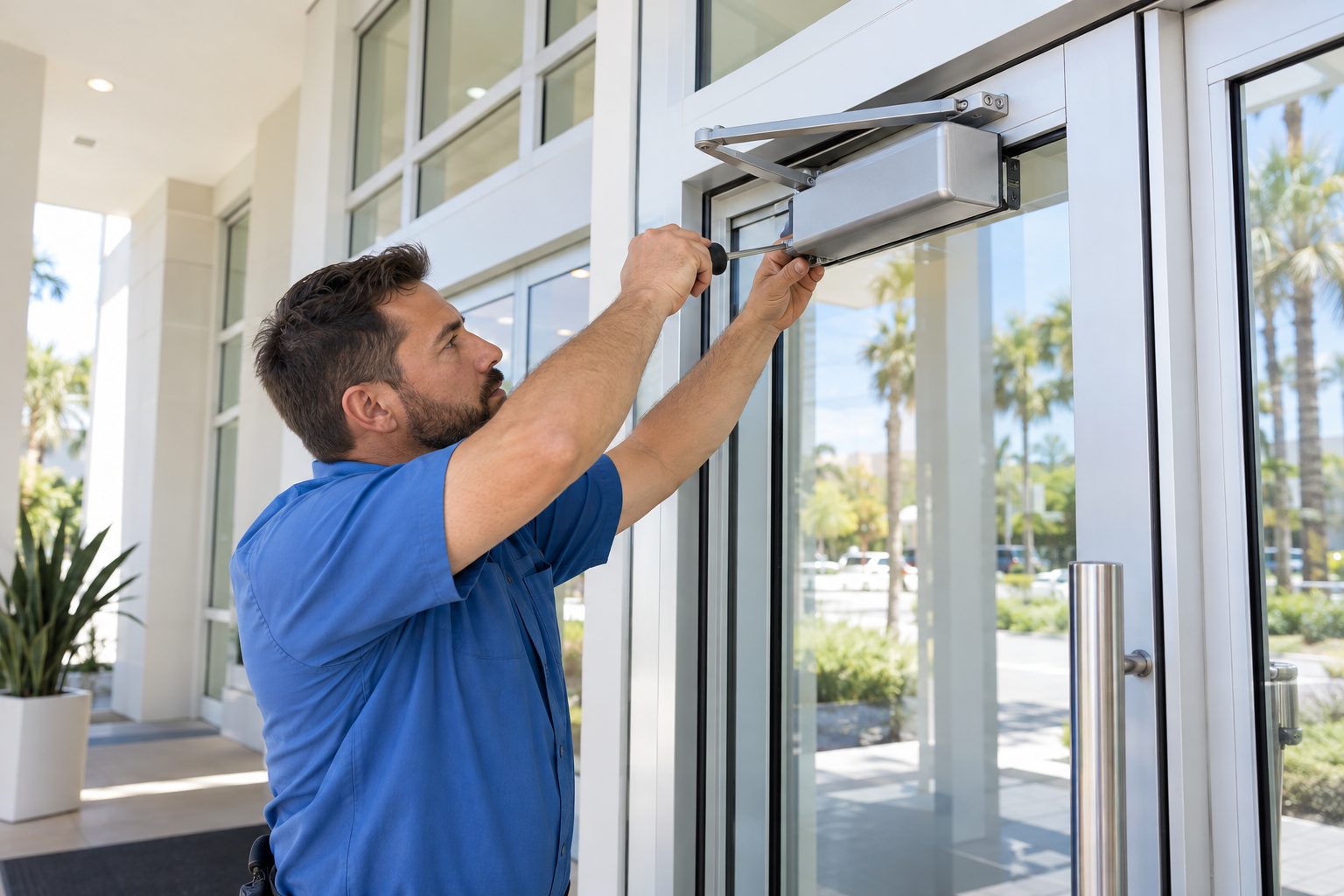
Aluminum storefront doors are heavy, glass, metal stile and rail, a closer fighting gravity every swing, and they hang on two small pivot points that carry all of that weight through thousands of open-close cycles a month. When those pivots wear, the door doesn't fall apart. It sags, a fraction of an inch at a time, until the hardware built to work with a perfectly hung door is suddenly being asked to work with one that isn't.
A deadlatch or mortise lock on a storefront door is built to engage a strike plate mounted at a fixed position in the frame. When the door sags even slightly, that fixed position and the door's actual resting position stop lining up, and the bolt starts catching the edge of the strike instead of sliding cleanly into it. From the customer's side of that interaction, the key feels stiff or the door won't lock, which reads exactly like a failing lock, even when the cylinder inside is in perfect condition.
A storefront door typically hangs on an offset pivot at the top and a floor-mounted pivot at the bottom, rather than the butt hinges used on a standard interior door. Those two points establish the door's exact plane relative to the frame, and any wear at either one, a worn bushing, a loosened set screw, a floor closer spindle that's developed play, lets the door drift out of that plane. The drift shows up as dragging on the threshold, a widening or narrowing gap at the lock jamb, or a door that swings slightly crooked even though nothing about it looks visibly damaged.
The bottom rail takes the kick plates, the delivery carts, the wheelchair footrests, and the general daily contact a storefront door gets that a residential door never sees. Repeated impact there can loosen the rail's internal connection to the stile, which changes how the whole door hangs even when the pivots themselves are fine. It's a separate failure point from pivot wear, but it produces a similar symptom at the lock, misalignment that looks like a bad deadlatch from the outside.
Storefront deadlatches operate on tight tolerances by design, since the auxiliary latch has to clear the strike on every swing without binding. A door that's shifted even a sixteenth of an inch out of position, from pivot wear, from a bottom rail that's loosened, or simply from the frame settling over years, can be enough to turn a smooth latch into one that needs a slam to catch, or one that doesn't catch reliably at all. Adjusting the strike position or shimming the door back into plane usually resolves it without touching the lock hardware itself.
A door that's out of alignment doesn't just affect the lock, the astragal between double doors stops meeting evenly, weatherstripping compresses unevenly along the frame, and a glass panel can develop stress at a corner where the door no longer sits square in its opening. Fixing the geometry at the pivots and rail generally corrects all of it at once, which is usually a better outcome than replacing a lock, an astragal, and a weatherstrip kit separately while the actual cause keeps working against every one of those fixes.
A dragging storefront door is a geometry problem wearing a lock complaint. Call (407) 792-1378 and describe what the door is doing, dragging, hard to lock, uneven gap, and the pivots, rail, and strike get checked before anything gets replaced that didn't need to be.
← All Commercial Locksmith servicesA quick check: lift up gently on the door handle while it's closed. If the door itself moves or the gap at the top changes, that's pivot wear, not a lock problem, even if the lock is what's failing to catch.
Almost always. Pivot adjustment, bottom rail tightening, and strike realignment resolve the large majority of sagging and dragging without any need to replace the door itself.
Temperature swings expand and contract aluminum slightly, and on a door already close to misaligned, that small daily movement is sometimes enough to push it in and out of catching properly.
When the lock really is the problem, it helps to know what is inside an aluminum storefront door, because it is nothing like a house lock. The vertical frame member on the lock side, the stile, is often only a couple of inches wide, so the lock has to fit into a very narrow pocket. That is why storefront doors use a special family of locks:
Because the lock body sits deep inside the door, a worn one is replaced by removing the cylinder and faceplate and sliding the body out of the stile. The door does not have to come down, and the glass is not touched.
Mortise cylinders are held in place by a set screw inside the stile. When that set screw loosens, the whole cylinder can rotate in the door as you turn the key, and the key seems to turn without locking anything. Sometimes the cylinder gets unscrewed a little each day until the cam no longer reaches the lock. That is a quick fix: reseat the cylinder at the correct depth and tighten the set screw. A cylinder that spins after someone tampered with it, though, may have been damaged by a wrench or pliers and should be replaced.
Many older storefronts have a key cylinder on both sides of the door, so staff need a key to get out after hours. That setup is a problem while people are inside, because anyone needing to leave in a hurry has to find the key first. Most business owners are better served by a thumb turn inside, or by a separate exit device that allows people to leave with one push while the outside stays locked. Your local fire marshal and building department are the authorities on what a specific occupancy requires, and it is worth asking them before you change how a public door locks. From the hardware side, we can set up the door the way they require.
Busy storefronts, restaurants and assembly spaces often use exit devices, commonly called push bars or panic bars, rather than a deadlock. On narrow stile doors these come in a few forms: rim devices that latch onto a strike on the frame, concealed vertical rod devices that latch into the top of the frame and the floor, and devices that work together with a pair of doors. They wear in ways a deadlock does not. Rods go out of adjustment, top latches stop catching, and the bar itself can crack after years of hard use.
Many exit devices can be held in the unlatched position during business hours, a feature called dogging, usually set with a hex key or a cylinder. It is convenient, but staff sometimes forget to undog the door at closing, leaving it unlatched overnight. If your device is often left dogged, a cylinder dogging option, which needs a key to set and release, or a closing checklist posted near the door, helps. We can also adjust or replace worn rods and latches so the door latches every time it closes.
For a storefront door that sees very heavy traffic, and whose pivots keep wearing out, a continuous hinge is worth considering. Instead of carrying the door's weight on two small points, a continuous hinge runs the full height of the door and spreads the load along its whole length. Geared continuous hinges are common on busy commercial doors because they resist sagging for far longer. Changing from pivots to a continuous hinge is more involved than adjusting a pivot, and not every door and frame is a candidate, but on the right door it can end repeated sagging complaints.
Glass storefronts will never be as hard to breach as a solid steel door, but the lock can be made much harder to attack. Common upgrades include:
Security film on the glass and a monitored alarm are outside our work, but they complement a well set up lock and are worth discussing with those providers.
If your business has been broken into, call the police first and let them document the scene. Take your own photos for insurance. Then the priorities are securing the building and getting open again. In practice, that often means several trades on the same day: a glass company to replace or board up broken glass, and a locksmith to deal with the lock, the cylinder, the strike and the door alignment. If the door frame was pried, the strike and the frame may be bent. We can replace damaged cylinders and lock bodies, straighten or replace strikes, and rekey every lock on the property if any keys were taken or may have been copied. Telling us about any damage to the glass or frame when you call helps us plan around the glass company's schedule.
In shopping centers and strip plazas, responsibility for the storefront door is often split between landlord and tenant. Some leases put the entire storefront, including the door and hardware, on the tenant. Others keep the structure and the frame with the landlord and leave the lock and keys to the tenant. Check your lease or ask your property manager before authorizing major work, especially anything beyond a lock, such as pivots, rails or door replacement. It avoids disputes later about who should have paid.
Staff who lock up every night are the first people to notice a door that is getting worse. A simple routine at closing helps catch trouble early:
When a problem is reported early, the fix is usually a simple adjustment scheduled during business hours instead of an emergency visit at closing.
Photos help a great deal with storefront doors. A photo of the whole door from inside and out, a close photo of the lock and cylinder, a photo of the edge of the door with the lock faceplate, and a photo of the top and bottom pivot areas let us see the brand and style of hardware and bring the right parts. Tell us whether it is a single door or a pair, whether it has a push bar or a deadlock, and when the problem started. If it started after an impact, a storm or an attempted break-in, mention that too.
The bottom of a storefront door gets less attention than the lock, but it causes its share of complaints. Thresholds in busy entries get worn, dented by carts and loosened by cleaning machines. A door sweep or bottom seal that has torn or come loose can drag, catch or leave a gap that lets in rain from afternoon storms and invites insects. When a door starts scraping the threshold, the cause may be a worn sweep, a raised threshold, a failing bottom pivot or a sagging door, and each needs a different fix. Replacing a sweep is simple. Resetting a threshold that has lifted is also straightforward once the cause is clear. The important thing is not to trim the door or grind the threshold to stop a scrape before finding out why it started, because that often hides a pivot problem that keeps getting worse.
Many businesses have a storefront door plus a rear service door, an office door and sometimes a stock room. Keeping those on a sensible key plan makes daily operations easier. A common setup puts the front and rear doors on the same key for managers, the office and stock room on separate keys, and the owner's key on a master that opens everything. When a storefront cylinder is replaced during a repair, it is a good moment to fit it into that plan, rather than leaving it on a random key that adds one more to the ring. In multi-tenant centers, check whether the landlord needs the storefront on a building master for emergency access before changing the key.
Searching locksmith near me in Orlando for a house lockout? We are mobile across metro Orlando and quote the price before we come out. Call (407) 792-1378.
ZIP codes we cover in Orlando: 32801, 32803, 32804, 32805, 32806, 32807, 32808, 32809, 32810, 32811, 32812, 32814, 32817, 32818, 32819, 32820, 32821, 32822, 32824, 32825. City services: Orlando Official Website.