Past the point where sidewalks stop, Wedgefield spreads out into roughly one-acre lots bounded by SR 528 and SR 520, with conservation land pressing in on most sides. Just over eight thousand people live here, spread across nearly three thousand houses that each sit on enough ground to need more than a front-door lock. There's no downtown here in the way most of the cities on our list have one -- Wedgefield is residential land, full stop.
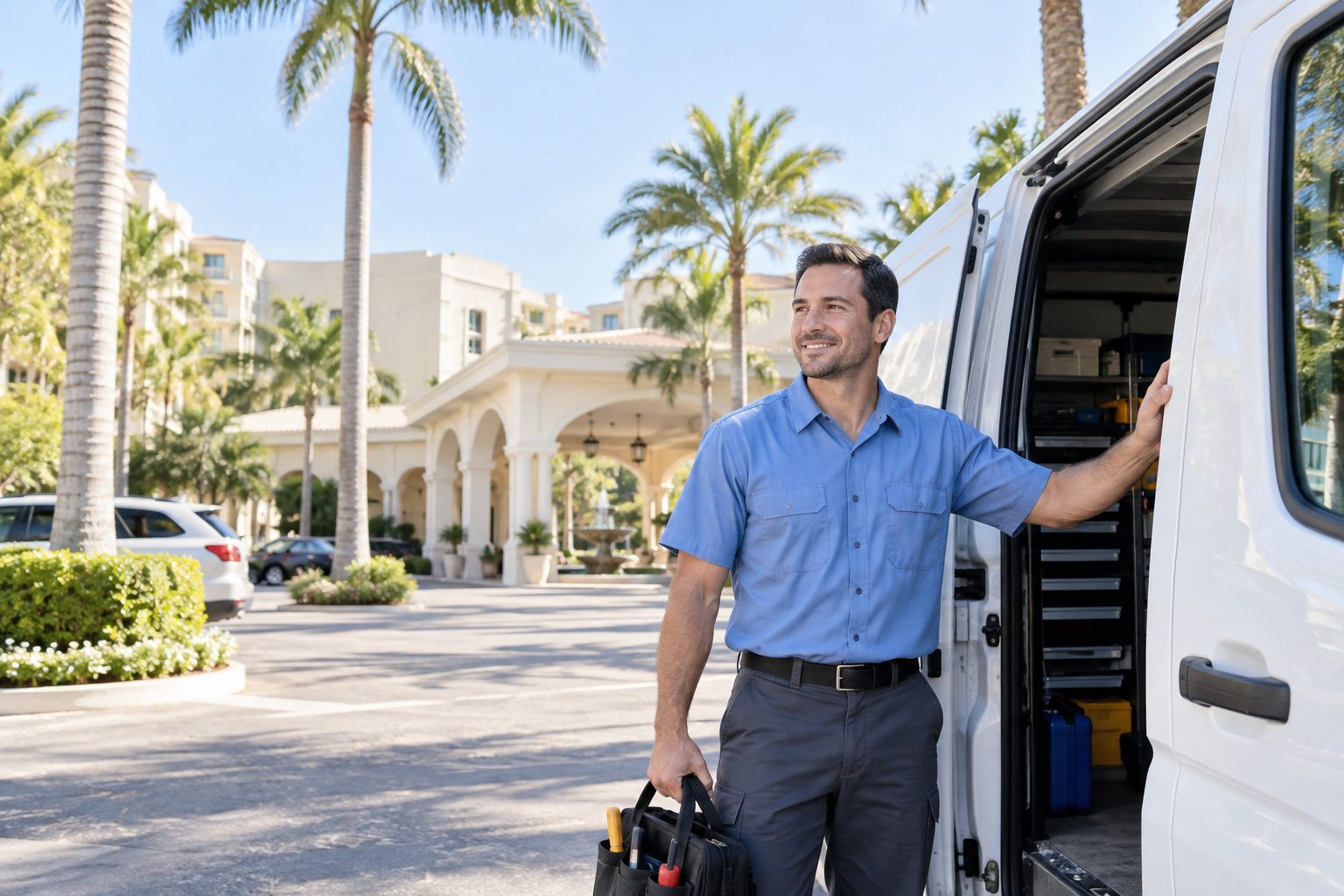
A property this size usually comes with a gate at the road, an outbuilding or two, maybe a pump house for a well, and a driveway long enough that a locked-out homeowner can't just walk to a neighbor's to borrow a phone. The work follows the land out here -- it's rarely only one door, and it's rarely a quick in-and-out the way a townhome lockout tends to be.
A locked gate at the road is often the first obstacle on a Wedgefield property, well before anyone reaches the house itself. Padlocks, keypad gate locks and chain-and-lock setups all show up out here, and getting through one is frequently a separate job from whatever's happening at the front door.
A gate lockout also changes how the visit starts. We're often working from the road inward -- clearing the gate first, then driving the length of the property to reach the house -- rather than pulling straight up to a front door the way most calls in town go.
Acre lots come with more than one structure to secure -- a shed, a barn, a detached garage, sometimes all three on the same property. Each tends to carry whatever lock was on hand when it was built, which means a Wedgefield property can have four or five different lock types across its buildings by the time we get the call.
Properties out here that aren't on municipal water rely on a well, and the pump house or equipment shed that goes with it usually gets locked separately from everything else on the lot. It's a small structure but an important one to keep secured, and it's easy to overlook until the lock seizes or the key goes missing entirely.
A seized padlock on a pump house is more than an inconvenience when the well is the only water source on the property. We treat that kind of call with the same priority as a house lockout, not as an afterthought behind it.
Being locked out on an acre lot surrounded by conservation land is a different situation than a driveway lockout in a subdivision. There's no quick walk to a neighbor, cell service isn't always reliable this far out, and the nearest hardware store is a real drive, not a five-minute errand. Bringing the right tools in one trip matters more here than almost anywhere else we cover.
Wedgefield's roads don't always match how a GPS pin lands on a map. A house set several hundred feet back from the road, behind a tree line or a gate, can be easy to drive past even with an address in hand. We factor that into how a rural call gets scheduled -- confirming the gate, the driveway, and which structure the lock trouble is actually at before we're on the way.
Wedgefield's commercial side is limited enough that most calls here are residential -- houses, gates and outbuildings rather than storefronts or offices. That keeps the work fairly consistent: one property, several structures, and whatever mix of locks accumulated across all of them over the years.
There's no strip mall or office park pulling a different kind of traffic through Wedgefield the way there is in most of the other places we cover. What comes up here comes up because someone owns land, not because a business opened a storefront.
We cover the single Wedgefield ZIP code, from the SR 528 side of the community to SR 520, including the acreage bordering conservation land.
Acreage, conservation land on most sides and real distance from the nearest hardware store all shape what a locksmith call looks like in Wedgefield. Gate, shed, pump house or front door, whatever structure on the property needs attention, call (407) 792-1378.
By the time a Wedgefield property has been through a few owners, it can carry a front door key, a back door key, a gate padlock key, a barn key, a shed key and a pump house key, none of them labeled. Consolidating that mess is one of the most useful jobs on a rural lot. Door locks on the house and detached garage can be rekeyed to one key. Many major padlock brands can be ordered keyed alike or rekeyed to match each other, and some can be set to use the same key as the house.
Not every owner wants everything on one key. A common compromise is two keys: one for the house and garage that only the family carries, and one for the gate, sheds and pump house that can be given to a farrier, a pool technician, a well service company or a neighbor who feeds animals. That way the outside key can be handed out without also handing over the house.
Many Wedgefield gates are manual with a chain and padlock, but more properties now use electric gate operators with a keypad at the road and remotes in the cars. Those systems add convenience and new failure points. A lightning strike during a summer storm can damage a keypad or the operator's control board. A solar-powered operator can run low after a stretch of cloudy weather. A remote battery dies, or a keypad code gets shared more widely than intended.
Every electric gate has a manual release so it can be opened by hand when power fails. Owners should know where theirs is and how it works, and keep the release key somewhere other than inside the house. If you are locked out at the gate with the power off, knowing that detail saves a lot of time. We handle the lock side of gates: padlocks, keyed gate latches, keypad lock hardware and the manual release lock. Motor, wiring and control board repairs belong to a gate operator technician.
Some Wedgefield lots keep horses or other livestock, and the tack room is often the most valuable room on the property after the house. Saddles and gear are easy to carry off and hard to trace. A solid tack room door with a real deadbolt, rather than a slide bolt and a padlock, makes a meaningful difference. If the tack room is inside a pole barn with thin siding, reinforcing the door frame and using a hasp mounted with through-bolts helps keep the lock from simply being pried out of the wall.
Feed rooms have a different goal. The lock there mainly keeps animals and pests out and keeps feed secure from weather. A keyed latch or a padlock on the outside key works well. Barn doors on rollers need a lock designed for sliding doors, such as a latch that pins the door to the track or a hasp that bridges the gap between the door and the wall.
With the St. Johns River, Lake Poinsett and the coast within driving distance, plenty of Wedgefield households keep a boat, a horse trailer, a utility trailer or an RV on the property. Those are easy targets because a trailer can be hitched and gone in minutes. A coupler lock that blocks the hitch, a wheel lock or boot, and a sturdy chain through the wheel to a fixed post all make that harder. Keying the coupler lock to your outbuilding key keeps the ring manageable.
RVs and camper doors use their own locks, and many older models share a small number of common keys. Replacing the entry lock and compartment locks on an RV with a different keyway is a reasonable step when you buy a used one.
Most Wedgefield homes have a mailbox at the road, often far from the house. A locking curbside mailbox with a slot for incoming mail keeps letters and checks out of casual reach. For packages, a lockable delivery box near the gate or at the house, depending on how far carriers are willing to drive in, helps with the long gap between the road and the front door. If a mailbox key goes missing, the lock on a residential locking box can usually be replaced without replacing the whole box.
Rural homeowners often keep a safe for firearms, documents or valuables. The most common safe problems are a forgotten combination, a dead keypad battery, or a keypad that fails after humidity gets inside. Many electronic safes have a keyed override hidden behind a panel, and keeping that key somewhere other than inside the safe solves most battery problems. If a safe will not open with the correct code, it is better to call than to keep trying, since repeated wrong entries can trigger a lockout period on many models. Proof of ownership is needed before a safe is opened.
Wedgefield sits between two highways with conservation land and open acreage around it, and storms reach it with little to break the wind. Before a hurricane, secure loose padlocks and hasps that could rattle loose, chain gates closed if the operator could be damaged, and move trailers and equipment somewhere they cannot be pushed around. Make sure you can open the gate by hand if the power is out, since emergency vehicles and utility crews may need to get in.
After a storm, doors on the house and outbuildings may swell and stop latching for a few days. Pump house and shed padlocks that sat in standing water can seize. A shot of dry lubricant and a few turns of the key often frees them; if not, the padlock can be cut and replaced. Do not leave a pump house or tool shed open overnight after a storm if it can be avoided, since those are the first buildings people check when they are looking for easy targets.
Many Wedgefield residents commute toward Orlando, the airport or the Space Coast along SR 528, or use SR 520 toward Cocoa. A lost car key far from home is a common call, and so is a key that breaks off in a truck ignition or door. For work trucks and older vehicles, a key can often be cut from the vehicle's code. For newer vehicles with transponders or push-to-start, the key has to be programmed to the car. Keeping a second key at home, and making sure someone knows where it is, turns many of these calls into a simple drive with the spare.
Because Wedgefield homes sit far from the road and from each other, a would-be intruder has more time and less chance of being seen than in a subdivision. That makes the front and back doors more important, not less. The basics carry more weight here: a deadbolt on every exterior door, a strike plate secured with screws long enough to reach the framing, and hinge screws on out-swinging doors that cannot simply be removed. Motion lighting over the main entries, and over the garage and barn doors, gives a far better picture of who is on the property at night.
Many homes here have double front doors or French doors to a back porch. On those, the inactive door should have flush bolts at the top and bottom that seat fully into the frame and the threshold. Without them, a single deadbolt only locks one door to the other, and both can swing in together under pressure.
Detached garages and workshops on acreage lots often have a roll-up or overhead door plus a walk-through service door. The overhead door is usually secured by an opener or a slide lock on the inside, but the service door is where many break-ins start, because it is out of sight from the house. A solid door with a real deadbolt, a reinforced strike and good lighting makes it much less inviting. If the building holds equipment like mowers, generators or welders, consider an interior chain and padlock on the most valuable items as a second layer.
For roll-up doors on outbuildings, a padlock through the track or a side slide bolt keeps the door from being lifted when nobody is home. Keying those padlocks to the outbuilding key keeps everything simple for the people who use them every day.
When an acreage property changes hands, the list of keys that should change is longer than on a subdivision home. The buyer inherits every key to the house, the gate code, the gate remotes, the outbuilding padlocks, the pump house and any safe that stays with the property. A walk-through with the seller to identify each lock and collect every key helps, but the only way to be sure is to rekey or replace what matters most. Start with the house, the gate and any building with valuable equipment, then work outward.
Sellers can help by labeling every key they leave behind, writing down the gate operator's brand and how to reset its codes, and leaving the manuals for any keypads or safes. That simple package saves the new owner a lot of guesswork on move-in day.
On a property where the nearest neighbor may be out of sight, a lockout is harder to solve on your own. A small keyed or combination lockbox mounted somewhere out of view, with a spare house key inside, is one practical answer. So is leaving a spare with a trusted neighbor down the road, or keeping one in a vehicle that stays locked in a secure garage. Whatever you choose, make sure the spare is not hidden near the front door, where anyone looking for one will check first.