Forty-eight is not a typo. Hunter's Creek is made up of 38 single-family neighborhoods and 10 multi-family ones, each platted separately during the master-planned build-out of the 1980s and '90s, and each answering to its own homeowners' association. Ashton doesn't necessarily follow the same hardware rules as Eagles Landing two streets over.
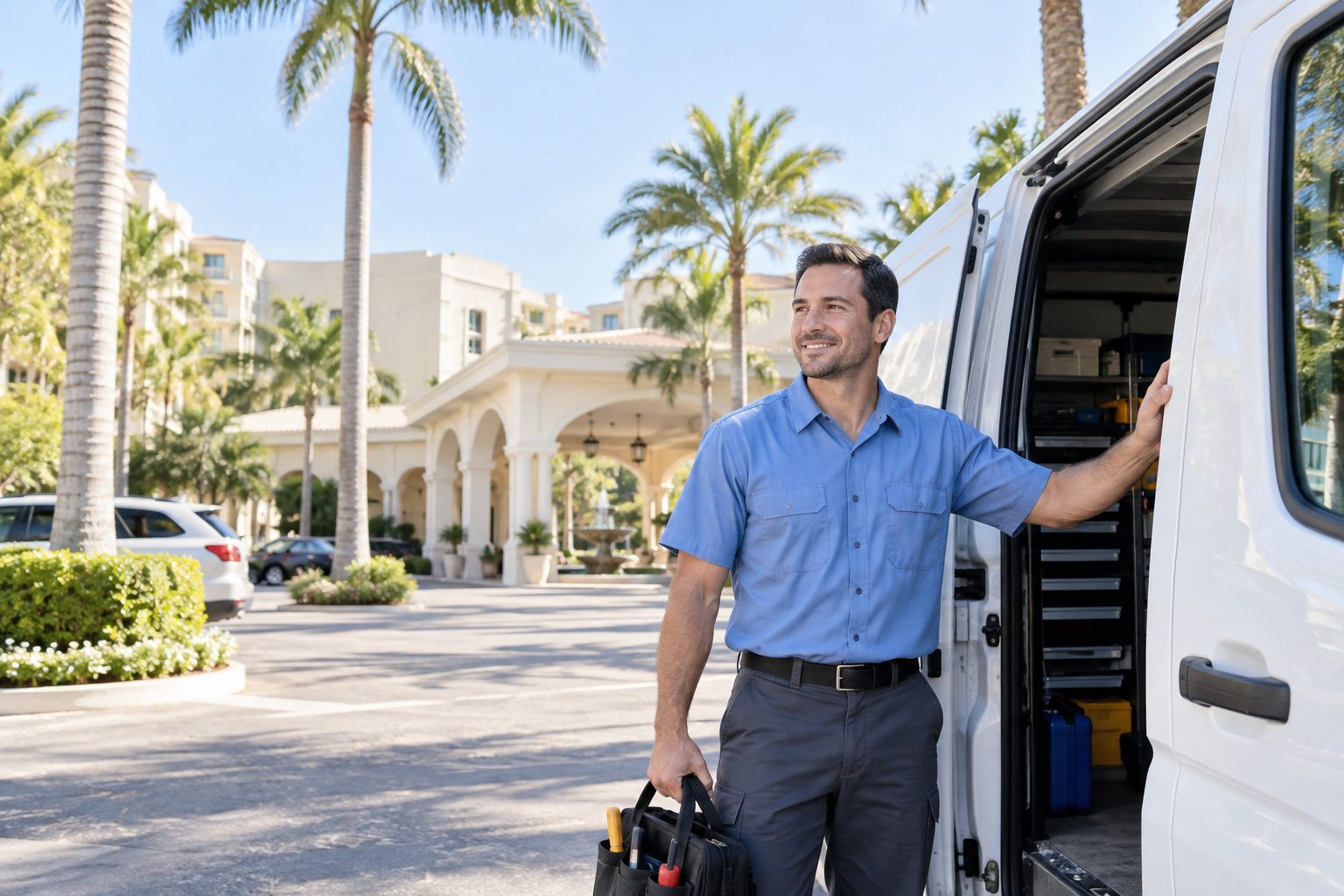
That's a lot of rulebooks for one 32837 ZIP code. Most of the community was built out within a couple of decades of itself, so the underlying hardware problem -- thirty-plus-year-old locksets reaching the end of their working life -- is fairly consistent. What changes, neighborhood to neighborhood, is what you're allowed to put in when the old one fails.
Even a reasonable guess about what a given street allows is still a guess. Knowing the neighborhood name upfront turns that guess into an actual plan before we ever load the truck, and saves everybody involved a second conversation later.
Most master-planned communities in the metro were built by one developer on one architectural theme. Hunter's Creek got there differently -- 48 distinct neighborhoods built out over roughly two decades, each with its own association and its own governing documents. There's no single Hunter's Creek standard for a front door deadbolt. There are dozens.
For us, that means the ZIP code alone tells us almost nothing useful before a call. Two houses a quarter mile apart can answer to completely different associations, with different opinions about finish, style and even whether a keypad lock is allowed to show on the exterior at all. It's a level of granularity most Orlando suburbs simply don't have.
Five of Hunter's Creek's neighborhoods give a sense of the range: Ashton and Heather Glen are established single-family sections from the community's early build-out; Calabay Cove sits along Lake Calabay, where waterfront lots add dock and shed hardware to the usual front-door questions; Cypress Pointe and Eagles Landing round out the mix. A locksmith who's only worked one of these five doesn't necessarily know what the other four expect on a front door.
And that's only five of 48. Multiply the differences between just these neighborhoods across the rest of the community and it becomes clear why a generic "Hunter's Creek" answer to a hardware question usually isn't a complete one.
A house built during Hunter's Creek's original 1980s-90s construction wave is old enough now that its builder-grade hardware is a reasonable candidate for failure -- worn cylinders, keys that stick, deadbolts that have simply outlived their mechanism. Replacing that hardware means solving two problems at once: the lock has to work, and the finish and style have to satisfy whichever of the 48 associations governs that particular street. We don't assume; we ask which neighborhood before we choose hardware.
The 10 multi-family sections of Hunter's Creek run on a different rhythm than the single-family streets -- condo and townhome turnover, cluster mailbox locks, and property managers who need a unit rekeyed between tenants on a schedule set by lease dates rather than by any single owner's calendar. It's closer to apartment-style work than to the single-family HOA questions the rest of the community raises.
Calabay Cove and a handful of other lots back directly onto Lake Calabay, and waterfront property here comes with the usual extra locks a lake adds anywhere else in the metro -- a shed, a dock gate, sometimes a boat lift padlock that's spent a decade in the weather. It's a smaller slice of the community, but a genuine one, and it calls for different hardware than a landlocked interior lot two neighborhoods over.
With 48 different sets of guidelines in play, guessing wastes everyone's time. We ask which neighborhood a job is in before we load hardware for it, because a satin nickel deadbolt that's perfectly fine in one section can be the wrong answer two streets away in another. It's a small extra step that keeps us from showing up with the wrong finish twice, and it's worth the quick question in a community built the way this one is.
We serve all of Hunter's Creek, ZIP code 32837, including Ashton, Calabay Cove, Cypress Pointe, Eagles Landing, Heather Glen and the community's other neighborhoods.
Tell us which of Hunter's Creek's 48 neighborhoods you're in when you call (407) 792-1378, and we'll show up already prepared with hardware that actually fits it -- not guessing on your doorstep.
A large share of Hunter's Creek homes have a screened pool enclosure behind the house, and that enclosure has its own door, usually a lightweight aluminum screen door with a simple latch or a small keyed lock. Owners tend to overlook it, but it matters for two reasons. First, the pool enclosure is often the path to the rear sliding glass door, which on many houses is the easiest door to get through. Second, for families with young children, the latch on the screen door is part of keeping kids away from the water.
Screen door hardware lives outdoors in full sun and rain, and it wears out fast. Latches loosen, springs weaken, and small keyed locks seize. When we are out for a rekey or lockout, we will look at the screen door hardware if you ask. For households with small kids, a self closing hinge and a self latching mechanism mounted high enough that a child cannot reach it is worth considering. Local pool safety requirements vary, so check with the county or your association on what applies to your home, but the practical goal is simple: the enclosure door should close and latch on its own every time.
Most Hunter's Creek houses from the original build out have a large sliding glass door, sometimes three or four panels wide, opening to the lanai. After decades of use, the rollers wear down, the door sits lower in its track, and the latch on the handle stops meeting the keeper on the frame. The door looks closed but may not be locked at all. Some owners do not notice until they try to lock up for a trip.
A repair usually involves adjusting or replacing the rollers so the door rides at the correct height, then replacing or realigning the latch. Adding a secondary lock, such as a foot operated bolt at the bottom or a pin that goes through both frames, gives much better protection than the handle latch alone. Our sliding patio door locks page explains the choices.
Some of the larger single family homes here have double front doors: one active door with the handle and deadbolt, and one inactive door held shut with flush bolts at the top and bottom. The flush bolts are the part that gets ignored. If the top bolt is not fully engaged into the head of the frame, or the bottom bolt does not drop into its hole in the threshold, the inactive door can be pushed open along with the active one, and the deadbolt protects nothing.
Check that both flush bolts slide all the way in, and that the hole in the threshold is not packed with dirt and sand. If the bolts are bent, worn, or the door has sagged so they no longer line up, they can be replaced or the door adjusted. On double doors that see heavy wind, this is also a hurricane season check worth making.
Many Hunter's Creek owners want to replace an original deadbolt with a keypad or a smart lock that works with a phone. That can usually be done, but older doors raise a few questions:
We can check your door before you buy anything, so you know which models will fit. More detail is on our smart locks and keyless entry page.
In most Hunter's Creek homes the garage is attached, and the door from the garage into the house is the one the family uses every day. Because the overhead garage door is usually closed, people tend to leave that inner door unlocked. That makes the garage door opener, the keypad on the outside of the garage, and any remote left in a car parked outside part of your home security.
A few practical steps help. Change the code on the exterior garage keypad when you move in, and again whenever someone who knew it no longer needs it. Do not leave a garage remote clipped to the visor of a car parked in the driveway. Put a deadbolt on the door from the garage into the house, and actually use it when you travel. And make sure you know where the manual release is on the opener, in case you need to open the garage during a power outage.
Hunter's Creek sits between the theme park and hospitality corridor to the west and the job centers along John Young Parkway, Orange Blossom Trail and the airport area to the east. Many residents work early mornings, late nights, or rotating shifts in hospitality, healthcare, and logistics. That means lockouts here do not keep regular hours. Someone coming home after a closing shift finds the key snapped off in the lock, or a morning commuter realizes the keys are sitting on the kitchen counter behind a locked door.
If you work odd hours, a few habits reduce the chance of being stuck:
Car trouble around Hunter's Creek often happens at shopping centers along John Young Parkway and near the Osceola Parkway area to the south, at school pickup, and in driveways. If the keys are locked inside, we can open most vehicles without damage. If the keys are lost, many makes can have a new key cut and programmed on site, including many push to start fobs. It helps to have the vehicle's year, make and model, plus the registration or title, ready when we arrive. Our all keys lost page explains what is involved when there is no working key left at all.
Summer afternoons in this part of south Orange County are hot, humid, and often end in a thunderstorm. That cycle affects locks more than most people realize. Doors facing west get full afternoon sun, and dark painted steel doors expand noticeably with heat, which can make a deadbolt bind until the evening cools things off. Wood doors swell during the rainy season. Electronic locks and garage keypads can fail if water gets inside the housing.
If a lock is only hard to operate at certain times of day, that is a sign the problem is alignment rather than the lock itself. Adjusting the strike plate so the bolt has a little room usually solves it. Forcing a stiff key is the most common way keys get bent or snapped inside the cylinder, which turns a minor adjustment into an extraction job.
After a storm, doors that were exposed to heavy rain may stick for a day or two until they dry out. If a lock is damaged or a door will not open after it has had time to settle, call rather than prying at it, since forcing a door can split the frame.
A number of Hunter's Creek homes and townhomes are owned by investors and rented out. If that is you, a rekey between every tenant is basic practice. It is also worth keeping a simple record for each property: lock brand, the date of the last rekey, how many keys were issued, and who received them. That record makes the next turnover faster and helps settle any question about who had access during a tenancy. For properties with many units, a master key system lets a manager carry one key while each tenant holds only their own. Our lock rekeying page covers how this works.
A rekey does not change what a lock looks like from the street, so it rarely raises an association question. That makes rekeying the easiest first step for a new Hunter's Creek owner: every existing lock keeps its approved finish and style, and only the pins inside change. If you later decide to upgrade to a new deadbolt or a keypad, you can take that request through your association on your own timeline without leaving the house on old keys in the meantime. Many owners find that a rekey plus a stronger strike plate and longer screws gives them the security improvement they were after, with no approval step at all. When replacement is truly needed because a lock is worn out, knowing your neighborhood lets us bring hardware in a finish that already matches what is on the house, which keeps the exterior consistent and keeps the job to a single visit.