GMC shares a lot of its underlying engineering with Chevrolet, but the two brands attract fairly different owners around Central Florida. A Sierra tends to belong to someone hauling equipment or pulling a trailer for work as much as for weekends. A Yukon is often the vehicle a larger family builds their road trips and school runs around. An Acadia sits somewhere in between, a daily driver with room for everyone's gear. The fleet of GMCs on the road here also skews a bit newer on average than some other brands, which shapes what kind of key system you're likely dealing with.
Call (407) 792-1378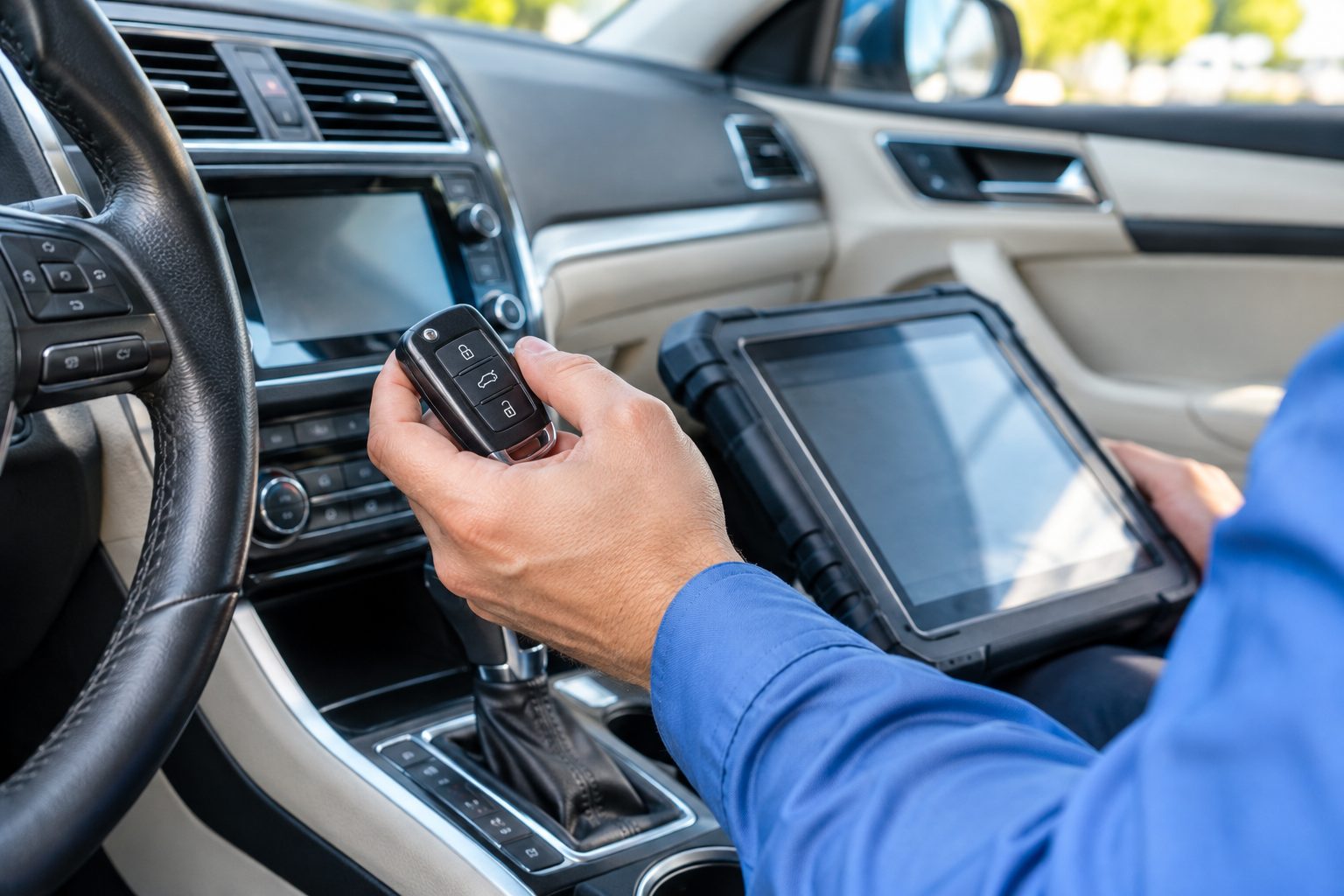
We come to whichever vehicle needs attention, a driveway in the suburbs, a work lot, a shopping center, and handle the cutting and programming there rather than sending you to wait somewhere.
Because a larger share of GMCs on the road tend to be from the more recent end of the model range, proximity fobs and push-button start show up more often than older-style keys with a separate metal blade. That's not universal, older Sierras and Yukons with a traditional key still exist and still need service, but when you call about a GMC, there's a reasonably good chance we're talking about a fob-based system rather than a simple cut key.
Whether it's a blade-and-transponder setup or a full proximity fob, the same basic split applies. There's a mechanical piece, a cut blade for entry or backup starting, and there's an electronic piece, where the vehicle's computer has to be taught to recognize that specific key or fob before the engine will run. A fob that unlocks the doors but won't get the Yukon started points to that second half not being finished, not a mechanical problem.
A Sierra's key often lives in a work environment, a console with tools rattling around, a job site where it gets set down and forgotten, a truck bed toolbox. A Yukon or Acadia key tends to live a gentler life inside a purse or a diaper bag, but that comes with its own failure points, like a fob that goes through the wash or gets buried under everything else in a bag. Both wear down eventually, and a fob that's simply getting old can start acting exactly like a fob with a dead battery, which is worth checking before assuming anything more serious is wrong.
If a working key or fob for the GMC still exists, cutting and programming a second one is the more contained job, since the truck or SUV already has something it trusts. When every key is gone, we're building that trust from nothing, and the job takes more time as a result. Either scenario is one we can handle at the vehicle, no tow required.
Every GMC job begins the same way: a photo ID from the person requesting the work, checked against a registration or title matching that specific vehicle. It applies to a personal Sierra just as much as a Yukon that belongs to a business, and we won't cut or program a key without it.
We verify the vehicle is yours: photo ID plus a registration or title that matches it. Every reputable locksmith does this, and we will not skip it.
Sierra, Yukon, or Acadia, older key or newer fob, we bring the tools to the vehicle and handle both the cutting and the programming on the spot. Call (407) 792-1378 to get started.
It depends on the model year and trim. GMC's more recent vehicles lean toward proximity fobs with push-button start, while older trucks often use a traditional key with a chip inside it.
That usually means the mechanical side is working fine and the vehicle hasn't accepted the fob's electronic signal, or the fob has a dead or failing battery. We'd check the simple explanation first.
Yes. We travel to wherever the truck is within the metro Orlando area, work sites included.
That's an all-keys-lost situation, which takes longer than adding a spare because there's no existing trusted key to reference. We can still do it at the vehicle.
A photo ID and the registration or title for that specific GMC, matching the person requesting the work.
GMC's range covers a lot of ground, and each model has its own key history. The Sierra 1500, 2500 and 3500 span decades of trucks on Central Florida roads, from older models with plain transponder keys to current trucks with proximity fobs. The Yukon and Yukon XL moved from keyed ignitions to push-button start. The Acadia and Terrain are crossovers that went through flip keys and remote-head keys before proximity fobs took over on many trims. The Canyon midsize pickup and the Savana van round out what we see, along with older Envoys, Jimmys and Sonomas still running in the area.
Knowing the exact model year matters because GM changed systems partway through several model runs, and a truck from one year may take a completely different key than the same truck a year later.
Many GMC trucks and SUVs from the mid-2000s into the 2010s used a metal key with a transponder chip in the head. Some of those keys are marked with a small circle and plus sign on the plastic, a hint that they carry a chip. A key cut perfectly but without the right chip, or with a chip not programmed to the truck, will turn the ignition and crank the engine but will not let it run. On many of these trucks, adding a key is straightforward when a working key is available, and more involved when every key is gone.
Trucks that work hard rack up miles and ignition cycles. A heavy key ring hanging from the ignition for years, a lot of starts and stops on a delivery or service route, and dust from job sites all wear the ignition cylinder. Symptoms include a key that has to be wiggled to turn, a key that turns but will not return to run, or a key that will not come out. Continuing to force it can break the key off inside, which turns an ignition repair into a key extraction first. If your Sierra's key is getting harder to turn, lighten the key ring and have the ignition looked at early.
Pickup owners often end up with more keys than they realize. Some Sierra tailgates have a keyed lock that may or may not match the ignition key, depending on the year and whether the tailgate was ever replaced. Aftermarket toolboxes and tonneau covers usually come with their own keys entirely. When a truck changes hands, those extra keys often go missing first. Toolbox and bed cover locks can usually be replaced or rekeyed, and in some cases matched to one key so the owner is not carrying three. It is worth listing every lock on the truck when you call so the right parts come along.
The Savana is a common sight with plumbers, electricians, cleaning crews and delivery businesses around Orlando. Cargo vans have side and rear doors that may use the same key as the driver door or a separate cargo key, and employees come and go. When a driver leaves without returning a key, the van may need a new key programmed and the old one removed from memory, and any cargo door locks that used the old key may need attention too. For businesses running several vans, a simple log of which keys belong to which van, and who holds them, prevents a lot of confusion.
Full-size pickups and large SUVs are popular across Florida, and popular vehicles attract thieves. Beyond good key habits, a few simple layers make a truck less appealing: a visible steering wheel lock, a lock on the diagnostic port under the dash, parking in a lit area or a closed garage, and never leaving a spare key hidden on the vehicle itself. A spare in a magnetic box under the bumper is one of the first places a thief checks. Keep the spare at home.
A lot of Sierra and Yukon owners tow boats, campers and trailers to the coast, the lakes and the springs. Hitch pin locks, coupler locks and trailer tongue locks each have their own small keys that get lost in the truck's console. Many of these locks can be keyed alike or replaced with a set that shares one key. When you are out at a boat ramp and cannot find the hitch lock key, the lock can usually be opened or cut without damaging the hitch, and replaced on the spot.
A closed truck cab parked in a Central Florida parking lot gets extremely hot. Fobs and spare keys stored in the console or the door pocket age faster in that heat, and their batteries weaken sooner. If a fob starts losing range, needs several presses, or only works close to the truck, a fresh battery often restores it. Keep spare fobs indoors, not in the truck, and replace the battery in your main fob on a regular schedule rather than waiting for it to fail in a parking lot.
The Canyon and Terrain are often first GMC purchases, bought used with a single key. That is a good reason to add a second key soon after purchase. A used vehicle may also have keys from previous owners still stored in its memory. On many GM vehicles, the programming process can clear old keys and add only the ones you have, which ensures a key given to a previous owner or a used car lot employee no longer starts the vehicle.
When a truck or van belongs to a business, the person requesting the key needs to show that they are authorized to act for the business. A registration in the company name, a business card with matching ID, or a call to the owner who confirms the request all help. This keeps company vehicles from getting keys made for someone who no longer works there.
Many Acadias and Terrains from the late 2000s and 2010s use a flip key, where the metal blade folds into the remote head and springs out with a button. These keys are handy but have a weak point: the hinge. After years of flipping, the spring weakens, the blade wobbles, or the pivot pin breaks, and the blade will no longer stay open. The remote and the transponder chip inside are often still fine. In many cases the electronics can be moved into a new flip key housing with a freshly cut blade, which keeps the existing programming and restores a solid key.
If the remote buttons still work and the car still starts, a shell replacement is usually all that is needed. If the remote has stopped working or the car no longer recognizes the key, it is a programming job rather than a shell job.
On current push-button trucks and SUVs, the fob stays in a pocket, and the truck unlocks when you touch the door handle and starts when you press the button with your foot on the brake. When the fob battery gets weak, the first sign is often a message on the dash that no key was detected, even with the fob in the cab. Most of these vehicles have a transmitter pocket where the fob can be placed to start the truck with a dead battery, usually in the center console or a cupholder. The owner's manual shows it. That trick, plus a new coin cell for the fob, solves many calls before anyone needs to come out.
If the fob has been through the washing machine, left in a pocket on a job site in the rain, or dropped in a pool, remove the battery right away and let it dry fully. Water that sits on the board causes corrosion that often shows up days later as a fob that works sometimes and then not at all.
GMC trucks and SUVs often head out to the Ocala National Forest, the St. Johns River, the Kissimmee chain of lakes and the coast. Losing a key at a boat ramp or campsite far from home is stressful, and cell service can be weak. Before heading out, it is worth leaving the spare key with someone reachable, or keeping it with a second person on the trip rather than in the same bag as the main key. A spare kept in a waterproof container, away from the main key, has saved plenty of weekend trips.
A full-size truck or a heavy Yukon is not cheap to tow, and a truck on a job site may not be easy for a tow truck to reach. Cutting and programming the key right where the vehicle sits avoids the tow, avoids the wait for a dealer appointment, and gets the truck back to work. For most GMC models this is routine. For very new models, we will say up front whether the job can be done on site.
Before we leave, the new key or fob should lock and unlock from a normal distance, open the tailgate if it has power release, start the truck several times, and, if the vehicle has remote start, run that too. Check the blade in the driver door as well. Any missing function is easier to fix while the tools are still at the truck.
Older Sierras with a manual lock and a key in the ignition are easy to lock with the key inside, especially when hopping out to open a gate. Opening a locked truck cab is usually quick and does not require damaging the door or window seals.
Searching locksmith near me in Orlando for a house lockout? We are mobile across metro Orlando and quote the price before we come out. Call (407) 792-1378.
ZIP codes we cover in Orlando: 32801, 32803, 32804, 32805, 32806, 32807, 32808, 32809, 32810, 32811, 32812, 32814, 32817, 32818, 32819, 32820, 32821, 32822, 32824, 32825. City services: Orlando Official Website.