Civic and Accord have been fixtures on Central Florida roads for as long as most of us have been driving, which means we run into Hondas from nearly every era in a single week, a high-mileage Civic still on its factory ignition, an Accord with a fob missing half its buttons, a CR-V that's never had a metal key at all because it doesn't need one.
Call (407) 792-1378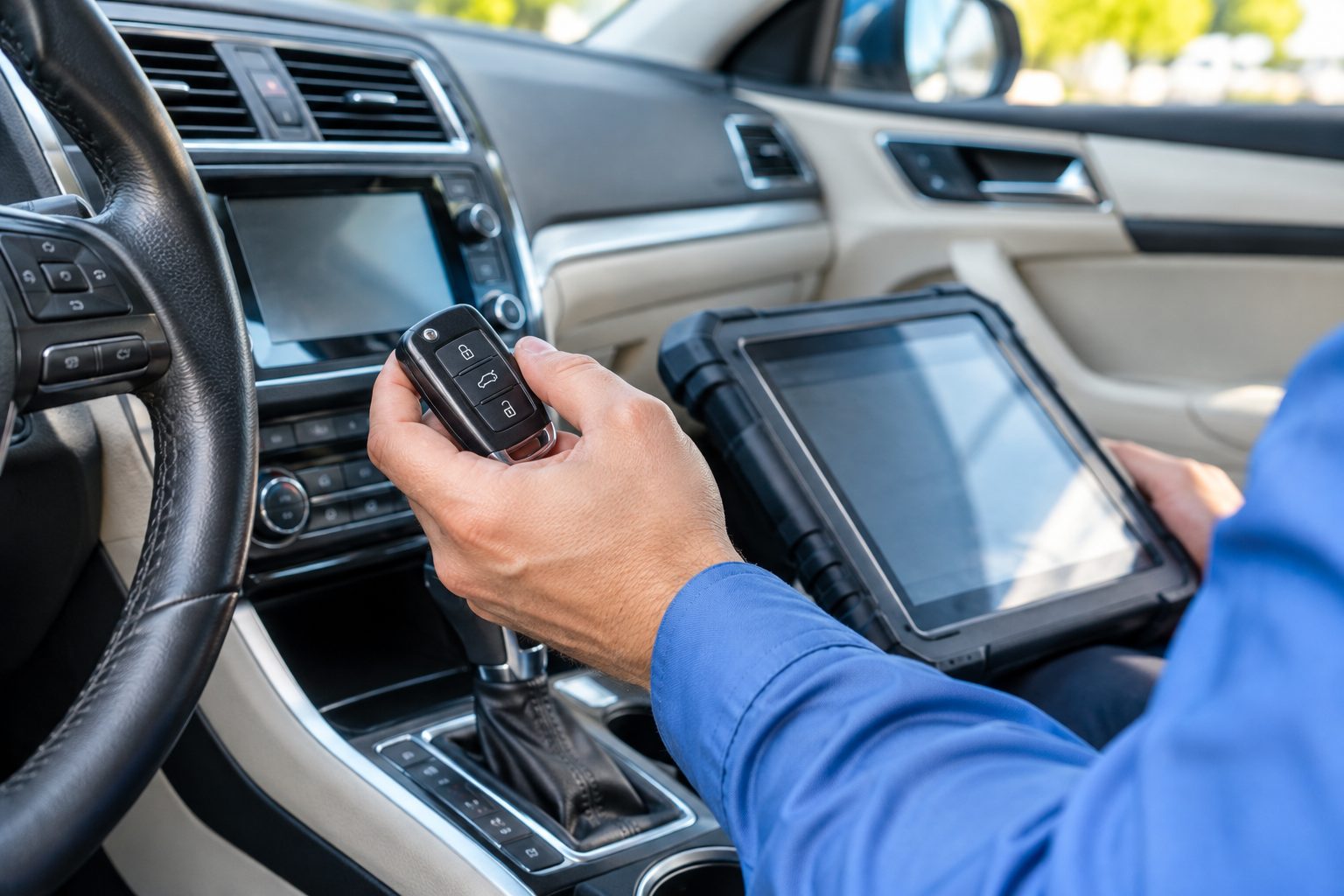
That span matters when you call about a lost or broken key, because the answer to 'what will this involve' depends almost entirely on which Honda era your car belongs to. We'll ask a couple of quick questions about your vehicle before we talk through what the visit looks like.
Older Civics and Accords use a key that does two separate jobs. The metal blade is cut to the specific pattern of your door and ignition locks, that part is pure mechanics, the same principle as any house key. Inside the plastic head sits a small transponder chip that the car's immobilizer checks for before it allows the engine to start. A key can be cut perfectly and still leave the car dead if that chip isn't recognized, which is why the two steps are treated as separate tasks even though they happen on the same piece of metal and plastic.
As the lineup moved forward, Honda leaned into keyless convenience. Later Accords, CR-Vs, and Pilots increasingly use a fob you never remove from your pocket, walk up, the door unlocks on its own, press a button on the dash to start. There's typically still a small metal blade tucked inside the fob housing for emergencies, since a dead 12-volt battery or a drained fob battery shouldn't leave you permanently locked out.
Programming this style of fob is its own process, distinct from the older transponder key, but the underlying idea hasn't changed: the vehicle has to be taught to accept this exact credential before it will run.
If you've still got a key that starts the car, adding a spare is generally the more contained version of this work, that working key can often be used to authorize the new one during programming. If every key is gone, we're originating a credential the car has never seen, with nothing already trusted to lean on, and that's a longer, more involved process by nature.
Before any blade gets cut or any fob gets paired, we ask for a valid photo ID along with the vehicle's registration or title in your name. This isn't optional or a formality we skip for a regular-looking Civic in a driveway, it's the standard we hold on every Honda, every time, because it's the only real safeguard against cutting a key for a car that isn't the customer's.
Older Civic and Accord calls are usually a straightforward transponder duplicate, often after years of one key wearing thin at the shoulder. CR-V and Pilot calls trend toward smart entry fobs, and we've seen no shortage of those go through a rideshare seat cushion or a pool deck at an Orlando-area resort. Fit and Odyssey fall somewhere in between depending on year.
We verify the vehicle is yours: photo ID plus a registration or title that matches it. Every reputable locksmith does this, and we will not skip it.
Honda's long run of Civic and Accord sales means we've worked on that full evolution, from a plain chipped key to a fob that never leaves your pocket. Whatever era your Honda belongs to, call (407) 792-1378 and we'll talk through what a visit involves before we're on our way.
Not at all. Plenty of older Civics and Accords on the road here still use a traditional chipped key, and we cut and program that style regularly.
No. We come to the car, home, workplace, a parking garage, rather than the other way around.
A photo ID and either your registration or title, matching the name on the vehicle. We check this on every job before cutting or programming.
The underlying idea is similar, the car has to accept a new credential, but the process and equipment differ from an older transponder key, since there's no blade turning an ignition cylinder involved.
Between the plain chipped key and the smart entry fob, many Hondas used a remote head key: a single piece with the cut blade, the transponder chip, and the lock, unlock and trunk buttons all built into one head. Many Accords, Civics, CR-Vs and Odysseys from roughly the late 2000s and into the 2010s used this style, and some models used a folding version where the blade flips out of the remote.
These keys are convenient, but they combine several parts that can fail separately. The blade can wear, the chip can stop responding, the buttons can crack or stop making contact, and the remote circuit can lose its pairing. When a remote head key starts misbehaving, it helps to figure out which part is failing:
Sometimes a repair or new shell fixes the issue without a whole new key. Other times replacement is the better answer.
Many Hondas have an immobilizer indicator, often a small green key symbol on the dash. On many models it lights briefly when you turn the key and then goes out if the key is recognized. If it keeps flashing and the engine will not start, the car is not accepting the key's chip. That can happen with a key that was cut but never programmed, a key with a damaged chip, or a key programmed to a different car. Before you call, try your spare key if you have one. If the spare starts the car, the problem is the original key. If neither starts it, something else may be going on.
Honda owners often buy replacement fobs online to save time. Some work well. Others cannot be programmed because they were previously used on another vehicle and are locked to it, because they are for a different model or year, or because the frequency does not match what your car expects. Fobs for many Hondas look nearly identical across models and years, which makes mistakes easy. If you already bought one, check the part number against your original, and tell us the part number when you call so we can say whether it will work before a trip is wasted.
Hondas are known for running a long time, and plenty of Civics and Accords around Orlando have very high mileage on their original ignition. After many years, the ignition cylinder can wear to the point where the key is hard to turn, sticks between positions, or will not come out. Sometimes a fresh key cut to the original code solves it, because the worn key was the real problem. Other times the cylinder itself needs service. We can tell which by trying a freshly cut key. The ignition repair page covers what happens when the cylinder needs work.
The Odyssey minivan and the Pilot are family favorites, and families visiting parks around Orlando lose fobs at a steady rate. Kids play with keys, fobs fall out of stroller bags, and a key set down on a ride storage shelf does not always get picked up again. If you are a visitor, check with guest services or lost and found at the park before calling, since fobs often turn up. Keep a photo of your registration on your phone, since the paper copy may be locked in the van. If the key really is gone, we can meet you at the parking area once you confirm where the vehicle is and how a service vehicle can reach it.
Odyssey and Pilot fobs often include buttons for power sliding doors and power tailgates. A replacement fob needs to match those functions, otherwise the car may start fine but the extra buttons will do nothing. Let us know which buttons your original fob had. It also helps to know whether your van has a walk away lock feature or keyless access on the sliding doors, since those depend on the fob as well.
Smart fobs and remote head keys do not like water. Central Florida gives them plenty of chances to get wet: a jump in a hotel pool with the key in a pocket, an afternoon downpour, a trip through the washing machine. If your Honda key gets wet:
Sometimes the remote buttons stop working after water exposure while the transponder or smart key function survives, and the car still starts. If the fob is fully dead, a replacement will need to be programmed.
Civics and Fits are popular first cars for students at UCF, Valencia and other area schools. Many of these cars are titled to a parent. If your name is not on the registration, the parent who owns the car can usually provide authorization along with a copy of their ID and the registration. Sort out the paperwork by phone before we arrive so the job is not held up on site. Young drivers should also have a spare key made while the original still works, and keep that spare at home rather than on the same key ring.
Honda's hybrid models, such as the Accord Hybrid and Insight, generally use smart entry with push button start. The key process follows the same principles as other smart entry Hondas: the new fob must be registered to the vehicle before it will start the car. With a hybrid, the car may start silently, which sometimes confuses owners into thinking a new key did not work. Look for the ready indicator on the dash, as described in your owner's manual.
If your smart entry Honda shows a message that the key is not detected, the fob battery may be weak. On many push start models, holding the fob close to or touching the start button while pressing it lets the car read the fob even with a low battery. Check your owner's manual for the exact method on your model. Replacing the fob battery is usually simple and is always worth trying before assuming the fob is broken.
Many Hondas use a high security or laser cut blade rather than a traditional edge cut key. Instead of notches along the edges, the blade has a wavy groove milled into its face. These blades are harder to copy on basic hardware store machines, which is part of the point, and they need a specific type of cutting machine to reproduce accurately. If you have tried to get a spare made at a kiosk and been turned away, this is usually why. We carry equipment to cut these blades from a code or from an existing key, and a freshly cut blade is often noticeably smoother in the ignition and door than an old worn one.
The emergency blade hidden inside a Honda smart fob is usually this same high security style. It is worth checking once that the hidden blade actually turns your driver door lock, since many owners never try it until the fob battery dies. If it does not turn, or the lock is stiff from years of disuse, sort it out while you are not stranded.
Some older Hondas came with a valet key that starts the car and opens the doors but will not open the trunk or glove box. It was usually a plainer key with a differently colored head. If your older Accord or Civic came with one and you still have it, keep it somewhere safe. It is a working key that can often serve as a starting point for making a new full key, which is simpler than working from nothing.
Owners who use the remote or smart entry every day may go years without putting a key in the driver door. In Florida humidity and rain, those unused lock cylinders can corrode and seize. When the remote finally fails, the door lock will not turn and the owner is stuck even with the correct key in hand. Once or twice a year, use the physical key in the driver door and add a little lock lubricant. If the cylinder is already seized, it can often be serviced or replaced and matched to your existing key.
When programming a new key or fob, many Hondas need every key you want to keep present during the same session, because the process can clear keys that are not there. If a family member has a spare, collect it before the appointment. Otherwise that spare may stop starting the car afterward and need to be programmed again on a second visit. Tell us how many keys you have and where they are when you call, and we will explain whether your model works this way.
Once the job is done, test every key before we leave: lock and unlock with the buttons, start the engine, and try the blade in the driver door. Checking all of it on the spot is far easier than finding a problem later in a parking lot.
If there are no working keys left, see our all keys lost page. Owners of Honda's luxury brand can find related notes on our Acura page.
Searching locksmith near me in Orlando for a house lockout? We are mobile across metro Orlando and quote the price before we come out. Call (407) 792-1378.
ZIP codes we cover in Orlando: 32801, 32803, 32804, 32805, 32806, 32807, 32808, 32809, 32810, 32811, 32812, 32814, 32817, 32818, 32819, 32820, 32821, 32822, 32824, 32825. City services: Orlando Official Website.