Hyundai's growth in Central Florida has been substantial enough in recent years that the average Hyundai we get called out for is simply newer than the average car of most other brands we service. That shows up directly in the kind of key work we do: proximity fobs and push-button start aren't the exception on Hyundai calls, they're closer to the default.
Call (407) 792-1378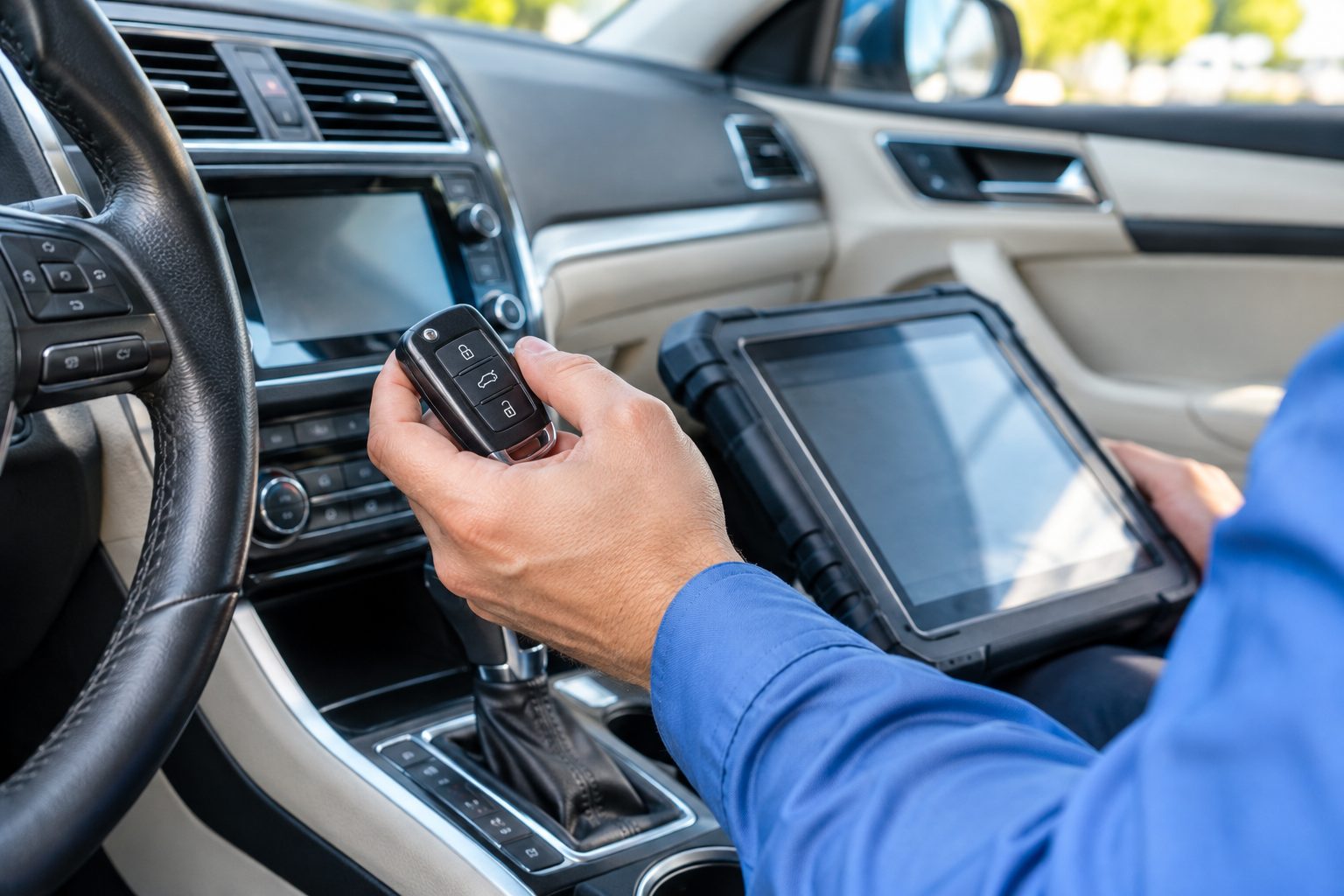
That's a real shift from how this kind of job used to go on most makes. It changes what we bring, how the visit unfolds, and what an owner should expect to be asked for.
Because so much of Hyundai's sales volume in this market is recent, we don't spend much of our Hyundai workload on older-style transponder keys the way we do on some other brands. Most calls involve an Elantra, Tucson, or Santa Fe with a fob that never leaves your pocket, walk up, the doors unlock, press the dash button, the engine starts. It's convenient daily and a real inconvenience the moment the fob is lost, cracked, or simply stops responding.
It's easy to think of a fob as just a fancy remote, but it's really two things bundled into one housing: a short-range signal the car uses to sense it's nearby, and, tucked inside most fobs, a small mechanical blade for manual entry if the electronics aren't cooperating. Programming one so the vehicle fully accepts it is a different process than cutting and coding an old-style key, even though the goal is the same in the end: the car has to trust this specific credential.
Not every Hyundai on our schedule is recent. Older Elantras and Sonatas with a traditional metal key and embedded transponder chip still come through, especially from owners who've held onto a reliable car well past when the newer models arrived. On those, the work looks closer to what we'd describe on almost any brand from that era, a blade cut to the lock, a chip programmed separately.
If a working fob still exists, it can usually help bring a replacement into the system, and that keeps the visit contained. If every fob for the vehicle is gone, we're starting from a car that has nothing left to reference, which takes longer and requires more care, that's true whether the fob went missing at a theme park, a rental counter, or somewhere far more mundane.
Hyundai's current lineup covers a lot of ground, Elantra and Sonata sedans, Tucson and Santa Fe crossovers, Palisade for larger families, and the proximity fob approach runs across most of it once you're looking at recent model years. That consistency is actually helpful from a service standpoint: once we know a given Hyundai is on the newer side, we generally know what kind of visit to expect before we ever see the vehicle in person.
We won't cut a key or pair a fob without seeing valid identification and paperwork, registration or title, that ties the vehicle to the person asking for the work. This holds whether it's a brand-new Santa Fe or a Sonata that's been in the family for a decade.
We verify the vehicle is yours: photo ID plus a registration or title that matches it. Every reputable locksmith does this, and we will not skip it.
With so much of Hyundai's Orlando-area fleet skewing newer, proximity fobs are the call we expect more often than not, though we still handle older chipped keys when they come up. Call (407) 792-1378 and tell us which Hyundai you're dealing with.
In terms of process, yes. There's no blade to cut for starting the engine, and pairing a fob to the vehicle's system is a separate procedure from mechanical key cutting.
Yes. Older Hyundais with a traditional chipped key are still common, and we work on both that style and newer proximity fobs.
A photo ID and either the registration or title for the vehicle, in your name. We ask for this on every job, without exception.
No. We come to wherever the vehicle is parked and handle the work there.
It affects what kind of key or fob your vehicle uses more than which specific model it is. Tell us the model and roughly how new it is, and we can generally tell you what to expect.
Any honest page about Hyundai keys has to mention the thefts of recent years. A number of Hyundai models sold in the United States with a traditional turn key, roughly across the 2011 to 2022 model years, were built without an engine immobilizer. Without that chip check, the engine does not ask the key to prove itself, and thieves learned that breaking the steering column cover and forcing the ignition cylinder could start the car. Those thefts spread widely, and Central Florida saw its share.
If you own one of those models, two things matter for key work. First, the key itself may not contain a working transponder chip that the car checks, which changes how a replacement key is made. Second, the ignition cylinder and steering column are the parts most likely to have been damaged in a theft attempt. If you come out to a cracked column cover or a mangled ignition, report it to the police before anything is repaired, and take photos for your insurance claim. After that, the ignition can often be replaced on site and matched to your key. Our ignition repair page covers that work in more detail.
Hyundai responded to the thefts with a software upgrade for affected vehicles and other anti-theft measures. If you have not already, contact a Hyundai dealer or check Hyundai's owner website with your VIN to find out whether your car is eligible and whether the upgrade has been installed. A visible steering wheel lock is also a simple, effective deterrent on these models. Push-button Hyundais with proximity fobs use a different system and were not part of this problem.
If you are not sure, look at the ignition. A slot for a key means a turn-key car. A round start button means a proximity system.
Several newer Hyundai models, including some Ioniq, Santa Fe, Tucson and Sonata versions, offer a digital key that lets a phone or an NFC card lock, unlock and start the car. The digital key is set up and shared through Hyundai's own app and account system, not by a locksmith. If you lose your phone, the physical fob still works, and if you lose the fob, the digital key may still get you going. That is a good reason to set up both and keep the physical fob somewhere safe rather than relying on the phone alone.
Many Hyundai owners also have access to remote lock and unlock through Hyundai's connected car app, if the service is active on their vehicle. In a lockout, the app can sometimes unlock the car within a minute. Check whether yours is active before you need it.
Newer Hyundai fobs can do more than open the doors, and some features need attention when a new fob is programmed:
When you call, tell us which of these your vehicle has. A replacement fob has to be the right part to support every feature, and some settings may need to be set up again after programming.
Hyundai proximity fobs run on a small coin battery, and a weak battery produces symptoms that look like a failed fob: shorter range, buttons that need several presses, and a warning on the dash that the key is not detected. Most Hyundai fobs open with the emergency key or a coin at a notch in the seam. The battery size is printed on the old battery. If a new battery does not solve the problem, and the fob has not been dropped in water or cracked, the next step is to test whether the car still recognizes it.
Most push-button Hyundais have a backup start method for a weak fob. On many models you hold the fob against the start button and press it, and the car reads the fob at very close range. Your owner's manual shows the exact method for your model.
Central Florida life puts fobs through a lot: pool bags, beach trips, rainstorms and theme park water rides. Water that gets inside a fob can corrode the circuit board over days or weeks, even if the fob seems fine right after it dries. If your fob gets soaked, take the battery out, open the case if you can do so without breaking the clips, and let it dry completely before reassembling. If it works intermittently afterward, the board may be damaged, and a replacement fob is the reliable fix. Keeping the fob in a zip bag or a small waterproof pouch on pool and beach days prevents most of this.
Used cars very often come with only one key. That feels fine until the day it is lost, at which point you are in an all keys lost situation instead of a simple spare. Having a second fob or key made while you still have a working one is quicker and less involved. It also lets you confirm that only the keys you hold are programmed to the car. On many Hyundais, keys that are not present during programming can be removed from the car's memory, so a key the previous owner kept will no longer start it.
The Ioniq 5, Ioniq 6 and Kona Electric are increasingly common around Orlando. Their key systems work much like other recent Hyundais, with a proximity fob and a hidden emergency key, but a few details differ. Some models have flush door handles that extend when the car is unlocked, and those will not extend if the car does not recognize the fob. The emergency key opens the driver door through a hidden cylinder. As with other electric vehicles, a flat 12-volt battery can make the car appear completely dead even when the main battery is charged. The owner's manual explains how to reach the emergency key cylinder and how to supply power to the 12-volt system if needed.
Genesis began as a model name within Hyundai before becoming a separate luxury brand. Older Hyundai Genesis sedans and coupes use Hyundai-style keys, while newer Genesis-branded vehicles use their own fobs and digital key systems. If your car is a Genesis, tell us the exact model and year so we can confirm whether we can supply and program the right fob.
The folding flip key used on many turn-key Hyundais is convenient, but the hinge is its weak point. After years of flicking the blade open, the spring inside wears, the pivot pin loosens, and the blade starts to flop, fold closed in the ignition, or refuse to lock open. A blade that folds while you turn the ignition can bend or snap. In many cases the fob shell or the pivot assembly can be replaced and the existing electronics moved into it, which keeps the programming intact and costs less than a whole new remote. If the circuit board is damaged or the buttons have worn through, a new remote key is the better route.
The blade on a flip key also wears like any other key. If it is rounded, chipped or bent from being used as a pry tool, a new blade cut to the vehicle's key code will work far better than one copied from the worn original.
On push-button Hyundais, the driver door key cylinder may go years without ever being touched. It sits behind a small cap on the door handle on many models. Then the fob battery dies, you slide out the emergency key, and the cylinder will not turn because it has seized from disuse and humidity. It is worth trying the emergency key in the door once a year, gently, and putting a little lock lubricant in the cylinder. If it has already seized, it can usually be freed and serviced, or replaced and matched to your emergency key, so you have a reliable way in when the electronics do not cooperate.
If you have already bought a replacement fob online, send us the part number and FCC ID printed on its back before the visit. Many Hyundai fobs look alike from the outside but are built for specific models and years, and some cannot be programmed once they have been paired to another car. Checking first keeps you from paying for a visit that ends with a fob the car will not accept. A quick photo of both sides of the fob, sent before we head out, usually settles the question in a minute or two.
Searching locksmith near me in Orlando for a house lockout? We are mobile across metro Orlando and quote the price before we come out. Call (407) 792-1378.
ZIP codes we cover in Orlando: 32801, 32803, 32804, 32805, 32806, 32807, 32808, 32809, 32810, 32811, 32812, 32814, 32817, 32818, 32819, 32820, 32821, 32822, 32824, 32825. City services: Orlando Official Website.