Before we talk about keys and fobs at all, there's a question worth asking about almost any locked Lincoln: does this one have a keypad on the driver's door? For a long stretch of Lincoln's lineup, the answer is yes, and it's easy to forget it's there since most owners never touch it after the day they bought the car. Run a finger along the trim strip near the window edge and there it is, a row of buttons that can pop the door open on their own, no key involved.
Call (407) 792-1378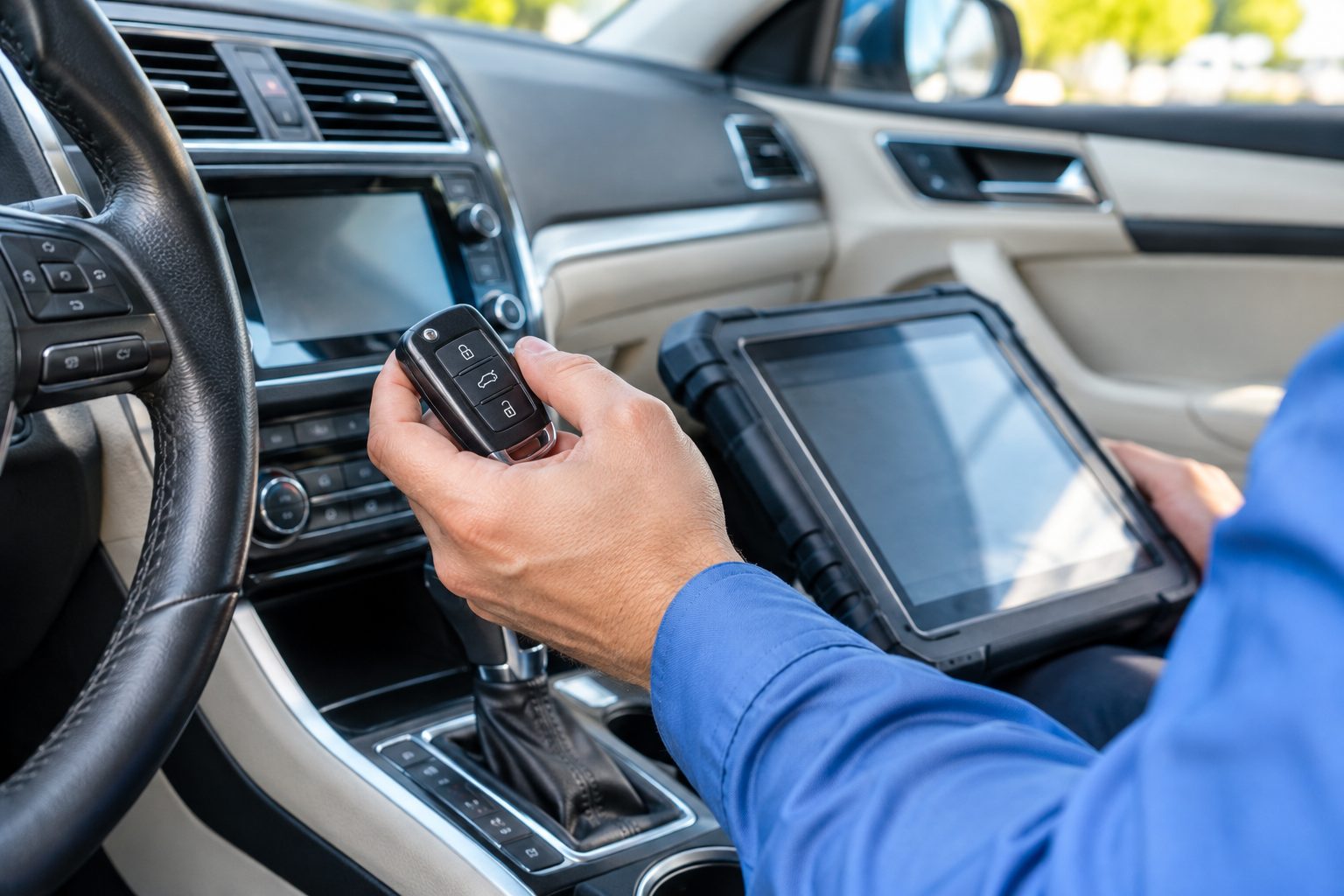
That's worth knowing before assuming the only way in is calling someone. It isn't a fix for every situation, the keypad opens the door, not the ignition, and a factory default code isn't something we keep on file. When it isn't the answer, or the real problem is a key that won't start the car, that's where we come in, traveling to wherever the Lincoln is parked.
The keypad sits flush against the driver's door on a large share of Lincoln models, a small panel of buttons that can be pressed alone or in pairs to enter a code. Punch in the right sequence and the door unlocks, independent of any key sitting in a purse or a coworker's car miles away. It's a feature Lincoln has offered across a long run of years, which is exactly why it surprises people, it's been sitting on their door the whole time, unused, until the day the actual key goes missing.
We can't pull a forgotten code out of thin air, and a factory default isn't on file. But if there's any chance a code was ever set, by a previous owner, a family member, written down and forgotten, it's worth trying before treating the car as fully locked.
Lincoln shares much of its mechanical and electronic foundation with Ford, and the key and immobilizer systems generally follow that lineage, a blade that operates the lock, paired with an electronic credential the vehicle must recognize before it will run. Where Lincoln tends to differ is which convenience features came standard, the keypad being the clearest example. Worth not assuming a Lincoln behaves exactly like every Ford just because the underlying architecture overlaps.
Newer Lincolns lean toward a fob that stays in a pocket or bag, unlocking the doors as you approach and starting the engine at the push of a button. Most of these fobs still carry a small blade tucked inside for emergency entry if the battery dies, but day to day the electronic side does almost all of the work. A fob that seems completely unresponsive is sometimes just a battery issue rather than a failed unit, worth ruling out before assuming the whole fob needs replacing.
Whether a Lincoln uses an older-style chipped key or a modern fob, the same split applies. Shaping a blade to operate the lock is a mechanical task. Getting the vehicle's computer to accept that credential is a separate electronic step, usually the more involved half. A duplicate made from a working key is one kind of visit; originating a key when every key is gone is a different one, taking longer since nothing already trusted exists to work from.
We ask every Lincoln owner for the same two things before touching a lock or a fob: a photo ID for the person requesting the work, and a registration or title naming that specific vehicle. It's a firm requirement, whether we're making a duplicate or originating the only key the car has.
We verify the vehicle is yours: photo ID plus a registration or title that matches it. Every reputable locksmith does this, and we will not skip it.
If your Lincoln is locked and there's no working key anywhere, check the driver's door for a keypad first, it might solve the whole problem before we even arrive. If not, or if the deeper issue is a key the car won't start with, call (407) 792-1378 and we'll come to wherever it's parked in metro Orlando.
A large share of Lincoln models do, mounted on the driver's door. It only unlocks the door and requires a code, so it's not a guaranteed fix, but it's worth checking before assuming you're fully locked out.
Then it won't help on its own, and we won't have a code on file to offer. It's worth checking with anyone who's had access to the car in case one was ever set.
The underlying architecture is closely related, since Lincoln shares much of Ford's engineering, but individual models and feature sets differ enough that we treat each vehicle on its own terms.
Possibly, but a dead battery inside the fob can look exactly like a failed unit. Checking the battery is a simple first step worth taking.
A photo ID from the person requesting the work and a registration or title matching that Lincoln. We confirm both before starting.
If your Lincoln has a door keypad but nobody remembers setting a code, there may still be one to find. Lincolns with a keypad usually came from the factory with a five-digit code already assigned. That code was typically printed on a small card included with the owner's manual packet, and sometimes on a label stuck somewhere in the glove box or trunk by a previous owner. Check the manual pouch first. People often keep it without ever looking through it.
On many newer models, the factory code can also be viewed on the center touchscreen from the vehicle settings menu, but only when the car recognizes a working key, which does not help during a lockout but does help afterward. Once you find the factory code, you can use it to program a personal code you will remember. Write the factory code down somewhere outside the car, since it cannot be changed and it always works.
On some newer Lincolns, the keypad is not a row of visible buttons on the door trim. It is hidden in the black panel on the pillar between the front and rear doors, and it only lights up when touched. Owners who came from an older Lincoln with visible buttons sometimes assume the new car does not have one at all. If you are locked out of a recent model, touch the pillar next to the driver's window and see whether numbers appear.
Several recent Lincolns can use a smartphone as the key through the Lincoln Way app. The phone unlocks the car as you approach and lets you start it, much like a fob. When it works, it is convenient. When the phone battery dies, the phone is left inside the car, or the app has an issue, the backup is usually the keypad code or a physical fob. Phone key owners should keep at least one physical fob at home and know their keypad code, because the phone is a single point of failure.
If you lose a phone that was set up as a key, remove it from your account through the app or the car's settings as soon as you can, the same way you would want a lost fob erased. If you lose every fob as well, a new fob can be programmed at the car on many models, and we can tell you whether yours is one of them when you call.
Some newer Lincolns use electronic door latches, where a small button or touch pad releases the door instead of a mechanical pull. They feel modern and smooth, but owners should know how the doors behave when the car's 12-volt battery is dead. There is a mechanical backup release on the inside, often a lever in the door pocket or armrest, and a mechanical key cylinder or override for getting in from outside. The owner's manual shows the exact location for your model. Knowing it in advance avoids a scramble if the battery dies in a parking lot.
Lincoln proximity fobs carry a physical blade inside, released by a small button or slide on the fob. On many models, the driver's door keyhole is concealed behind a small cap on the handle, which pries off with the tip of the blade. Using the blade on the door may set off the alarm until the car recognizes the fob inside. If the fob battery is too weak to be detected, many Lincolns have a backup location, often in the console or near the steering column, where the fob can be placed so the car reads its chip directly. The manual shows the spot for your model.
Orlando's airport, resort and event traffic keeps a lot of black car and chauffeur services busy, and Lincolns have long been a common choice for those fleets, especially the Town Car in years past and the Navigator more recently. Fleet vehicles have heavy key traffic: several drivers, keys left in lockboxes at a base, and fobs that go home in the wrong pocket at the end of a shift. For fleet owners, a spare key for every vehicle, labeled by vehicle rather than by driver, and a simple sign-out log, prevent a lot of lost time.
Older Town Cars use a chipped key rather than a smart fob, and those keys wear from years of daily use. A key that has worn smooth can stop turning reliably in the ignition or door. A new key cut to specification, rather than copied from a worn one, often restores smooth operation. If the ignition itself is worn, see our ignition repair page.
Many older Lincolns, like many Fords of the same era, allow an owner to add an extra key without special equipment if two working programmed keys are already available. The process involves turning each existing key in the ignition in a specific sequence and then the new, correctly cut key. It only works when two working keys are present, and it only works on vehicles that support it. If you have just one working key, or the car does not support owner programming, the new key has to be programmed with equipment connected to the car. We can tell you which applies to your Lincoln when you give us the year and model.
A lot of Lincolns are leased, and the lease return inspection usually expects all keys that came with the car. If you lost one during the lease, replacing it before the return avoids a charge for a missing key. Check the paperwork to see how many keys were delivered with the car. A properly programmed replacement works with the car the same way the original did.
Summer heat shortens fob battery life, and a Lincoln left in an open lot through an Orlando August sees very high cabin temperatures. Keeping the fob out of direct sun inside the car helps. The keypad on the door or pillar also lives outdoors in rain and sun. If some keypad buttons stop responding while others work, moisture or wear in the keypad is a likely cause, and it is a separate repair from the keys. After a heavy storm, if the keypad or the keyless entry acts oddly, give the car time to dry before assuming anything has failed.
Have the model and year, the vehicle identification number, your photo ID and your registration or title. Tell us whether the car has a keypad and whether you know the code, whether it uses a phone key, a proximity fob or a traditional key, and how many working keys you still have. If you are a fleet operator, have the authorization from the company that owns the vehicle. And tell us where the car is parked, including the garage level or lot name.
Used Lincolns often change hands with a single key and no keypad code card. Before you are ever locked out, take care of three things. First, look for the factory keypad code in the manual packet or through the touchscreen settings with the key present, and set a personal code. Second, add a spare key or fob, since one working key makes the job simpler than none. Third, consider having the car's key memory cleared and your keys reprogrammed, so any keys the previous owner kept stop working. If the car uses a phone key, make sure the previous owner's phone and account have been removed from the vehicle, which the dealer or the previous owner may need to help with.
Many Lincolns try to prevent locking a proximity fob inside, sounding a warning or refusing to lock when the fob is detected in the cabin. That protection is not perfect. A fob in the trunk, a fob with a weak battery, or a fob sitting in a spot where the car's antennas do not read it well can end up locked inside anyway. If that happens, try the keypad first. If there is no code, the car can be opened without damage, and the fob retrieved.
Most Lincoln fobs include remote start, which many Orlando owners use daily to cool the cabin before getting in. When a new fob is programmed, the remote start function normally comes along with it, as long as the car was equipped with factory remote start and the fob has the button. If the car has an aftermarket remote start system instead, that system may need its own setup to work with the new key. Tell us which kind you have so the visit covers everything you use.
For most households, two working fobs plus a known keypad code is a comfortable setup. Each driver carries a fob, and the keypad covers the day a fob is left somewhere. If you only have one fob, adding a second is a much smaller job than replacing the only one after it is lost. Keep the spare at home, never inside the car, and make sure everyone who drives the Lincoln knows where it is.
Searching locksmith near me in Orlando for a house lockout? We are mobile across metro Orlando and quote the price before we come out. Call (407) 792-1378.
ZIP codes we cover in Orlando: 32801, 32803, 32804, 32805, 32806, 32807, 32808, 32809, 32810, 32811, 32812, 32814, 32817, 32818, 32819, 32820, 32821, 32822, 32824, 32825. City services: Orlando Official Website.