A snapped key in the ignition is stressful, but it is a well-understood problem. The most important thing is what you do in the next few minutes: stop turning, stop pulling and avoid anything that pushes the broken piece deeper. The right approach protects the cylinder and the car's electronics.
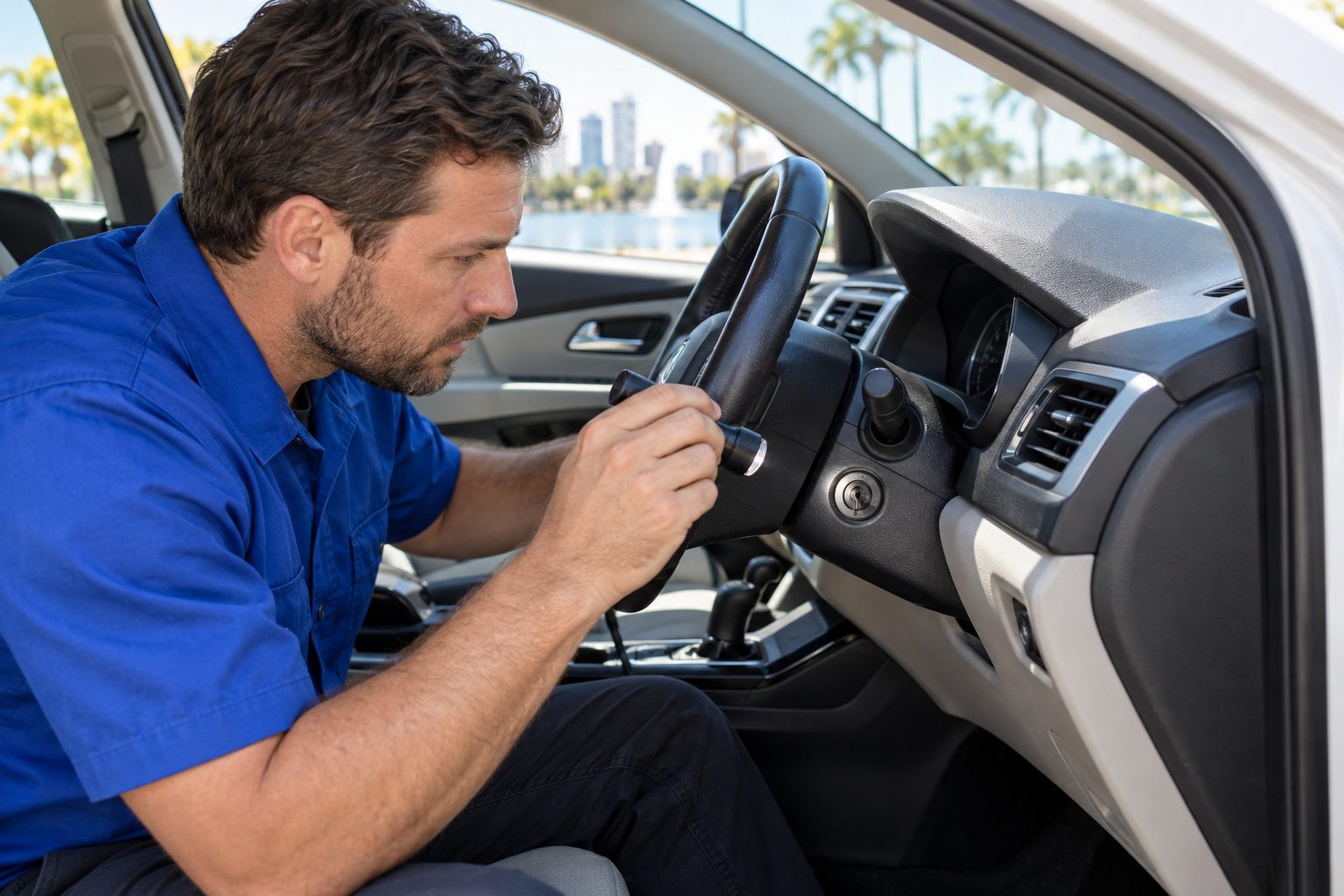
A car key is a thin blade of brass or nickel silver, often with a plastic or metal head that may hold a transponder chip. The blade has a pattern of cuts along its edges that lift small wafers or pins inside the ignition cylinder. When the key breaks, the break usually happens at the weakest point, often at the shoulder just below the head, or near a deep cut in the blade. The head comes away in your hand, and the blade stays inside.
Sometimes the blade breaks flush with the face of the cylinder, leaving nothing to grip. Sometimes a few millimeters stick out. Sometimes the break is deeper inside, and the piece has rotated slightly. Each situation calls for a different approach, which is one reason a technician asks you what you can see and feel before any tool touches the lock.
A break in an ignition is different from a break in a door. An ignition cylinder is connected to the steering column, the lock that holds the wheel, the switch that powers the car and, in many vehicles, the transponder reader. Pushing a tool into it is not a casual step. Mistakes can damage the cylinder, scratch the keyway, or interfere with the reader that tells the engine computer the right key is present.
Keys rarely break without a cause. Wear is the biggest. After many seasons of daily use, the cuts on the blade round off and metal fatigues. A worn key also grips the wafers poorly, so the driver has to twist harder to start the car. Eventually the blade fails under the strain. If your key has been feeling rough, loose or hard to turn, that was an early warning.
Heavy key rings contribute. A bundle of keys, fobs and trinkets hanging from the ignition pulls the key sideways every time the car moves. Over time, that load wears the cylinder and bends the key, creating stress at the shoulder. Bumpy roads make it worse. Removing weight from the ring is one of the simplest preventive steps a driver can take.
Heat and humidity play a part too. Orlando summers bake a parked car and expand metal parts. A key that is slightly worn can bind in a hot cylinder, and a hard twist is enough to finish it. Corrosion, grit and dried lubricant inside the cylinder can have the same effect. Finally, a locked steering wheel can pin the cylinder, and a driver who forces the key while the wheel is under pressure can snap it. See steering wheel locked, key stuck for that scenario.
Stop. Do not turn the broken blade, and do not try to start the car with the head or any other tool. Put the transmission in park if it is not already, set the parking brake and turn off any accessories. If the car is running and you are worried about it being switched off, do not touch the ignition. A running car can stay running until you decide to turn it off by another means.
Look closely, without touching, at what is visible. Take a photo with your phone. Note whether any piece of the blade sticks out, whether the head has come away completely and whether anything else is damaged. Keep the broken head. A technician may be able to use it to match the cuts when making a new key, and the transponder chip, if present, may be reused in some systems.
Do not use superglue to rejoin the pieces. It is a common idea and a bad one. Glue can run into the cylinder, seize the wafers and make extraction far harder. Do not use tweezers, a needle or a paperclip on the broken piece unless you are certain it protrudes enough to grip with fingers. The page on broken key extraction describes the general approach for any lock.
The temptation to fix this with tools you own is understandable. Needle-nose pliers, a small screwdriver or a thin blade seem like an obvious answer. The problem is that an ignition keyway is narrow, with tight tolerances and spring-loaded parts. A wrong move can push the broken blade deeper, jam it between wafers or scratch the walls of the keyway.
Deeper is much worse. When a piece sits a few millimeters inside, a technician can often hook it with a thin extractor. When it has been pushed to the back of the cylinder, it may require removing the cylinder from the column, which is a bigger job. If wafers are bent or the keyway is scored, the cylinder may no longer be reliable and will need to be replaced.
There is also the transponder system to think about. Many modern vehicles include a coil around the ignition that reads a chip in the key. Metal tools can scratch or disturb that coil. Rough handling can damage wiring behind the cylinder. And in some cars, repeated attempts to start the engine with a damaged key can trigger an immobilizer lockout, which complicates things further. Leaving it alone until the right tool is in hand is the safer path.
A technician begins by assessing the break. They look at how much of the blade remains, where it sits and whether the cylinder is damaged. They check that the transmission is in park and, if the car has an electronic shifter, make sure the car is safe to leave off. They ask about the vehicle's make, model and age, since ignition designs vary.
If a piece is accessible, purpose-made extractors, which are thin tools with fine hooks or barbs, can grip the blade and draw it straight out. The technician works slowly, keeping the tool aligned with the keyway so nothing gets scratched. A tiny amount of lubricant intended for locks may be used to reduce friction. The goal is to remove the piece in one go, without disturbing the wafers.
If the blade is deep or jammed, the cylinder may need to be removed from the steering column to be worked on at a bench. That is a more involved step and depends on the vehicle. Some cars allow removal with the cylinder in the ignition position, while others need the steering column partly dismantled. The technician will explain what is needed and whether it is better to repair or replace the cylinder. After extraction, the lock is tested, and a new key is cut or programmed.
Removing the broken piece is only half the job. You still need a working key. If you have a spare, a technician can often use it to cut another. If you do not, a new key can be cut from the vehicle's information, which usually requires proof of ownership. The guide on documents needed for car key replacement lists what to have ready, such as registration and identification.
Most cars built in recent decades use a transponder chip, which must be programmed to talk to the car. Cutting the blade is not enough. The chip must be matched to the vehicle's immobilizer, a step that requires diagnostic equipment. The page on transponder key programming explains how this works. Some vehicles use smart keys with push-button start, which have different procedures, described on smart key replacement.
If the ignition was damaged, a new key may not turn it properly. In that case, the cylinder is replaced and keyed to match. A technician may recommend replacing the cylinder even when extraction succeeds, if the keyway has been scratched or the wafers are bent. It is better to fix it once than to risk a repeat failure. For the broader topic of ignition work, see ignition repair.
While you wait, make the vehicle safe. Park in a legal, visible place. If you are in a busy lane or a parking lot with traffic, put on hazard lights and, if safe, move the car by neutral and pushing with help. Do not attempt to tow a car with the ignition in a locked position unless it can be done correctly, since a locked steering wheel can cause a crash when towed.
If you are at a theme park lot, a mall or an apartment complex, tell security or the property manager so the vehicle is not mistaken for abandoned. Keep valuables out of sight. In Orlando heat, do not leave children or pets in a parked car while you wait. If you are in a place with no shade, wait in a nearby building and give the technician your exact location when you call.
If you rely on the car for a time-critical trip, such as a flight or an appointment, say so, and plan an alternative while the repair is arranged. Nobody can promise an arrival time, but the technician will tell you what to expect once they know your location and the vehicle. Mobile service is useful here, since the work can be done where the car sits, and there is no need to tow it to a shop unless the problem requires it.
A short, clear description speeds everything up. Tell the technician the make, model and approximate age of the vehicle, since ignition designs differ from one brand to the next. Say whether the car uses a traditional key in the ignition or a push-button start with an emergency blade. Mention whether the key had a plastic head with buttons, a chip or a plain metal head, and whether the head came away intact.
Describe what you can see: whether any of the blade is visible, whether the key broke flush with the cylinder, and whether the car is currently on, off or in accessory mode. Say where the car is parked, whether it is safe from traffic and whether it is in a lot with gate or garage access. A technician may need to know about low ceilings or tight spaces in parking structures near malls, hotels and theme parks.
Have your identification and proof of ownership within reach, along with the vehicle registration or title. If the car is leased or rented, have the paperwork and contact details for the owner, since the technician may need authorization. If you have any other working key, even a worn one, mention it. Finally, tell the technician whether you have other keys that were not broken, since a spare can simplify cutting and programming a new one.
Keys also break in car doors, trunks, glove boxes and fuel doors, and the same principles apply: stop, do not force, and let a technician extract the piece. A broken key in a door lock is easier to reach than one in an ignition, but it is still delicate. Be careful with a fuel door lock, where a stuck piece can prevent refueling.
House keys break too. A snapped key in a deadbolt, a padlock or a mailbox lock is handled with similar tools. The page on key stuck in the door lock covers the related situation of a key that will not come out, and key will not turn in the lock explains why forcing a key is risky.
For motorcycles, boats and RVs, ignition and door locks follow similar patterns, though the cylinders are often smaller or more exposed to weather. A broken key on a boat in a marina may require different care because of corrosion. If your vehicle is anything other than a standard car, mention that when you call, so the technician can bring the right tools and, if needed, the right key blanks.
Once the problem is solved, a few habits reduce the risk of another break. Replace a worn key before it fails. If your key has rounded cuts, feels loose or needs wiggling, get a fresh one cut from the original or from the vehicle's records. Do not copy a copy. Each generation adds error and wear.
Lighten the key ring. Keep only the vehicle key and a fob on the ring that goes in the ignition, and move the rest to a separate ring. A short, light ring reduces strain. When starting the car, turn the key smoothly and avoid forcing it. If the steering wheel is locked, gently turn the wheel while turning the key rather than applying more twist to the key.
Keep a spare in a safe place, not in the car. If you do not have one, make one now while the original works. The guide on car key types through the years explains why modern keys are more complex and more valuable. When you are ready, call. A phone conversation will tell you what to expect, and quotes are given by phone. Complicated jobs need an on-site look, and the service call charge is explained before anyone is dispatched.
Only if a good length sticks out and you can grip it with your fingers without any tool. Using pliers, tweezers or a needle risks pushing the piece deeper or scratching the keyway. If nothing is easy to grip, stop and call. Extraction tools made for locks are far gentler on the cylinder.
Often not. Many broken keys can be extracted without harming the cylinder, and a new key can then be cut or programmed. If the cylinder is worn, the keyway is scratched or the wafers are bent, replacement may be wiser. A technician will test the ignition after extraction and tell you honestly which is needed.
No. Glue can run into the cylinder, seize the wafers and make extraction much harder. Even if it holds, a repaired key is weak and can snap again inside the lock. Keep the broken pieces instead. A technician may use them to match the cuts when making a new key.
Usually yes. A new key can be cut and programmed for a vehicle, which is a security matter, so a technician will ask to see identification and proof of ownership such as registration or title. Having these ready speeds things up. The page on documents for car key replacement lists what is normally needed.
Push-button cars do not have a key ignition in the usual sense, so a snapped blade is more likely to be in a door lock or the emergency blade of a smart key. The care is the same: do not force it. A technician can extract it and replace or reprogram the smart key if needed.
Quotes are given only by phone. Describe the vehicle, what you can see of the broken key and where the car is. Simple jobs can be quoted from that. Complicated jobs need an on-site look, and a service call charge applies, which is explained on the phone before any technician is dispatched.
Describe the situation by phone and we will tell you what the job involves. Quotes are given by phone. Jobs that cannot be quoted without seeing them need a technician on site, and the service call charge is explained on the phone before anyone is dispatched.