Losing the only key to your car is stressful, but it is a routine job for an automotive locksmith. This page explains what to check first, what information to gather, what proof of ownership is needed and how a new key is made on site.
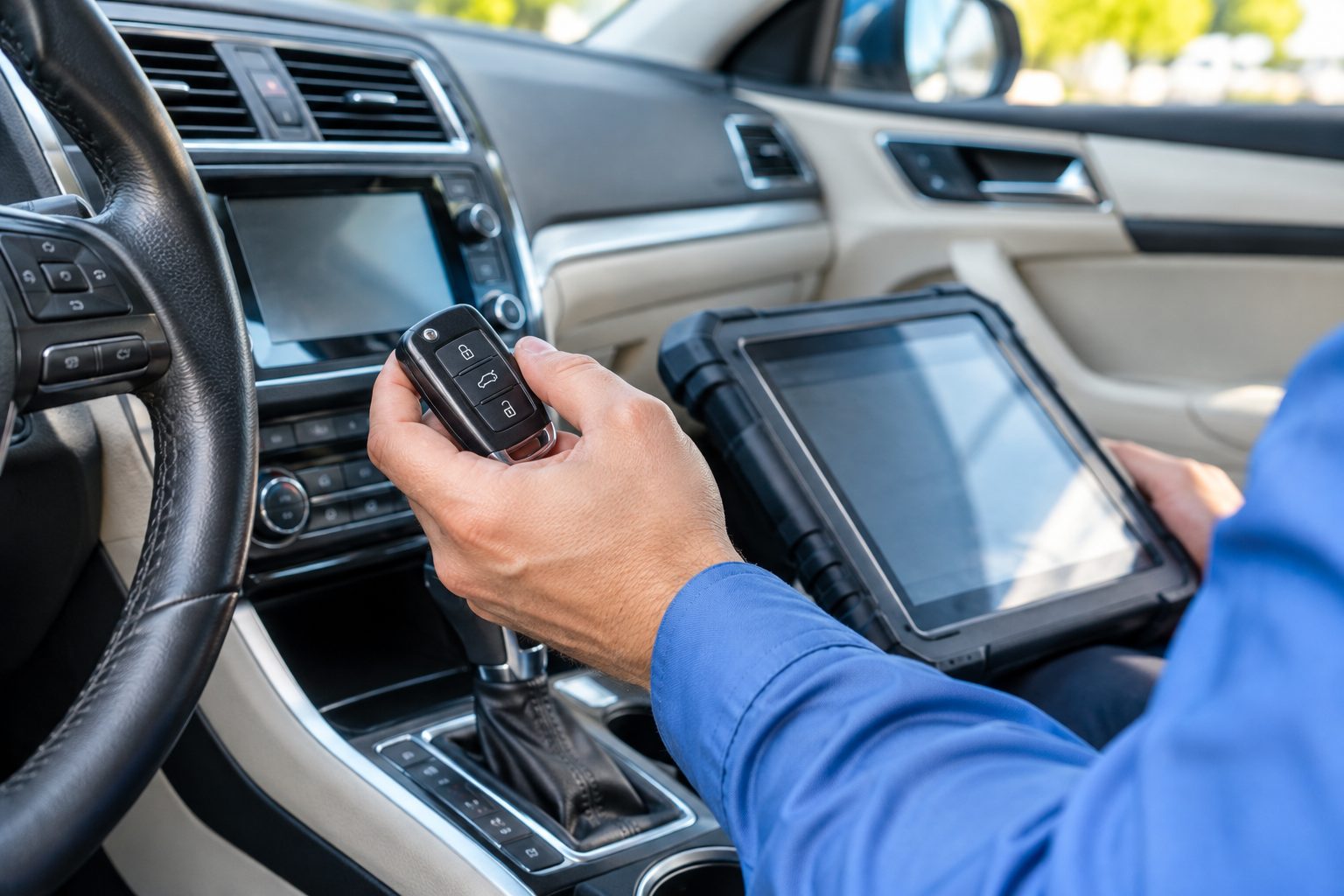
Before assuming the key is gone, retrace your steps with some discipline. Keys turn up in strange places, and an organized search is faster than a frantic one. Check the pockets of every jacket and pair of trousers you wore. Check bags, strollers, the bottom of a beach tote and the car seat area of anyone who was with you. Look in the places you stopped: a restaurant table, a restroom shelf, a shop counter, a ride locker at a theme park.
Call the places you visited. Lost property desks at attractions, hotels and shopping centers often hold keys. If you rode a shuttle or a ride share, contact the company. If you were at a hotel or resort, check with the front desk. If the key has a fob with a manufacturer logo, an honest finder may not know which car it belongs to, so leaving your contact information at the places you visited helps.
Also confirm whether the car itself is accessible. If the car is locked and the key is lost, you face two problems: getting into the car and getting a key that starts it. If the car is unlocked, you may be able to look inside for the key. If the car is on private property, such as a driveway or a hotel garage, you have more options than if it is on a street. Our page on car lockout service describes how a lockout is handled.
The best solution is a spare. Check at home, at work, with family members, and in places you might have stored one. Many people forget they left a spare with a relative, in a drawer or in a glove box of another vehicle. If a spare exists, a friend or family member may be able to bring it to you.
If a spare exists and you have it, the best step is to copy it as soon as the emergency is over. Having only one key is a risk, and having just one spare is a smaller risk. A second spare costs little compared with the inconvenience of a full replacement. Our page on spare key duplication explains how copies are made and programmed.
If there is no spare, the situation is called an all keys lost job. It is a normal service for an automotive locksmith, though it takes more work than copying from an existing key. Our page on all keys lost describes the process in more detail.
A little preparation makes the call faster and the quote more accurate. Gather the details of the vehicle first. You will need the make, model and year, and whether the car uses a traditional key, a transponder key, a remote head key, a smart key with push button start or something else. If you are not sure, a photo of the dash, the ignition or the start button will help.
Next is the vehicle identification number, or VIN. It is a 17-character identifier printed on a plate at the base of the windshield on the driver side, on the driver door jamb and on your registration, title and insurance card. The VIN lets a technician look up the correct key blank, the correct chip and the right programming procedure for your vehicle. You can read it from outside through the windshield if the car is locked.
Also gather the paperwork and identification. Have a photo ID, the registration or title, and, if you can, an insurance card. Note whether the vehicle is owned, leased or rented, because that affects who can authorize a key. Write down where the car is, how it is parked and any access issues such as a gated lot or a parking garage level.
A trustworthy locksmith will ask for proof that you own or are authorized to use the vehicle. This can feel like an obstacle when you are stressed, but it protects you. Without such checks, anyone could ask for a key to someone else's car. The check is routine, quick and a good sign about the person you are dealing with.
Typically, you will be asked for a government photo ID and a document that ties you to the vehicle: the registration, the title or an insurance card. The name should match, or the technician may ask for additional proof. If you are driving a company car, a leased car or a rental, the technician may need authorization from the owner, such as a letter or a call to the rental company.
If you do not have the documents on you, do not worry. A photo of the registration on your phone may suffice in some cases, and a technician can explain what is acceptable. Our guide on documents needed for car key replacement describes the accepted forms in more detail.
Be wary of anyone who offers to make a key without asking for any proof. That is a warning sign, and our guide on how to spot locksmith scams lists other red flags.
There are generally three routes to a new key. The first is the manufacturer's service channel. A franchised service center can order a key by VIN and program it, but you often need to have the car towed there, the process can take time and appointments may be limited. The second is a mobile automotive locksmith, who comes to the car, cuts the key, programs it and tests it on site. The third, for a car that will not be driven soon, is to arrange a key through another channel and schedule the work.
A mobile locksmith is often the most convenient choice, especially in a place like Orlando where the car may be at a hotel, a theme park lot or a driveway far from the nearest service center. The technician brings key cutting equipment and a programming tool, and can make a key for many makes and models. For some vehicles with advanced security, the work may need specialized procedures, and the technician will tell you honestly whether they can do it.
Whatever route you choose, ask what is included. Will the new key be a full replacement with all functions, including remote buttons? Will the old key be erased so a finder cannot use it? Will the technician test every function before leaving? Our page on car key replacement explains the typical steps.
The technician will first check your identification and proof of ownership. They will look at the vehicle, confirm the VIN and identify the key type. If the car is locked, they will open it carefully, without harm to the paint or seals.
Then they will cut a key blade, if the key has one, using the vehicle's data. For many vehicles, the cut is derived from the VIN or by decoding the lock itself. They will then program the transponder chip and any remote functions to the car using diagnostic equipment connected to the vehicle's data port. For push button smart keys, they program the fob to the vehicle's immobilizer.
Once programmed, they will test the key. The doors should lock and unlock, the remote buttons should work, the key should turn the ignition smoothly and the car should start and run. If the lost key was still programmed into the car, the technician can erase it so that a finder cannot use it. Ask about this step, because it matters for security.
A lost key is also a security question. If the key was lost near the car, at a place where someone could find it and match it to the vehicle, that is a risk. If the key has a tag with your address or a remote that can open your home, the risk goes beyond the car. Think about what else is on the keyring: house keys, office keys, a gate remote.
If your house keys were on the same ring, consider rekeying the locks as well, especially if the ring may have been taken and your address is on registration papers in the car. Our page on lock rekeying explains how locks can be changed without replacing them. If the loss followed a theft or a break-in, see our page on lock safety after a burglary.
For the car, ask the technician to erase the lost key from the immobilizer. With the old key erased, it will not start the car even if someone has it. If the car has a smart key, ask whether the lost fob can be disabled. Also consider reporting the loss to your insurer if the key was stolen along with other items.
If the car is a rental, the rental company owns the vehicle and usually has procedures for lost keys. Call the rental company's roadside assistance first. Some companies will only allow their own contractors to make keys, and some will charge fees. A locksmith may be able to help if the company authorizes it. Our guide on rental car key lockouts explains what to expect.
If the car is leased, the leasing company is the owner, and the technician may need their authorization. Check your lease for terms about keys. If the car is a company vehicle, your employer may have a procedure.
If you are visiting from out of town, a lost key can disrupt a trip. A mobile technician can come to your hotel or the theme park lot. Our guide on theme park visitor car key tips offers habits that help visitors avoid trouble. If you are carrying proof of ownership, such as a photo of the registration, you will save time.
When you call, give the vehicle details, your location, what key type you believe the car uses and whether the car is locked. Mention whether you have a spare anywhere. Be ready for the technician's questions about ownership. You will be told how the service call charge works before anyone is dispatched. Quotes are given by phone, and no figure appears on this page. For complicated jobs, such as a vehicle with advanced security, an on-site visit may be needed first.
After you have a new key, make a spare. Keep one at home in a secure spot and give another to a trusted person. Consider a key tag with a phone number only, not an address. Use a small pouch or a keyring tracker if you tend to misplace things. Our guide to lockout prevention habits collects simple routines.
Losing the only car key is a hassle, not a disaster. When you are ready, call and tell us about your vehicle and where you are. We will walk you through the next steps.
Yes. This is called an all keys lost job. The technician uses the vehicle identification number and the lock to cut a key, then programs the transponder and remote to the car. It takes more work than copying a key, and proof of ownership and identification are required before the work begins.
Have the vehicle's make, model and year, the VIN, a photo ID and the registration, title or insurance card. Know the type of key your car uses and the exact location of the car. A photo of the dash plate or registration on your phone can speed things up considerably.
It may, unless the technician erases it from the car's memory. Ask for the lost key to be removed from the immobilizer if the vehicle allows it. This prevents a finder from starting the car. Not every vehicle supports this, and the technician can tell you what is possible for yours.
Not usually. A mobile automotive locksmith can cut and program many keys at the car, saving the tow. Some vehicles with advanced security may need specialized procedures, and the technician will tell you honestly if yours does. Describe the make, model and year when you call so the right approach can be planned.
Contact the rental or leasing company first. They own the vehicle and often have rules about who can make keys. A locksmith may be able to help with their authorization, and the technician will ask for it. Having the rental agreement or lease paperwork ready will make things smoother.
Quotes are given only by phone. Share the vehicle details, key type and location, and say whether the car is locked. A service call charge applies and is explained before any technician is dispatched. For complicated jobs, an on-site visit may be needed before a firm quote is given.
Describe the situation by phone and we will tell you what the job involves. Quotes are given by phone. Jobs that cannot be quoted without seeing them need a technician on site, and the service call charge is explained on the phone before anyone is dispatched.
Before assuming a key is gone for good, give yourself a structured search. Start with the last time you remember using the car and write down where you went. Check every place you stopped, the pockets of the clothes you wore, bags, jackets, the couch cushions, the kitchen counter and the area near the front door. Look in the car if it is accessible, including under seats and in door pockets. A calm search of known places often turns up a key within minutes. Keep any old keys, receipts or notes together in one place so the next decision is easier to make.
Use technology and other people. Ask household members to check their own spaces. Call places you visited, like restaurants, stores or friends' homes, and describe the key clearly. If your key has a tracking tag or a phone app, use it. If the key may have fallen out near the parking space, walk the route slowly and look at the ground. Do not forget less obvious spots, such as a gym locker, a car seat or a gym bag. A short pause to think often brings back a forgotten detail.
Set a time limit. After a reasonable search, accept that the key may be lost and shift to planning. Gather your ownership documents, note the vehicle details and think about whether anyone else might have found the key and could use it. If a theft is possible, tell the police and consider asking about reprogramming so that the lost key no longer works. We explain the scope and quote before work begins, and a good plan reduces the stress of an already difficult day. Ask questions whenever a term or a recommendation is unclear, and expect a plain answer in return.
A lost car key is more than an inconvenience, because someone else may find it. If your registration, a garage remote or an address sits in the car or on the key ring, a finder could connect the key to your vehicle. Consider how likely it is that the key was dropped in a public place versus at home. If you lost it near your home or car, treat the risk more seriously. If it vanished in a crowded location, the odds of misuse may be lower, but caution is still wise.
When a new key is made, ask whether the old one can be removed from the vehicle's memory. Many systems allow the technician to erase previous keys during programming so only the new ones start the car. This is a significant security benefit, though availability depends on the make and model. For older vehicles without such a feature, a lock change may be worth discussing if the door or ignition cylinder could be affected. The options and their effects are explained before work begins. Local weather and daily use both play a part, so think about how your own routine affects the hardware involved.
Also think about what else was on the ring. House keys, mailbox keys and office keys may have been attached, and each of them carries its own risk. If the lost key ring held a home key, rekeying the home locks is worth considering, especially if the loss happened somewhere your address might be known. Plan the response to the whole ring, not just the car key. A short checklist of every item can show you what to address first. It helps to share this information with everyone in the household or workplace who might be affected by the outcome.