Community associations share doors that hundreds of people touch: the clubhouse, the pool gate, the fitness room, the mailbox bank, the pedestrian gate. Those locks wear out faster than a house lock and carry rules about who may hold keys. This page explains how a locksmith helps boards and managers keep them working.
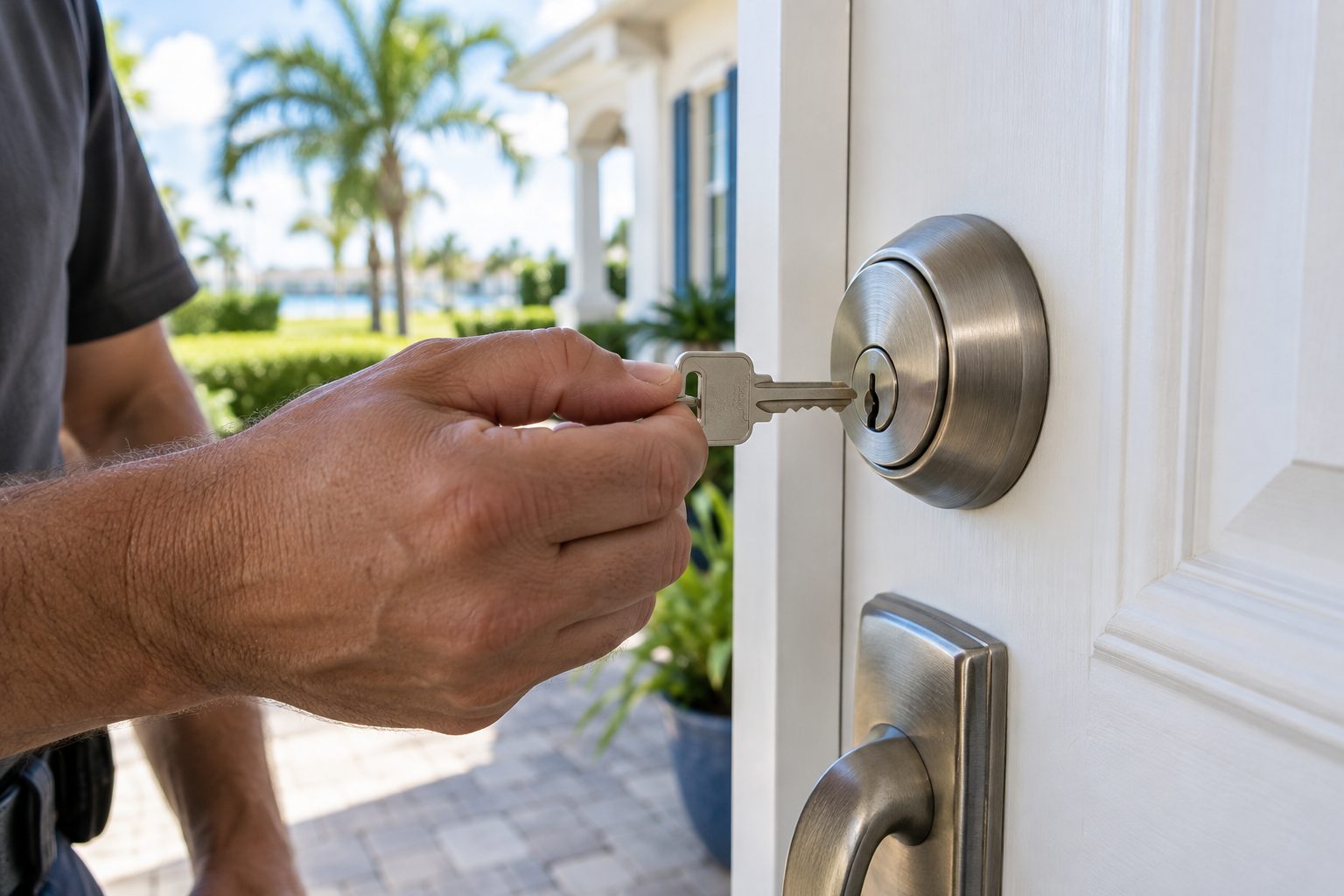
A front door lock at a private house is used by a handful of people. A pool gate or clubhouse door in a Central Florida community may be used dozens of times a day by residents, guests, contractors and staff. The latch is slammed, the key is forced, kids lean on the bar, and in warm months the hardware is wet or sandy. Metal that would last for years on a private door can show wear within a season.
The second difference is who is in charge. A home has an owner. A community has a board, a management company, bylaws, vendor rules and sometimes a budget process that requires approval before a repair is ordered. A locksmith who works with associations has to be comfortable with that structure and ready to document the work in a way that a board can review at the next meeting.
The third difference is exposure. A broken pool gate latch is not only an annoyance; it can become a safety issue for children. A clubhouse door that no longer locks properly can lead to damage and after-hours use that the association did not intend. A mailbox cluster that sticks creates complaints that land on the manager's desk.
Because of those differences, a good first step is a simple walk of the property with a manager or board member. The locksmith looks at each door and gate, notes the hardware, checks how it is used and records what needs repair or replacement. Pricing is given by phone, and for anything beyond a single repair an on-site visit is usually needed before a quote is final. A service call charge applies to that visit and is explained before dispatch.
Pool barrier hardware has to do more than keep a gate shut. In Florida, pool barriers are regulated, and gates generally need to be self-closing and self-latching. The details are in state code and local enforcement, and a locksmith is not a code inspector, but they can tell you whether a latch is closing fully, whether the spring or hinge is doing its job, and whether the latch is placed where it should be.
Common problems include a latch that no longer catches because the post has shifted, a spring that has weakened, a hinge that has sagged so the gate drags, and a lock cylinder that has corroded from chlorine and moist air. Each can be repaired or replaced, but the cause matters. If the gate post leans, a new latch will not solve it.
Do not tie a pool gate open, prop it with a rock, or defeat the closing mechanism to make it easier for maintenance. If the gate will not close and latch, treat it as a hazard until fixed. Place a temporary barrier and call for service. The page on pool gate lock service covers the types of hardware and what a technician checks.
Locks near pools are best chosen for corrosion resistance. Stainless steel or coated hardware lasts longer than plain steel in a humid, chemical environment. A technician can recommend suitable options for your gate type. Even the best hardware benefits from periodic maintenance, which is simple and often overlooked.
Indoor amenity doors have a different set of needs. A clubhouse may be used for events, meetings and private rentals, so the association has to decide who can open it and when. A fitness room may be restricted to residents with a fob or key. A game room may need to be locked after hours. Each use case suggests a different lock.
Traditional keyed locks are the simplest and least maintenance, but they depend on key control. If a key is copied and passed around, the association loses track of who can enter. Keypad locks and card or fob readers allow the board to change access without collecting keys, and some systems can log entries. They are also more complex and need power or batteries and a plan for failures.
When a door sees heavy use, the grade of the lock matters. Light residential locks are not designed for hundreds of cycles a week. A commercial-grade lever set or an exit device is often a better fit for a busy clubhouse door. Where life safety is involved, such as an assembly room with a larger occupancy, exit hardware rules apply and the door must let people out without a key or particular knowledge. See the page on panic bar and push bar hardware and fire door and exit hardware for the principles.
A locksmith can help the board compare options and plan hardware so that the door remains secure and legally safe to exit. For access control that logs entries, see electric strikes and maglocks, which explains how electronic locking components work and what each requires.
Many Central Florida communities, especially newer subdivisions and townhome developments, use cluster mailboxes serviced by the postal carrier. The units have a main carrier door and individual resident compartments. The postal service controls the carrier lock. Associations or owners are generally responsible for the resident compartment locks, though the exact arrangement can vary.
Lost mailbox keys are among the most frequent requests a locksmith receives from communities. A resident loses a key, or a new owner never received one. The compartment lock can often be rekeyed or replaced without removing the whole unit. Do not pry or hammer a compartment door open; that can damage the box and create a larger repair.
A locksmith will ask about the manufacturer and model, whether the compartment is the resident or carrier side, and whether the door is jammed or the key is simply missing. Some compartments use a small cylinder that can be replaced with a new matching one; others need more involved work.
The association may want to adopt a simple policy: who requests mailbox rekeys, how identity is confirmed, who pays, and how keys are issued. A written policy saves staff time and reduces disputes. The page on mailbox and cluster box locks covers more of the technical side, and mailbox key lost explains what a resident should do first.
Communities with walls or fences often have pedestrian gates for walkers and cyclists and a larger vehicle gate at the entrance. The vehicle gate is usually operated by a gate contractor or an access control vendor, and a locksmith does not typically service the operator. The pedestrian gate, by contrast, is a simple latch and lock problem that locksmiths handle routinely.
Typical issues include a latch that no longer catches because the gate sagged, a lock that has seized from rust, a key that no longer turns, or a gate that people prop open. Each is solved differently. A sagging gate may need hinge adjustment before any lock work. A seized lock may need replacement. A gate that people prop open may need a spring closer or a different latch.
If a gate is part of a controlled entry system with a keypad or readers, coordinate with the vendor so that repairs do not interfere with the system. A locksmith can often handle the mechanical latch and the vendor can handle the electronics.
Read the page on gate lock and latch repair for a full description. If a gate is part of the pool barrier, treat it with the extra seriousness described above.
Key control means knowing who holds keys, why, and what happens when they leave. For an association it begins with a list of every lockable space: clubhouse, maintenance shed, pool equipment room, mailroom, gate controls, any storage cages. For each space, record how many keys exist, who holds them and what key system they belong to.
Restricted keyways make unauthorized duplication harder. A common key can be copied at almost any hardware store. A restricted key requires authorization at the supplier, which means the association controls copies. This is helpful for the maintenance room and the clubhouse, where an unaccounted copy is a real concern. A locksmith can explain which keyways are available for your hardware and how authorization works. See high-security locks for the concept.
Think about turnover. Boards change, managers change and vendors change. A key policy that depends on the memory of one person will fail. Write down who may request keys, who signs them out, how they are returned and what happens if one is lost. Rekey after a manager or vendor leaves if keys were not recovered. It is a manageable cost compared with the uncertainty of unknown keys.
Board members often hold keys informally. Consider whether every board member needs a key to every door. A simple matrix of door by role can show who needs what. A locksmith can set up a master key plan so that a few keys open multiple doors while individual spaces stay separate. The guide on key control policies applies to associations as well as businesses.
Associations often cannot simply order work. The board may need to approve expenditures above a threshold, collect competing quotes, or follow a procurement policy in the bylaws. A locksmith can support the process by providing a written scope of work after a site visit and by explaining the options in plain language.
Quotes are given by phone for simple jobs. For complex or multi-door work, an on-site visit is needed first, and the call-out charge for that visit is explained when you call. Do not expect a published price list; the cost depends on the hardware, quantity and schedule.
Prioritize by risk. Safety items such as pool gates and exit doors come first. Security items such as the maintenance room and the clubhouse come next. Convenience items such as a sticky mailbox compartment can be scheduled. A phased plan lets the board spread work across budget cycles without leaving a hazard open.
Document everything. Before and after photographs of each door, the key records, and the invoice make an easy file for the next board. If the association uses a reserve study, the lock and hardware items can be noted for future replacement. A locksmith who explains hardware lifespan in general terms helps with that planning, though no one can predict exactly when a given lock will fail.
Central Florida is not coastal, but humidity, afternoon storms, sprinkler overspray and summer heat all take a toll on locks. Moisture gets into cylinders and corrodes pins and springs. Sprinklers aimed at gates or doors speed up the process. Heat can warp plastic components and make keys stick.
Before hurricane season, a check of exterior gates and doors is wise. Make sure they close and latch, hinges are secure, and nothing is likely to rattle loose in wind. After a storm, check again. A door frame can shift, and a latch that worked in May may not catch in October. See hurricane season door and lock prep and humidity and lock longevity for practical notes.
Lubrication helps, but the wrong lubricant can attract dirt and gum up a lock. A dry graphite or silicone-based product made for locks is generally preferred to oily sprays. If a lock is already stiff, lubrication may not be enough, and replacement may be the sensible choice. A technician can tell the difference.
A seasonal inspection routine is simple. Walk the property once or twice a year. Open and close every gate. Turn every key. Note anything that sticks or rattles. Give the list to your locksmith and plan repairs before a problem becomes a complaint.
Call with the community name and address, your role, and the doors in question. Say whether the problem is a repair, a rekey, a key control project or an access system. Describe the door types: wood, metal, glass, gate, mailbox. If you have photos, have them ready to describe.
If you are a manager or board member, be prepared to show authority. That might be a management contract, a board resolution or a work order. The locksmith will want to confirm that the work is approved before changing hardware that affects residents.
Ask about scheduling. Many community doors can be worked on during business hours without disruption, but pool gates and amenity doors may need to be closed during repair. Tell residents in advance if an amenity will be unavailable.
Ask for the quote by phone and tell the dispatcher if the board needs a written scope for approval. The technician will explain what an on-site visit includes. When you are ready to start, call and describe what you are seeing. The person on the phone will explain options and what to expect.
Yes, in most cases. A technician can check whether the latch catches, whether the spring or hinge needs adjustment, and whether corrosion has damaged the lock. If the gate post has shifted, that may need separate repair. Treat a gate that does not latch as a hazard and keep children away until it is fixed.
It depends on the arrangement. The postal service controls the carrier side of cluster boxes, while the resident compartment lock is usually the owner's or association's responsibility. A locksmith can often rekey or replace a compartment lock without removing the unit. Call and describe the box type and the problem.
Restricted keyways make copying harder because duplicates require authorization from the supplier. This works well for maintenance rooms and clubhouses. A locksmith can explain which options fit your hardware. Pair that with a written policy on who signs keys out and how they are returned.
Each has tradeoffs. Keys are simple but hard to control once copied. Keypads and fobs let the board change access without collecting keys but need power and maintenance. Busy doors need commercial-grade hardware, and assembly spaces must allow exit without a key. A technician can help compare options.
For routine repairs, managers often have authority, but larger work may need approval under your bylaws or procurement policy. A locksmith can provide a written scope after a site visit. Check your governing documents, and tell the dispatcher what documentation the board will require.
There is no fixed schedule that fits every property. A walk of gates, amenity doors and mailboxes once or twice a year, plus a check before hurricane season and after major storms, catches most problems early. Heavy-use doors may need more attention. Call if anything sticks, rattles or fails to latch.
Describe the situation by phone and we will tell you what the job involves. Quotes are given by phone. Jobs that cannot be quoted without seeing them need a technician on site, and the service call charge is explained on the phone before anyone is dispatched.