Hotels and resorts near the tourist corridor run hundreds of doors that must work for guests every day. Guest rooms, housekeeping closets, back-of-house corridors and public areas each need different hardware and key control. This page explains how a locksmith supports lodging properties in the Orlando area.
A guest does not think about the lock on a hotel room. The card goes in, the light turns green, and the door opens. Behind that simple moment is a system of hardware, software, keys, policies and people. A failure at any point shows up as a locked-out guest at the front desk, often late at night after a long travel day.
Orlando lodging ranges widely. There are large resorts with thousands of rooms, mid-size hotels along International Drive and in Lake Buena Vista, small motels on older commercial roads, extended-stay properties with kitchens and individual entrances, and vacation condos in managed complexes. Each has different hardware, but they share the same pressures: heavy use, high guest turnover, many staff with access and strong expectations for safety.
The doors in a property can be grouped. Guest rooms have electronic or keyed locks and often a deadbolt, a latch guard and a connecting door. Back-of-house areas such as housekeeping, laundry, storage, kitchens and offices have their own locks. Public areas include lobbies, fitness rooms, pools and business centers. Exterior and service entrances connect them all.
A locksmith typically does not replace a hotel's entire electronic lock system; that is usually done by the manufacturer or an authorized installer. A locksmith can service mechanical hardware, repair doors and frames, handle deadbolts, latch guards and connecting doors, rekey back-of-house areas and respond to lockouts. Pricing is given by phone, and larger projects need an on-site visit first, with a service call charge explained before dispatch.
Many hotel rooms use card-based or electronic lock systems supplied by a specific manufacturer. Those systems are tied to proprietary software, and the room locks are programmed by the property's front desk or engineering team. A locksmith cannot normally reprogram those systems and may refer the property to the manufacturer's service channel.
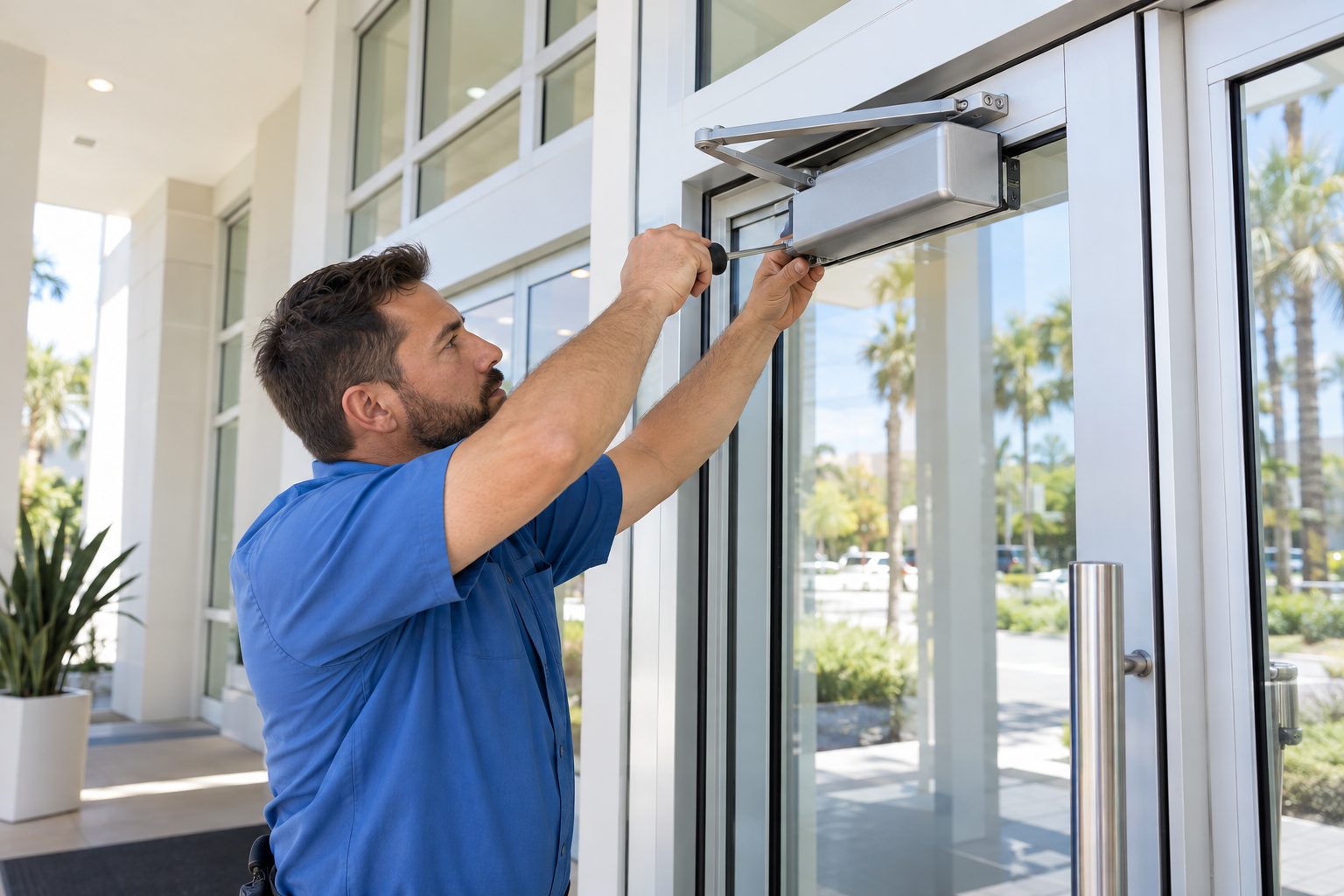
What a locksmith can do is work on the mechanical side. Deadbolts that stick, latch bolts that do not retract, strike plates that have loosened, door frames that have shifted, and hinges that sag are all common problems. A door that does not close fully will not lock properly even if the electronics are perfect. A technician can adjust or replace the hardware so the door closes and latches.
Other mechanical items include latch guards and security bars. A swing bar or a latch guard prevents a door from being opened wide while it is partly open, and is a common safety feature. Peepholes and door viewers can be replaced. Chains, where used, can be repaired.
Connecting doors between rooms need careful hardware. They must lock from each side independently, and the locks must work reliably. A worn connecting door lock is a security and privacy issue. Ask a technician to check them during maintenance rounds. See door hardware repair and strike plate reinforcement for related work.
Housekeeping staff hold the most access in a hotel. They enter rooms all day, often with a master credential that opens a whole floor. Engineering and maintenance also need broad access. The result is that many people hold keys or credentials that open many doors.
Control begins with a policy. Each credential should be assigned to a named person and logged. Credentials should be returned at the end of each shift or kept in a secure place. Lost credentials must be reported at once, and the system should be able to cancel them. Those policies are for the property's management and the lock system vendor to set up.
For mechanical keys in back-of-house areas, a restricted keyway and a key log reduce risk. Housekeeping closets, linen rooms, storage areas and offices can be keyed alike within a department, or on a master system, depending on the property's needs. A locksmith can plan and implement these systems. See master key systems and key control policies for businesses.
Be careful with emergency keys. Many properties keep a set of emergency or master keys in a secure place at the front desk or in security. The set should be accounted for at every shift change. If a key goes missing, treat it as a serious incident and consider rekeying the affected areas.
Guest lockouts at hotels are common and usually simple. The guest loses a card, the card demagnetizes or the lock battery fails. Front desk staff verify the guest, issue a new card or send engineering. Most of these never need a locksmith.
A locksmith may be needed when the lock itself fails mechanically, when a deadbolt is thrown and the guest cannot be reached, or when a door is damaged. In those cases the property will have its own procedure for verifying that the person inside the room is the registered guest and that the work is authorized. A locksmith will wait for confirmation from management before working on a guest room door and will not open a room on the word of a stranger.
If a guest is in distress, unresponsive or unaccounted for, the property should follow its emergency procedures and call 911. A locksmith is not an emergency responder. Staff should not allow anyone to open a room without proper authority.
Parking garages, pool gates, fitness rooms and business centers have their own lockout risks. A pool gate that does not latch is a safety hazard; see pool gate lock service. A fitness room with a keypad that fails can leave guests frustrated. A technician can repair or replace the hardware. This site does not promise arrival times, and no locksmith can honestly promise a technician at every hour; the dispatcher will explain what is available when you call.
Back-of-house areas are where a hotel's operations happen. Loading docks, receiving doors, kitchens, laundry, storage and employee corridors are used heavily and are exposed to deliveries, trash and contractors. These areas often have doors that are propped open, hardware that has been repeatedly knocked and locks that have been abused.
Commercial-grade hardware pays off here. Heavy-duty levers, mortise locks, exit devices and sturdy closers stand up better than residential hardware. Kitchen doors need hardware that resists steam and grease. Receiving doors need strong strike plates and frames.
Exit hardware needs particular attention. Panic bars and push bars on corridors and exits must always allow exit, and fire doors must close and latch. A locksmith can repair and adjust these devices but is not a code authority. Questions about code compliance go to the fire marshal or the building official. See panic bar and push bar hardware and fire door and exit hardware.
Delivery access is a perennial problem. A supplier arrives early or late and the door is locked or propped open. A keypad with a changeable code, a camera and a clear schedule reduce problems. A technician can install keypad locks and electric strikes that work with the property's access system.
Hotels and resorts also have many small locks that are easy to overlook: mailboxes in staff areas, lost-and-found cabinets, vending and ice machine closets, lockers for employees, pool equipment rooms and gift shop storage. Each has its own key or code.
Employee lockers are a common point of confusion. Locks go missing, keys are lost and staff leave without returning them. A locksmith can rekey or replace locker locks and set up a master arrangement so management can open lockers when required by policy. See locker lock service.
Public-area doors such as fitness rooms, game rooms and business centers need reliable hardware. They are used by many guests, often roughly. A keypad or card reader with a code that changes periodically is common. Check that the lock releases smoothly from inside and that the closer works.
Pool areas need regular attention. Gates should close and latch by themselves, and locks near water corrode quickly. A routine check of latches and hinges helps prevent problems. Treat any gate that fails to latch as a safety hazard until fixed.
Orlando lodging is shaped by tourism. Peaks come at school holidays and summer, with slower periods in between. During peaks, properties run near capacity and every door fault becomes visible. Maintenance planning around slower seasons helps reduce disruption.
Humidity, heat and afternoon storms accelerate wear. Exterior doors, balcony doors and pool-area hardware corrode faster than interior hardware. Salt air is not a factor inland, but moisture is. Schedule regular inspections of exterior hardware and plan replacements before they fail.
Hurricane season matters for lodging. Before a storm, doors, shutters and exterior hardware need checking. After a storm, verify that frames and latches still work. A door that no longer latches after a storm is a security and safety issue. See hurricane season door and lock prep and humidity and lock longevity.
Guests come from many places and may not know local conventions. Clear signage, simple instructions at the front desk and well-maintained hardware reduce confusion and complaints.
The best time to call a locksmith is before something fails. A walk through with the engineering team can identify doors that stick, locks that are stiff and hardware that is near the end of its life. A list prioritized by risk and guest impact helps plan work.
Plan work so rooms are out of service as little as possible. A technician can often work on a single room in a short visit, and a batch of similar rooms can be scheduled together. Tell the dispatcher about occupancy patterns and any times when work would be less disruptive.
Documentation is useful. Record which doors were repaired, what was done and when. A pattern of repeated failures on one floor may point to a door alignment issue or a heavy-use area. Management can then address the cause.
Quotes are given by phone for simple work. Larger projects, such as a back-of-house rekey, a key system or access control, need an on-site visit, and a service call charge applies and is explained before dispatch.
A mid-size hotel near International Drive has a guest room door that will not close fully. Housekeeping has been told to slam it. The cause is a worn hinge and a strike plate that has shifted. A technician replaces the hinge screws with longer ones, realigns the strike and tests the latch so the door closes quietly and locks properly.
An extended-stay property has exterior entry doors for each unit. Over several years the deadbolts have become stiff from humidity. A technician lubricates, adjusts and replaces the ones that are beyond saving, and makes a list of the doors that will need attention next season so work can be planned in a slow period.
A resort has a staff corridor with a keypad door whose code has not been changed in years. Many former employees may know it. Management resets the code, sets a schedule for regular changes and assigns the administrator login to a small group. The mechanical key backup is tested at the same time.
A small motel has a row of ground-floor rooms with older keyed locks. The owner wants better control without a full system replacement. A technician rekeys the rooms to a controlled system, adds latch guards and checks each door frame. The work is done a few rooms at a time between guest turnovers.
A pool-area gate at a hotel has a latch that no longer catches. Staff tie it shut with a cord. A technician replaces the latch and adjusts the closer so the gate shuts and latches on its own, and the cord is removed. Temporary fixes around pools are risky, and a proper repair is the only real answer.
Gather the property name, address and your role. Describe the door or area: guest room, corridor, loading dock, pool gate, office. Say whether the issue is a lockout, a broken lock, a rekey, a damaged frame or a key control project. If the lock is electronic, say who supplies it.
Be ready to show authority. A manager, chief engineer or owner may be asked for identification and for confirmation that they can authorize the work. A technician will not work on a guest room without management's confirmation.
Have any key lists, floor plans or room numbers ready. Take photos of the door and lock if you can. Tell the dispatcher about any access restrictions, such as the need to check in with security or the front desk.
Ask for the quote by phone. A service call charge applies for on-site visits and is explained before dispatch. When you are ready, call and describe what you need. The person on the phone will explain the options and what to expect.
Usually not. Most hotel electronic locks are proprietary and programmed through the manufacturer's system. A locksmith can service the mechanical side: deadbolts, latches, strike plates, frames and hinges, and back-of-house keyed hardware. Say what kind of lock you have when you call.
Only with confirmation from authorized management and the property's own verification procedures. A locksmith will not open a guest room on the word of a stranger. If a guest may be in distress, follow your emergency procedure and call 911.
Assign each credential or key to a named person, log it, collect it at shift end or store it securely and report losses at once. A restricted keyway and a key log help for mechanical keys. The property's policy and its lock system vendor set the details.
They are among the most-used and most-exposed locks on a property. A technician can repair or replace latches, locks and closers. Pool gates must close and latch by themselves, and a gate that does not should be treated as a hazard until repaired.
Often, with planning. A technician can work on single rooms in short visits and batch similar jobs. Tell the dispatcher about occupancy patterns and slower periods. No arrival window is promised in advance, but options are discussed on the call.
It depends on the property. Larger properties often benefit from a master system with restricted keys and a log. Smaller ones may need only a few locks keyed alike. A technician can discuss options after learning how departments use each area.
Describe the situation by phone and we will tell you what the job involves. Quotes are given by phone. Jobs that cannot be quoted without seeing them need a technician on site, and the service call charge is explained on the phone before anyone is dispatched.