The Mills 50 District is known for small independent businesses, restaurants and older commercial buildings. Those buildings often carry old doors, mixed hardware and many hands on the keys. This page explains how mobile locksmith service fits a neighborhood of small operators.
Mills 50 is a district of independent shops, restaurants, markets and service businesses, many of them in older commercial buildings that have changed hands and uses several times. A storefront that began as one kind of shop may now be a restaurant, and the door has been patched, re-hung and re-locked more than once. Behind a modern sign there may be a wood door, an old frame and a lock that predates the current owner.
That history shapes lock work. Doors are not always standard sizes. Frames may be worn or out of square. Hardware from different decades may sit side by side. Keys may have been copied many times, with no record of who holds them. For an owner who runs a small business with a handful of staff, this is a real security question: who can open the door, and would you know if a key had gone missing?
The good news is that many problems are fixable without replacing a whole door. A technician can look at the lock, the frame and the strike plate and tell you what is worn, what is fine and what is worth upgrading. The aim is to make the building secure and keep the business running, not to sell you everything at once.
A lockout at a business is different from one at home because there is a clock running: staff are waiting, deliveries are due and customers may be on their way. The first question is whether anyone else holds a key. A partner, a manager, a landlord or a neighbor in the same building may have one. Check before you call, because the quickest fix is often a phone call away.
If no key can be found, a mobile locksmith can help. The technician will ask for identification and something that shows you have authority over the business, such as a lease, a business license on display, a utility bill in the business name or a landlord's confirmation. This may feel like a delay, but it protects every business on the street. A technician who opens a door without checking is a danger to everyone.
Tell the dispatcher what kind of door and lock it is. A glass storefront door with a narrow-stile lock is a different job from a solid wood door with a deadbolt or a steel rear door with a rim cylinder. If the lockout happened because the lock failed, say so. The technician may need to bring a replacement cylinder or a different set of parts. See business lockout for more on how these calls go.
Restaurants have more door activity than most businesses. A front door opens hundreds of times a day. A rear door is used for deliveries, trash and staff breaks. Walk-in storage rooms and office doors hold cash, supplies and records. The wear on locks is steady and heavy, and a failing latch often shows itself at the worst time, such as in the middle of a busy service.
Rear doors are a common weak point. They are often propped open, left unlocked for convenience or fitted with hardware that is lighter than the front. A better deadbolt, a reinforced strike plate and a door viewer or camera can make a noticeable difference. At the same time, keep in mind that exit doors must release from the inside without a key whenever people are inside. A lock that traps staff in an emergency is a serious problem, not a security feature.
Kitchen conditions also matter. Heat, grease and moisture are hard on hardware, and cleaning chemicals can corrode finishes. Choose commercial grade hardware where doors take heavy use and wipe down hardware gently, not with harsh solvents. The restaurant lock service page describes common jobs, and panic bar and push bar explains exit hardware.
Small businesses often have high turnover, especially in food service and retail. Each person who leaves may still hold a key, and in many cases nobody remembers exactly who has which one. That is a quiet risk. It does not mean anyone will misuse a key, only that the owner cannot be sure they will not.
Rekeying is the practical answer. The technician changes the pins inside the lock cylinder so that old keys stop working and new keys are cut for the people who need them. The lock itself stays in place, and the door usually looks the same. For a business with a few doors, this can be done in one visit. For a business with many doors, a keyed-alike or master key plan can reduce the number of keys each person has to carry.
A simple routine helps. Keep a written log of who holds which key, with dates. Ask for keys back when someone leaves and note it. Consider rekeying at a set interval, or after any key goes missing. See business lock rekey and key control policies for businesses for ideas that suit a small team.
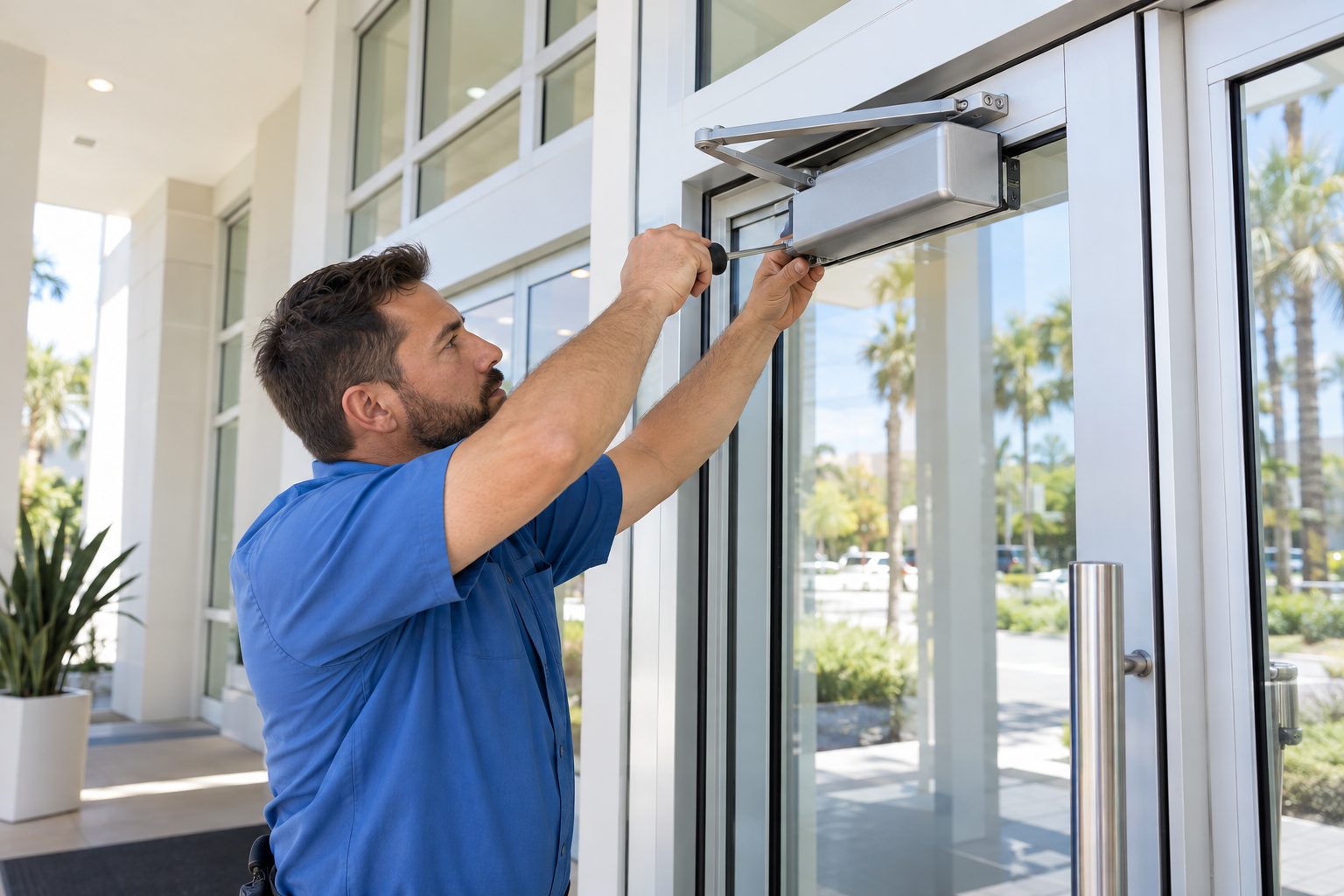
Storefront doors come in a few common types, and each has its own quirks. Aluminum and glass doors often use a narrow-stile lock built into a thin frame, with a pivot at the top and bottom instead of ordinary hinges. When these doors drag, the lock bolt can miss the strike and the door will not secure. A technician can adjust the closer and the pivots, which often solves a lock problem without touching the lock.
Wood doors may have mortise locks, which sit in a pocket cut into the door edge. They are durable, and many can be rekeyed or have the cylinder replaced. Others have a surface-mounted rim lock with a deadbolt. Over time, wood doors swell, shrink and drop on their hinges, so the strike plate no longer lines up with the bolt. Adjusting the hinges and the strike plate often cures a lock that seems to have failed.
Steel doors are common at rear entries and offer good strength. Their weak points are the frame and the latch area. A reinforced strike plate with long screws that reach into the wall framing gives far more resistance than short screws in a thin jamb. See storefront door repair and mortise lock service for more on how these doors are handled.
A lock is only one part of a working door. A door closer pulls the door shut after each use, and if it is weak or broken, the door may not latch and the lock does nothing. A closer that slams can damage the frame and the latch. Adjusting the closer speed and force is a common service call and a small job when caught early.
Exit hardware matters for safety. A panic bar or a lever on an exit door must release the door from the inside without a key, prior knowledge or a tool whenever the building is occupied. If a lock has been added that blocks this, it can trap people during an emergency. A technician can check that your exit hardware is working and that nothing has been added that interferes with it.
Fire doors have extra rules. They must close and latch on their own, and modifications can affect their rating. Do not drill, prop or replace hardware on a fire-rated door without checking what is allowed. See door closer adjustment and fire door and exit hardware for what a technician looks at.
A break-in is stressful, and a business owner has to handle the police report, the insurance conversation and the practical question of how to secure the building. Call the police first and wait until they say you can touch anything. Do not disturb the scene beyond what is needed for safety. Once the report is made, a locksmith can secure the door.
The technician will look at what was damaged and why the door failed. Was the lock forced, the frame split, the glass broken or a key used? The answer shapes the repair. A bent latch can be replaced. A split frame needs reinforcement or repair, since a new lock on a weak frame does not fix the real weakness. If a key may have been taken or copied, a rekey is a sensible step.
Think also about layers. A door with a good lock, a solid frame, a reinforced strike plate and a visible camera or sign is harder to attack than one with only a strong lock. Lighting and a clear view from the street help too. See lock change after a break-in and after a burglary lock safety for more.
Not every small business has the same needs. A grocery or market has stock that needs protecting overnight, and a heavy flow of customers during the day. A salon or barber shop holds equipment and personal property but may have little cash on site. An office-style service business keeps records and computers. A shop that sells small, valuable items needs a stronger back door and better control of who holds keys than one that sells bulky goods.
Ask what you are really protecting and from whom. If the main risk is a forced rear door, spend on the frame and the strike plate. If the main risk is a former employee, rekey and keep a key log. If the main risk is customers wandering into back rooms, a simple keyed lockset or a keypad on the staff door may be enough. A technician can walk the building with you and suggest changes in order of usefulness, so that you spend on what matters first.
Shared buildings add another question. If two or more tenants share a rear hallway or a back door, one tenant's weak lock can affect the others. Agree with neighbors and the landlord on who holds keys to shared doors and who maintains them. A shared door that nobody feels responsible for is often the one that fails.
Small businesses often cannot afford a long closure. A good locksmith plans the work for the least disruption: a rekey during a slow period, a hardware change after closing or a repair done while staff continue to work on the other side of the building. Tell the dispatcher when you open and close and how long you can leave a door out of service.
In a neighborhood of shared buildings and walls, a few practical points help. Check whether a landlord controls the exterior hardware or must approve changes. Tell any neighbors who share an entry that work will happen. Keep customers clear of the area where the technician is working. If a door has to be left unsecured briefly, plan for someone to stay until it is locked again.
The 24-hour concept means that help can be requested at any hour, but availability depends on the day, location and technician workload. The dispatcher will tell you honestly what to expect. Quotes are given by phone only, and more complicated jobs need an on-site visit, with a service call charge explained before anyone is dispatched.
Before you call, gather a few details. The street address and the name of the business. The type of door: glass, wood, steel, front or rear. What the lock is doing or what happened. Whether any key still works. Your photo identification and a document that links you to the business or the building. If a landlord must approve the work, have their contact ready.
On the call, ask any question you have. Ask the company name, ask what the service call charge covers and ask what can be quoted on the phone. If the job needs a visit first, ask what happens at that visit. You should leave the call knowing what you are agreeing to. Our how to choose a locksmith guide lists more questions worth asking.
Mills 50 businesses work hard, and a lock that works quietly in the background is part of that. A rekey at the right moment, a door that closes and latches as it should and exit hardware that is checked now and then prevent most of the calls that interrupt a day. When you are ready, call and describe what is going on, and the dispatcher will explain the next step.
Yes, once you show that you have authority over the business. Expect to give photo identification and show a lease, a utility bill in the business name or a landlord's confirmation. Tell the dispatcher the type of door, since a glass storefront and a steel rear door need different tools and parts.
It is a sensible step when you cannot be sure every key was returned. Rekeying changes the pins inside the lock so old keys stop working, and the lock usually stays in place. For businesses with many doors, a master or keyed-alike plan can reduce how many keys each person carries.
The door may be dragging because of a worn closer, loose pivots or hinges, or shifted frame, so the bolt misses the strike. A technician can adjust the closer and alignment, which often solves the problem without replacing the lock. A door that does not close fully on its own should be checked.
Quotes are given only by phone, after you describe the job. More complicated work needs an on-site visit first. There is a service call charge, and it is explained on the phone before dispatch. Ask any question before you agree, so there are no surprises when the technician arrives.
Exit doors must open from the inside without a key whenever people are in the building. A lock that traps people is a safety problem. A technician can check that your exit hardware releases smoothly and that nothing has been added that blocks it, and can suggest options that keep the door secure from outside.
Check your lease and ask the landlord before changing exterior hardware. Some leases require approval or a copy of the key. A technician can still help with repairs and rekeying inside your suite, and can work with the landlord's approval on building doors.
Describe the situation by phone and we will tell you what the job involves. Quotes are given by phone. Jobs that cannot be quoted without seeing them need a technician on site, and the service call charge is explained on the phone before anyone is dispatched.