Losing a car key in a theme park garage, a beach lot or a crowded tourist area is stressful because home, spare keys and your usual tools are far away. This page walks through what to check first, what to prepare, and how mobile key service works on location.
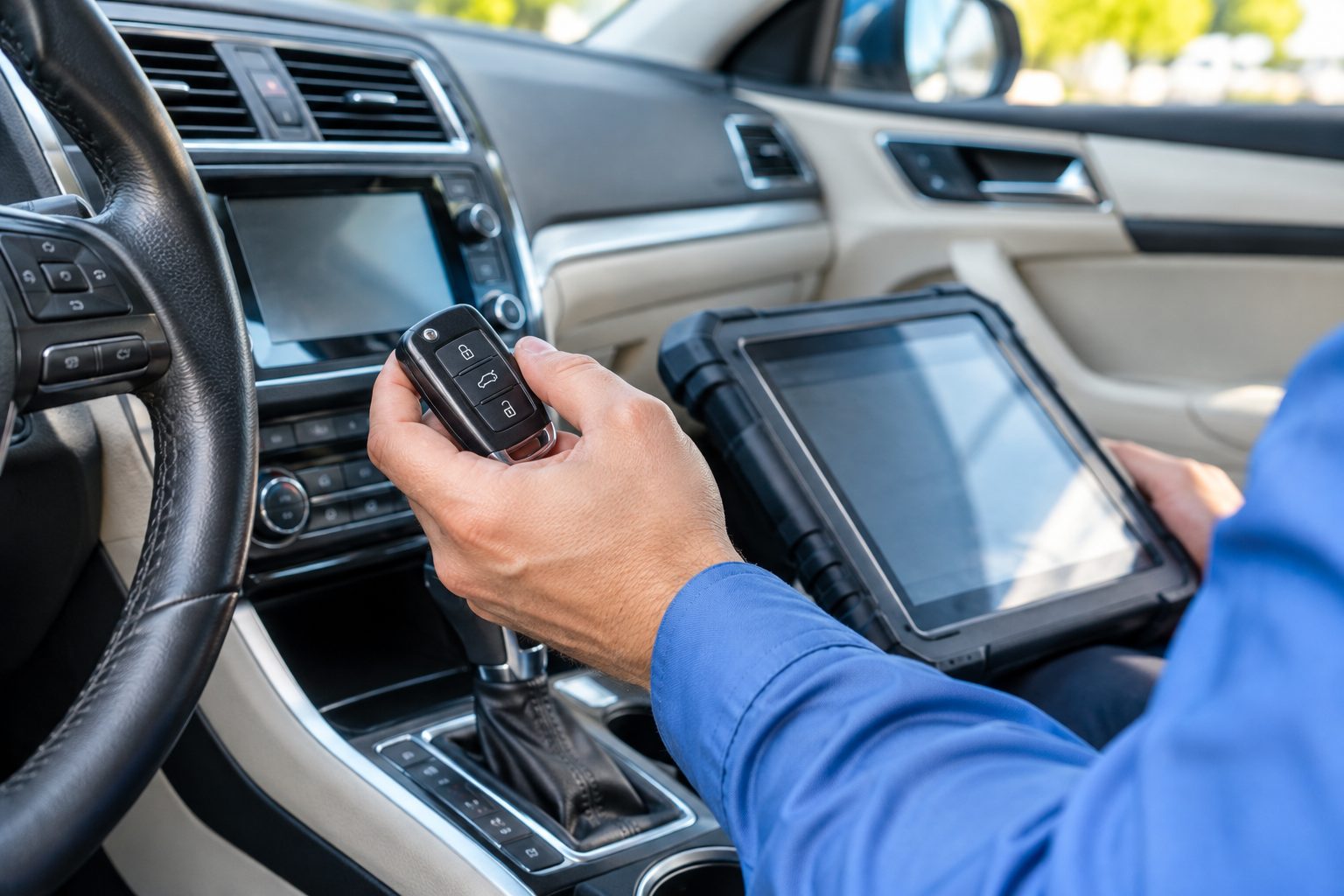
A lost key at your own driveway is an annoyance. A lost key in a parking structure after a long day at a theme park, or at a beach lot after the sun has set, is a different problem. Your phone battery may be low, the family may be tired, the children may be hungry, and the spare key is sitting in a drawer a few hours away. Every one of those details makes it harder to think clearly, so the first goal of this page is simple: slow the situation down and sort it into small steps.
Central Florida sees a constant stream of visitors. Many of them are driving a rental car or a vehicle that is not their daily driver, or they have travelled a long way on a road trip. Residents have the same problem when they spend a day at an attraction, a lakeside park, a sports event or a trip to the coast. In every case the situation is the same: a vehicle that is not going anywhere, a key that is missing, and a person who needs a clear plan.
The good news is that a missing key is a solvable problem in most cases. Modern vehicles can have new keys cut and programmed on location, without towing the car to a shop, when the right information and proof of ownership are available. The rest of this page explains how to work through it calmly.
Before you call anyone, spend a few minutes confirming that the key is actually gone. People are often surprised by where a key turns up, and a short search can save you a service call. Take a breath and work through the places a key usually hides on a trip.
Check every pocket and bag twice, including zippered pockets, swim bags, beach totes, the bottom of a backpack, and any pocket in a child's bag or a stroller basket. Keys fall to the bottom of a bag and hide under snack wrappers, sunscreen bottles and towels. Check the clothing you changed out of, because a key left in swim shorts is a classic.
Retrace your steps. If you used a locker, a ride, a restroom or a restaurant, think about where you set the key down. Many attractions have a guest services or lost and found desk, and a key that has been turned in will often be held there. Ask staff to check, and leave a phone number. Beach areas may have a lifeguard stand, a parking office or a nearby shop where honest finders leave items.
Look around the vehicle itself. Walk the full length of the parking row, check the ground near the driver's door and the trunk, and look underneath the car. Keys fall during loading and unloading more often than people expect, especially when you are juggling bags and children.
If you have another person in your group, ask them to check their own pockets and bags. It is very common for one family member to be carrying the key without realizing it.
Decide quickly whether anyone is in danger. If a child or a pet is locked inside the vehicle, or if someone is showing signs of heat distress, call 911 first. Central Florida heat builds inside a closed car much faster than most people expect, and emergency responders are trained and equipped for that situation. Do not wait for a locksmith in that case. Our page on a baby locked inside a car covers that emergency in more detail.
If it is late and the parking area is dark or empty, move to a well-lit, busy spot and keep your group together while you sort out the key. If the location feels unsafe, ask a security officer, a parking attendant or a staff member to stay with you. A locksmith can meet you at the vehicle, but your comfort and safety while you wait matter more than the car.
If there is any chance the key was taken rather than lost, such as a missing bag or a break-in nearby, treat it as a security matter. A thief who has your key and knows where your car is parked has a very simple way to take the vehicle. In that case, contact local law enforcement and ask for advice before you do anything else. Our guide on what to do if your car is stolen with keys explains the next steps in plain language.
The right call depends on who owns the vehicle, and it is worth settling this before you phone anyone.
If the car is a rental, the rental company owns it and controls what can be done to it. Most rental agreements say what to do if a key is lost, and the company often has its own roadside or key replacement process. Call the number on your rental agreement or on the key tag first. Some agreements require you to use the company's approved process, and a locksmith cannot make a new key for a car that the renter does not own without the owner's agreement. Our article on rental car key lockouts explains how this usually works.
If the car belongs to a friend or relative, contact the owner. The owner can confirm ownership details, supply the registration or title information, and give permission for a new key. A locksmith will normally need to work with the owner or see proof that the person present is authorized.
If the car is yours, you are in the best position. You will be asked to show that you own it, and then the process is straightforward. If you financed the car, the registration will still be in your name, which is typically what matters for proof.
A reputable locksmith will ask you to prove that you are the owner or an authorized user before making a key. That is a safety feature, not an obstacle. It protects you, because it stops someone else from making a key to your vehicle. Gathering these items before you call speeds up the conversation.
Photo identification such as a driver license or passport, in your name. Proof of ownership or authorization, such as the vehicle registration, the title, or a rental agreement that names you. The vehicle identification number, which is usually visible through the lower corner of the windshield on the driver's side, and is also printed on the registration and insurance card. The make, model, year and color of the vehicle. The exact location of the car, including the level of a garage, a row number, a lot name or the nearest landmark.
If your documents are in the locked vehicle, do not panic. Many people keep the registration in the glove box. If you cannot reach it, look for another route: an electronic copy of the registration in an insurance app, a photo of the title on your phone, or a call to your insurance company or the motor vehicle agency. Your phone may have the vehicle details stored in a note or a photo. Explain what you have, and the dispatcher can tell you what is acceptable.
Our guide on documents needed for car key replacement lists these items in more detail so you can check them off before the technician arrives.
A mobile locksmith brings the tools and equipment to the vehicle, so the car does not have to be towed. For most modern vehicles, the technician identifies the key type, confirms your proof of ownership, cuts a new key or prepares a new remote on site, and then programs it so that the car recognizes it. The details depend on the vehicle, and we will explain them on the phone.
The first step is the phone call. You describe the vehicle, the location, and what has happened. The dispatcher asks about the year, make and model, whether you have any working key at all, and what documents you have. This tells the team whether the job is a simple one or whether the vehicle needs more work.
Quotes are given by phone. We do not post prices on this page, because the cost depends on the vehicle and the key type, and a fair number can only be given after we know those details. Complicated jobs may need an on-site visit, and there is a service call charge, which is explained on the phone before dispatch. You should always hear the terms before anyone is sent, and you can decide at that point whether to go ahead.
When the technician arrives, they will ask for your identification and proof of ownership. They will then work on the vehicle, usually in the open parking space, and test the new key by starting the engine, locking and unlocking the doors, and checking any remote functions. You should test the key yourself before they leave, including the trunk and any push button start.
Parking structures can be tight. Tell the dispatcher if your car is on a low-clearance level, in a gated area or in a section that requires a ticket for entry. Tell them about any parking fees or access rules that apply, because the technician may need to arrive in a service vehicle.
The difficulty of replacing a key depends largely on the technology in it. Understanding the general categories helps you answer the dispatcher's questions.
Older vehicles may use a plain metal key with no electronics. These are the simplest to copy, but a copy still requires a way to cut it correctly when no original is available. Many vehicles from the late 1990s onward use a transponder key, which has a chip in the head that talks to the engine immobilizer. The new key must be programmed to the car, not only cut. Our page on transponder key programming explains the process.
Newer vehicles often use a remote key fob, a flip key, or a smart key with push button start. A smart key lets you start the car without inserting a blade, and replacement involves programming the car to accept the new device. Our article on smart key replacement covers these in depth.
If you do not know which you have, the dispatcher can usually work it out from the make, model and year. If you have a photo of a spare key, a picture of your fob, or a photo of the remote buttons, send it or describe it. Do not worry if you cannot answer everything. The goal is to give the technician enough information to bring the right equipment.
A few vehicles, especially some European and luxury models, need extra steps and can take longer. The dispatcher will tell you honestly if your vehicle is one of those so that you can plan your evening.
While you wait for the technician, there are practical things you can do to make the time easier. Move your group to a comfortable, shaded or air-conditioned place if the weather is hot, and bring water. Many parking garages at attractions have a nearby building or shop where you can sit. Keep your phone charged, and if the battery is low, ask a shop or a guest services desk if you can use a charger.
Stay reachable. Keep your phone on and answer calls from unfamiliar numbers, because the technician may phone to confirm the parking location. If you move away from the vehicle, tell the dispatcher so that the technician knows where to find you.
Do not accept help from strangers who approach you in the lot offering to open the car. Anyone who seems to appear conveniently, especially after you have been seen searching, may not have your best interests in mind. Stay near staff and security, and wait for the professional you called. If you are unsure about a service provider, our guide on how to spot locksmith scams explains the warning signs, such as a very different quote when the technician arrives, an unmarked vehicle, or a refusal to confirm the business name.
If your plans are tight, for example a flight to catch or a hotel check-in, tell the dispatcher. We cannot promise an arrival window, because it depends on traffic, location and current demand, but we will give you the best information we have and help you decide whether there is another option you should pursue at the same time.
Some common reactions make the situation worse. Do not try to force the door, break a window or use tools from a stranger to get into the car. Modern vehicles have airbags, wiring and sensors in the doors, and damage can cost much more to repair than the key. A broken window also leaves the vehicle exposed in a public place.
Do not leave the vehicle unattended with the doors open or the windows down while you search for the key. If the car is unlocked and your belongings are visible, the risk of theft is real. Gather valuables and keep them with you.
Do not buy a key from an unknown online seller or a stranger without checking that it is the correct type for your vehicle. A key that is cut but not programmed will not start the engine. A poorly made blank may be cut incorrectly and cause problems in the ignition.
Do not give your vehicle information or payment details to an unverified caller who contacts you first. Locksmith scams sometimes target people who have posted a plea for help on social media. Call a service yourself, ask for the business name, and confirm the terms. We never ask for payment before you have heard the terms by phone.
Once you are back on the road, take a few steps so that the next trip does not repeat the problem. First, ask about a spare. When one key is lost, you may have none left, and a second key is far easier to make while the technician is already working on the vehicle. Having two keys means a lost one is an inconvenience instead of an emergency. Our page on all keys lost situations explains why this is the hardest version of the problem.
Ask whether the lost key should be removed from the vehicle's memory. Many vehicles can be programmed so that old keys no longer start the car. If your key was lost in a public place, this is a sensible security step, since someone could find it and match it to your vehicle. The technician can tell you whether this is possible for your car.
Use habits that protect the key on trips. Attach it to a bright lanyard or a clip that fastens to a bag. Keep it in a zippered pocket, never in a loose back pocket on a ride. Consider leaving a spare with a trusted person at home, or keep a spare in a place that is not in the car, so that you are never completely stranded. Our page on theme park visitor car key tips goes through these habits for a day at an attraction.
Take a photo of your registration and insurance card and store it on your phone. Many problems in the first hour come down to missing documents, so a quick photo can save a lot of time.
If the key is truly missing and you are ready to get moving, call and tell the dispatcher what happened and where you are. Have your photo ID, vehicle details and parking location ready. You will hear the quote and the service call terms before anyone is sent, and you will know what to expect. We are happy to answer questions, including whether your documents are acceptable, so that the visit goes smoothly and you can get back to your trip.
In most cases yes. A mobile locksmith can usually cut and program a new key on location using the vehicle identification number and proof of ownership. Some vehicles need extra steps, and the dispatcher will explain what applies to yours when you call. A technician will always ask for identification and ownership papers before starting work, which protects you as the owner.
Look for other proof. An electronic copy of the registration, a photo of the title, an insurance app that lists the vehicle, or a call to the motor vehicle agency can all help. Photo identification in your name is still needed. Tell the dispatcher what you have, and they can explain what is acceptable before a technician is sent.
Usually not. Mobile key service is designed to come to the vehicle, so the car can stay where it is parked. Some unusual vehicles or damaged ignition systems may need more work, and the dispatcher will tell you honestly if that applies. Towing is not the default for a lost key in a parking lot.
Call the rental company first, using the number on your agreement or key tag. The company owns the vehicle and may have its own process for replacement keys. A locksmith generally needs the owner's agreement or proof that you are authorized. Ask the rental company what they allow before you arrange anything else, to avoid extra problems when you return the car.
Quotes are given only by phone, because the cost depends on the vehicle, the key type and the situation. Complicated jobs may need an on-site visit. There is a service call charge, and it is explained on the phone before a technician is dispatched. You will know the terms before you agree to anything.
It is a good idea. Having two keys turns a lost key from an emergency into an inconvenience, and making a second one while the technician is already programming your vehicle is usually simpler than a separate visit later. Ask the dispatcher about it when you call, and consider whether the lost key should be removed from the vehicle.
Describe the situation by phone and we will tell you what the job involves. Quotes are given by phone. Jobs that cannot be quoted without seeing them need a technician on site, and the service call charge is explained on the phone before anyone is dispatched.