Downtown Orlando packs condos, parking garages, offices and entertainment venues into a few walkable blocks. Each has different lock needs, different rules and different people who must approve the work. This page explains how mobile locksmith service works in a dense urban setting.
Downtown Orlando is made of layers. A resident of a tower may pass through a street door, a lobby, an elevator that needs a fob, a floor hallway and finally the unit door. A restaurant worker may use a back alley door, a staff entrance and a stockroom lock. An office tenant may use a garage gate, a lobby turnstile and a suite door. Any one of these layers can fail, and each is controlled by a different person.
That matters for locksmith work because the person who calls is not always the person who can approve the job. A tenant can ask for a lockout to be solved at a unit door but may not be allowed to change a lobby lock or a garage gate. A manager may control the suite but not the building hardware. A good technician will ask early who owns each piece of the door and who has authority, because working on the wrong lock can cause trouble for everyone.
Downtown also brings practical difficulties: tight loading zones, parking limits, building access hours and security desks. A mobile locksmith will plan for these, and the dispatcher will ask about them when you call. Telling them about the lobby, the elevator access and any security check-in saves time and avoids a technician standing at a door they cannot enter.
A lockout from a condo unit is one of the most common downtown calls. The first step is not a locksmith: contact the building manager, concierge or association office. Many buildings keep a controlled set of unit keys or have a process for authorized entry, and using it may be faster than any outside call. Some buildings require that all lock work go through an approved vendor, so ask before you call anyone.
If an outside locksmith is allowed, the technician will need to enter through the lobby, which means the front desk may need to approve the visit. Expect to show photo identification and proof that you live in the unit, such as a lease or a utility bill. The technician will do the same, since a building that lets anyone through is no longer secure. Do not climb or lean over a balcony to reach an open door. The height makes that dangerous.
After the door is open, ask what caused the failure. A lock that has worn out will fail again. A door that has shifted in its frame may need an adjustment. A lock that was installed backward or loose should be corrected. If you replace hardware, check your governing documents, because some buildings require a specific model or finish. Our condo and high-rise lock guide covers these points in more depth.
Parking garages produce their own pattern of car calls. Keys locked in a car on a level that is hard to reach. A fob that stops working after a long night. A car that will not start after a battery drain. A key lost during a night out. In every case, a precise location helps: the garage name or address, the level, the section and any numbered space.
Garages often have height limits, ticket gates and pay rules. A technician arriving in a service vehicle may need to park on a lower level or in a nearby lot, and you may need to meet them and walk them to the car. Tell the dispatcher what you know about access. If you arrived by rideshare and the car is elsewhere, say so, since the technician will need proof of ownership at the vehicle itself.
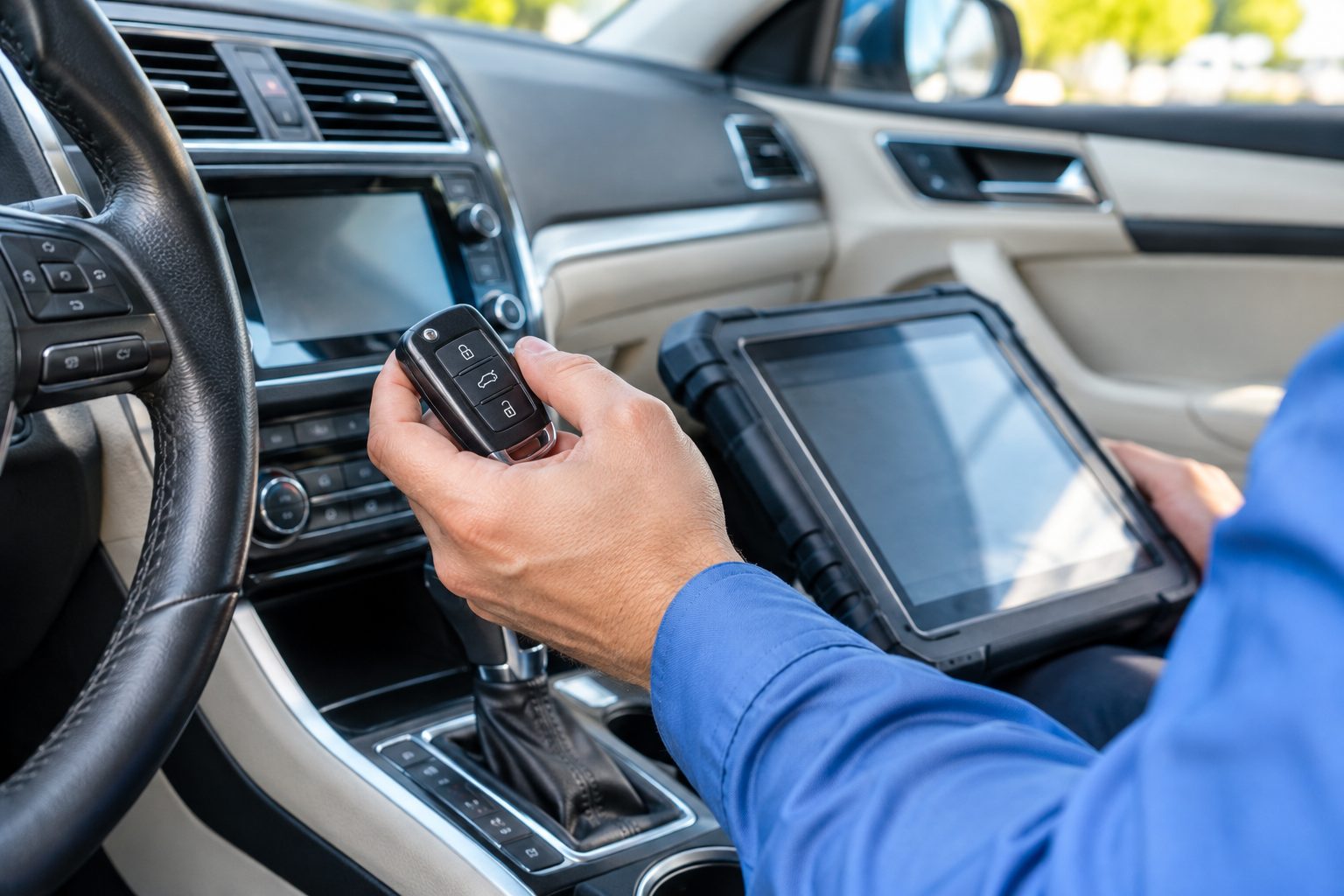
If a replacement key is needed, the work is usually done on site. The technician cuts a blade if the key uses one, then programs the transponder or smart key to the car's computer. This requires the vehicle identification number, proof of ownership and photo identification. See car key replacement and car lockout for details. If a person or animal is trapped in a locked car, call 911 first.
Office lock work downtown usually involves a suite door that the tenant controls inside a building that someone else controls. Typical requests include rekeying after staff turnover, replacing a damaged lock, installing a better deadbolt on an interior storage door and adding keycard readers to a suite. Landlord rules matter: many leases state who may change locks and whether the landlord must keep a copy of the key.
A rekey after someone leaves the business is a practical safeguard. If a former employee holds a key to the suite, changing the cylinders means that key no longer opens the door. For offices with several people, a master key system provides a manager key and individual keys for different rooms. See commercial locksmith and master key systems for what that involves.
Access control, meaning keycards or keypads in place of metal keys, is growing in offices because it can be changed without cutting new keys. The tradeoff is more equipment and more things to maintain. The access control vs traditional keys guide compares the options so that you can decide what fits your space and your landlord's rules.
Venues that operate late have lock problems that other businesses do not. Doors are opened and closed many times a night. Staff hand off keys at shift change. Alley doors are left propped open. Damage from a rough night can leave a lock bent or a latch loose. When the doors fail, it is often at closing time, when the manager is tired and eager to leave.
Practical advice for venue managers: keep a written key log and know who holds which key. Rekey whenever a key goes missing or a manager leaves. Use exit hardware that releases from the inside at all times, because an exit must always work in an emergency. Choose commercial grade hardware for heavy use rather than residential locks that will wear quickly. See restaurant lock service for more on this setting.
If a venue is locked out after hours, the technician will confirm that the caller has authority, usually through identification and a link to the business. The same applies to any hardware change on a leased space. Ask the owner or the landlord before replacing exterior hardware, especially on doors that are part of a fire exit route.
Not every downtown building is new. Older storefronts, converted warehouses and historic apartments have doors with old hardware, wooden frames and mortise locks that are no longer made in the same way. These buildings can charm tenants and frustrate lock work, because parts are harder to find and some doors have been repaired many times.
A mortise lock sits in a pocket cut into the edge of the door. It can often be rekeyed or have its cylinder replaced without changing the whole body. In other cases, a worn mortise body needs replacement, and the technician will explain whether a modern equivalent fits the old pocket. Wooden frames can crack at the strike plate, so a reinforced strike plate with longer screws can add real strength. See mortise lock service for how this is handled.
If the building is historic, check whether any rules apply to exterior hardware before making changes. A good technician will ask. The goal is to improve security without damaging what makes the building what it is. Our historic home lock guide describes the same ideas for residential doors.
In a busy downtown, a lost key or fob can be anywhere: a bar, a rideshare, a venue coat check, a park bench. The first step is the same as anywhere else: retrace your steps and call the places you have been. Many venues and rideshare services keep lost items for a short time. If the key is not found quickly, assume it is gone and act accordingly.
For a home or condo key, the safest step after a loss is to have the lock rekeyed. A key that carries no tag is unlikely to be traced to your door, but a key with a building fob or an address on a tag is easier to misuse. If a building access fob is lost, tell the management so that it can be deactivated, which is usually more important than the physical key.
For a car key, move quickly if you believe someone may have taken it. A technician can program a new key and, in many cases, remove the lost key from the car's memory, so that it no longer starts the engine. Keep the registration and the vehicle details ready. The lost the only car key page lists the steps.
Many downtown properties have rules for outside contractors: insurance paperwork, approved hours, freight elevators and sign-in procedures. A tenant can help by calling the building office ahead of time and asking what the locksmith must do. Passing that information to the dispatcher means the technician arrives prepared.
Noise and access rules can limit when work happens. Some buildings do not allow certain work in the evening or on weekends. If your lockout is urgent, tell the building so that they can make an exception or send a representative. If a business is closed and the manager cannot be reached, the technician may need to wait for a person with authority to be present before starting.
A good locksmith respects these rules rather than trying to bypass them. The rules exist to protect residents and tenants, and a company that ignores them puts you in a difficult position with your own building. If a technician suggests skipping a required step, treat that as a warning sign and ask the dispatcher to clarify.
When you call, the dispatcher will ask for the exact address, the building name, the floor or suite and the nature of the problem. They will ask whether you have identification and proof of residence or authority. They will explain that quotes are given by phone only, that more complicated jobs need an on-site visit, and that there is a service call charge explained before dispatch.
On arrival, the technician will confirm who you are, look at the door and explain the plan. On a lockout, they will say what approach they intend to use and whether anything may need to be replaced. On a rekey or replacement, they will test every key from both sides. They will also tell you about any weaknesses in the hardware, such as a loose strike plate or a worn deadbolt, so that you can decide what to do next.
Ask for the work to be explained in plain words. Ask how many keys you have, and make sure each one has been tested. If you need to report the change to your building or landlord, ask for a short written note describing what was done. Our what to expect on a locksmith call page walks through the full process.
Downtown searches can bring up companies that are not local and answer under a generic name. Ask for the company name, ask about the service call charge before dispatch and watch for any quote that changes once the work begins. Verify credentials yourself and be cautious of anyone who refuses to give a name. Our guide to spotting locksmith scams lists the usual tactics.
If there is any risk to life, such as a trapped person, a hot car with a child or animal, or a smell of gas or smoke, call 911 first. A locksmith can secure the door afterward. Never climb a balcony, railing or ledge to avoid waiting.
When you are ready, call and tell the dispatcher what is happening and where. They will walk you through the questions and explain the next step so that you can decide with full information. Call whenever you need help, and ask for anything to be repeated until you are comfortable.
Usually yes, once you prove that you live there. Contact the building manager or concierge first, since some buildings keep unit keys or require an approved vendor. The technician will ask for photo identification and proof of residence, and the front desk may need to approve the visit. Never use a balcony to reach another door.
Tell the dispatcher the garage name, level and section and any ticket, gate or height limit. The technician may park elsewhere and meet you. Have registration and photo identification ready, because the technician must confirm that the car is yours before opening it or making a key.
Check your lease first. Many leases say who may change locks and whether the landlord keeps a copy. A locksmith can rekey or replace suite hardware once you confirm authority. For building doors or common area hardware, the landlord or manager usually must approve the work.
Quotes are given only by phone, after you describe the job. Complicated work needs an on-site visit before a final quote. A service call charge applies, and it is explained on the phone before dispatch. You can ask any question on the call before agreeing to anything.
Rekey the locks that the person could open. Rekeying changes the internal pins so old keys stop working, usually without changing the look of the door. Keep a written key log, and consider a master key system or access control if many people need different levels of entry.
The service is built around 24-hour calls, but availability depends on the time, location and workload that day. The dispatcher will say honestly what is possible. Have your address, building name, floor or suite and a description of the problem ready when you call.
Describe the situation by phone and we will tell you what the job involves. Quotes are given by phone. Jobs that cannot be quoted without seeing them need a technician on site, and the service call charge is explained on the phone before anyone is dispatched.