Hiawassee sits on the west side of Orlando, where quiet subdivisions, apartment communities and busy retail strips share the same roads. If a key will not turn, a door will not latch or a car key has vanished, a mobile locksmith can come to you. Call and describe what is happening.
West Orlando around Hiawassee Road is a mix of things, and that mix shapes the kind of calls a mobile locksmith gets here. You have single-family neighborhoods with driveways and garages, apartment and townhome communities with shared parking, and commercial strips with small shops, restaurants, salons and offices along the main roads. Churches, schools and service businesses sit between them. That variety means one phone number has to cover very different problems: a parent locked out of a house, a tenant with a snapped key, a shop owner who cannot open a back door, and a driver who has just discovered the only car key is gone.
Because the area is spread out and built mostly around cars, many people live a short drive from where they work and shop, and they spend a lot of time moving between vehicles, home doors and gates. That increases the number of times a key is handled, dropped, bent or left on a counter. A key that is used several times a day, in humid Florida air, wears faster than one that sits in a drawer. Most of the calls that come from neighborhoods like this one are ordinary wear and ordinary mistakes, not crime, and most of them are quick to fix once a technician is standing at the door.
The goal of this page is practical. It explains the common situations in and around Hiawassee, what is safe for you to try before calling, what to leave to a professional, and what the call itself will be like. It does not promise a specific arrival time, because traffic, weather and the number of calls in progress all change from hour to hour. What it can promise is that you will get a straight explanation by phone before anyone is dispatched.
The most common call is the plain home lockout. Someone steps outside to take out the trash, the door swings shut, and the key is on the kitchen counter. Or a spouse takes the only key on the way to work. In a single-family home, a locksmith's first job is to work out which door is the best option and to open it without harming the lock, the frame or the finish. Many homes in this part of Orlando have a front entry with a keyed deadbolt, a garage entry door, and a sliding glass door at the back. Each one is a different kind of problem, and the technician chooses the approach that leaves your home secure when the job is done.
Townhomes and condos add a few wrinkles. Shared walkways, association rules and property managers sometimes mean the technician needs to confirm that you live there before starting. Expect to be asked for a photo ID that shows the address, or other proof that the home is yours or that you are a lawful tenant. This is not a hassle for its own sake. A legitimate locksmith asks because opening a door for the wrong person is a serious mistake, and anyone who does not ask should make you a little nervous.
If you are locked out right now, check the simple things first. Walk around and look for a door or window you may have left unlocked, but do not force a window or climb anything if you could be hurt. Check whether a family member, roommate or neighbor holds a spare. If a child or pet is inside and in danger, or you smell gas or see smoke, call 911 first and let emergency crews decide how to enter. For everything else, a call to a mobile locksmith is the safest way back in. For a longer explanation of how that visit works, see house lockout service.
Lots of people in west Orlando rent, and lots of homes change hands or change tenants. Every time that happens, there are keys in circulation that you cannot account for: the former tenant, a past roommate, a contractor who was given a copy, a relative who once watered the plants. Rekeying is the practical answer. It changes the inside of the lock so that the old keys stop working and a new key does the job, usually without replacing the hardware you already own.
A technician will look at each lock on the property, check that the cylinders are in good shape, and tell you whether rekeying makes sense or whether the lock is worn enough that replacement is the better path. A rekey is often a reasonable choice for solid, working locks. A replacement is more sensible when the lock is loose, corroded, damaged by a break-in attempt or too basic for the door it protects. Both options are explained in rekey versus replace, and the service itself is described on the lock rekeying page.
One good habit is to rekey every exterior lock to the same key at the same time, so that you carry one key instead of three. If you are a landlord or property manager with several units, ask about keeping a simple record of which key opens which door, so that the next turnover is easier. Quotes for this kind of work are given by phone after you describe how many locks there are and what brand and type they are.
In an area built around driving, car key problems are constant. People lock keys in cars at grocery stores, at work, at schools and in apartment parking lots. Fobs get run through the wash, dropped in puddles during a summer storm, or crushed in a bag. And every so often someone loses the only key to a vehicle, which is the most stressful version of the call because the car will not move and the owner has no spare to copy.
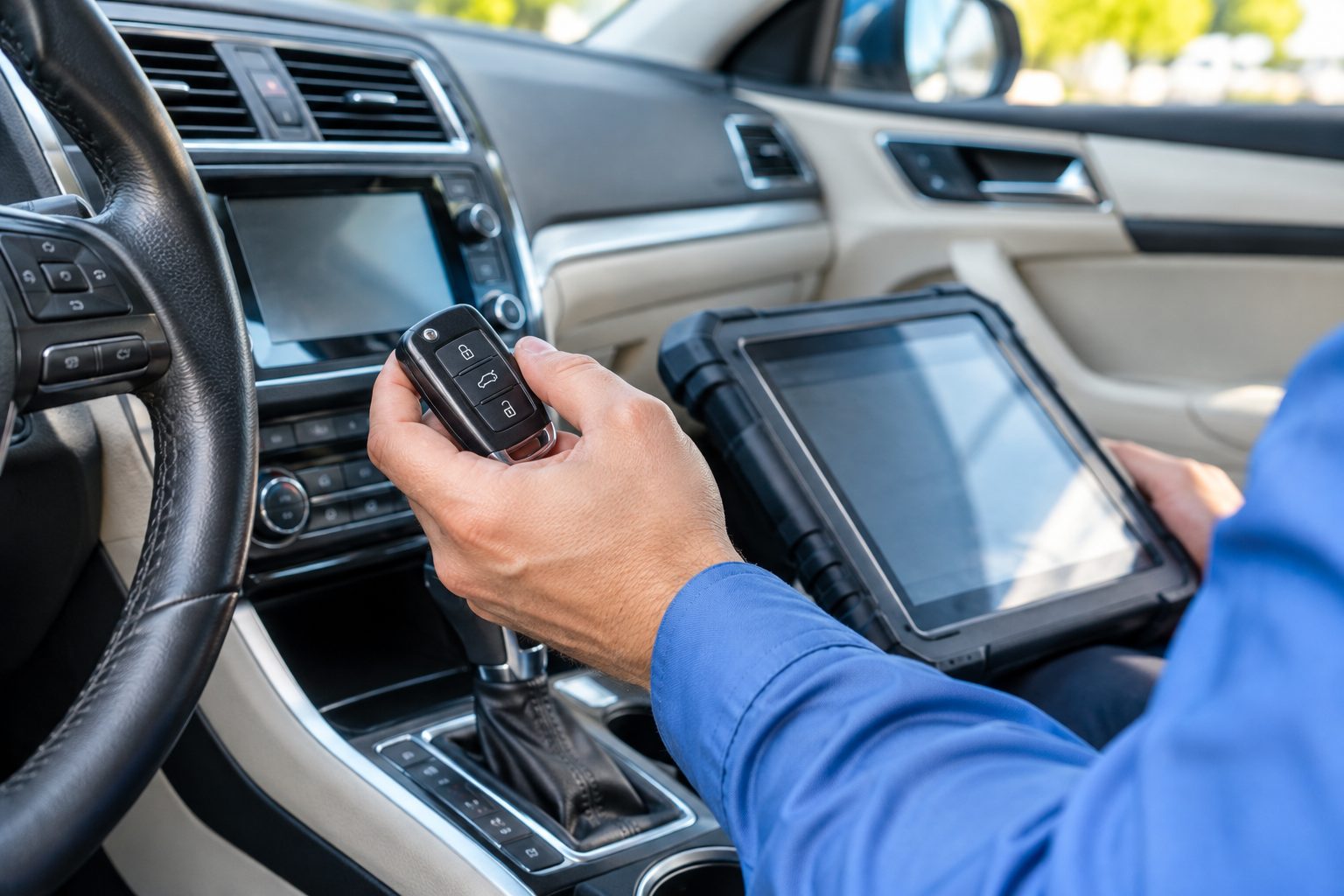
A mobile automotive locksmith can often handle the situation at the vehicle: opening a locked car without damage, cutting a key from the vehicle's identification, and programming a new transponder key or fob to the car so that it starts the engine. Which of these is possible depends on the make, model and model year, and some vehicles need more preparation than others. Newer vehicles with push-button start and smart keys often need diagnostic equipment and a more careful process than a simple blade key. The honest answer to many questions is that the technician will know more once the vehicle is in front of them and the details are confirmed.
Have some information ready when you call. The make, model and year of the vehicle help most, along with whether it uses a metal key, a key with a plastic head, a flip key, a fob or push-button start. You should be ready to show ID and proof of ownership, such as a registration or title, because a responsible locksmith will not make a key for a car without checking. If the vehicle is in a locked parking structure or gated lot, say so on the phone. You can read more about the process on the car key replacement page and the documents needed guide.
Hiawassee and the roads around it carry a lot of small business traffic. A restaurant owner locking up late, a salon manager whose front door has started to stick, an office that needs a back door rekeyed after a staff change: these are the daily realities of commercial locksmithing. Business calls tend to be about continuity as much as security. A door that will not lock means the building cannot be left alone, and a door that will not open means a day of lost work.
Commercial hardware is also a different category from residential hardware. Storefront doors often use rim cylinders, mortise locks, panic bars and door closers that are built to take thousands of cycles a month. Adjusting or replacing these parts requires knowing how they fit together, and it matters for safety as well as security, because exit hardware has to let people leave quickly. A technician who understands exit devices will not fit a lock that traps people inside, and will tell you plainly if a request would create a problem.
If a key employee leaves, or keys have been loose for a long time, rekeying the business is a sensible reset. If you have several doors, a master key system can simplify things by letting one key open several locks while individual keys open only their own. For a closer look at the options, see commercial locksmith services and business lockout help. Because commercial jobs vary a great deal, many are quoted after an on-site visit, with the service call charge explained on the phone first.
A large share of west Orlando housing is rental, and rentals create a specific kind of lock problem: turnover. When a tenant moves out, keys can be lost, copied or kept. Florida landlords and property managers are generally expected to keep dwellings secure, and changing or rekeying locks between tenants is a common way to do that. If you manage rentals, a calm, repeatable routine saves effort: inspect every lock, rekey as needed, label keys, and keep a record of who has what.
Tenants have their own questions. If you have lost your key, the first step is to contact your landlord or property manager, because the lease may say who is allowed to change locks and who needs a copy. A locksmith can help once the right person has authorized the work. If you are locked out of an apartment after hours and cannot reach management, a mobile locksmith can verify that you live there and open the door, but expect to be asked for ID and proof of residence.
Property managers often ask whether it is better to have all units keyed alike, or to give each unit its own key and a separate management key. There is no single right answer. A management key is convenient but creates one key that must be guarded carefully. Separate rekeys cost more time at turnover but keep each unit independent. Talking through the buildings, the number of doors and how your staff work will point to the right choice. The property manager lock service page describes this in more detail.
Central Florida is hot, humid and stormy for much of the year, and locks feel it. Moisture gets into cylinders, deadbolts and latch mechanisms. Over time that can cause corrosion, sticky pins, sluggish springs and handles that feel loose. Rain-driven moisture reaches the exposed side of an entry door, and sun on a dark door can warp the slab slightly or make weatherstripping shrink. All of these show up as small annoyances first: a key that needs a wiggle, a deadbolt that does not quite throw all the way, a door that needs a shoulder push to latch.
Hurricane season adds its own pattern. Before a storm, people want to be sure their doors close, lock and hold. After a storm, swollen doors, bent strike plates and damaged frames lead to lockouts, doors that will not latch, and locks that have been forced or knocked out of alignment. If a door has shifted, a locksmith can often adjust the strike plate, reinforce it, or replace a failing latch, but if the frame itself is cracked or the door is badly damaged, a carpenter or door installer may be the right person to call as well.
A little maintenance goes a long way. A small amount of the right lubricant, applied sparingly and only as the manufacturer suggests, helps many locks. Avoid heavy oils that attract dust. If a lock feels gritty or stiff, have it looked at before it fails completely, and replace keys that are visibly worn. See humidity and lock longevity and hurricane season door and lock prep for more detail.
There are a few reasonable things a worried owner can do before calling. Check every door and window you can safely reach without climbing or breaking anything. Think back: did you hand a spare to a neighbor, a friend or a family member? If you have a smart lock or a keypad, check whether the batteries are the problem, because many lock-ups are simply dead batteries and the unit may have a backup method that the manual explains.
There are also things to leave alone. Do not pry at a door or frame, because the damage can cost far more to repair than the lock itself. Do not spray large amounts of oil into a lock, which can gum it up. Do not follow internet tricks to open a lock you do not own or cannot prove you are allowed to open. And do not hand your ID or payment to anyone who arrives unannounced and says they were sent by a company you did not call. Reputable locksmiths are quick to identify themselves and explain the process.
If something about the situation feels unsafe, such as someone trying to enter your home, a break-in in progress, or a medical emergency, call 911 first. A locksmith is the right call for access, repair and security, and an emergency responder is the right call for danger. For more about common problems and quick checks, browse the key will not turn and door will not latch pages.
When you call, you will talk with someone who asks about the problem, the type of lock or vehicle, and where you are. You will be given a quote by phone for the work described, and you will be told about the service call charge before a technician is dispatched. Quotes are only given by phone, not by text or by a list on a website, because the right answer depends on the details. Complicated jobs, such as commercial systems, damaged frames, or multiple locks, may need an on-site visit before a final quote.
At the door, the technician will confirm the work, check your ID or proof of ownership as appropriate, and start. A good technician will explain what they found, show you any damaged part, and tell you what they recommend and why. You should never feel rushed into a replacement when a repair will do, and you should never feel talked out of a repair when a lock is truly worn out. If anything differs from the phone conversation, the technician should say so before work begins.
Afterward, test every key. Turn each lock several times from both sides, open and close the door, and confirm that the deadbolt fully throws. Ask what to do if something feels off a few days later. For a deeper description of the process, read what to expect on a locksmith call and how a phone quote works.
Because the Hiawassee area is large and busy, there are plenty of people advertising locksmith services. Some are excellent. Some are middlemen who answer the phone and send whoever is available. Ask who will actually come, ask for the business name, and be wary of a quote that sounds too good and a final bill that sounds nothing like it. Verify credentials that matter in your situation, and do not hesitate to ask the technician to identify themselves and their vehicle before you open the door.
A helpful rule of thumb is to look for plain answers. A trustworthy company explains what the service call charge covers, what the work will involve, and what could change the quote. It does not pressure you to drill a lock that can be opened another way, and it does not tell you a lock is ruined before looking at it. Read more in how to choose a locksmith and how to spot locksmith scams.
When you are ready, call and describe the problem in your own words: what lock, what door, what happened, where you are. You do not need technical terms. If you are not sure whether the job is a repair, a rekey or a replacement, say so, and let the technician explain the options. Calling does not commit you to anything until you have heard the quote and agreed to it. Whether you live in a subdivision, an apartment community or run a shop off the main road, a call is the quickest way to find out what is possible.
Yes, mobile service is available across the west Orlando area including Hiawassee, but availability on any given day depends on dispatch and traffic. Call, say where you are and what the problem is, and you will be told by phone whether and how a technician can reach you before anything is sent.
Quotes are given only by phone, because the right answer depends on the type of lock, the door and the situation. There is a service call charge, and it is explained on the phone before a technician is dispatched. Complicated jobs may need an on-site visit before a final quote is given.
For a home or apartment, expect to show photo ID with the address or other proof that you live there. For a vehicle, expect to show ID and proof of ownership such as registration or title. Businesses may be asked for proof that the caller is authorized to enter or change the locks.
Rekeying is often enough when the locks are in good condition, because it makes old keys stop working without new hardware. Replacement makes more sense when locks are worn, damaged, or too basic for the door. A technician can look at each lock and explain which option fits, then quote by phone.
Often yes, depending on the make, model and year, and on proof of ownership. Many vehicles can have a key cut and programmed on site. Some newer or more complex systems need more preparation. Give the vehicle details on the phone, and the technician will tell you what is possible before anyone is dispatched.
Call 911 first. If a child, a pet in distress or a person needing medical help is inside, emergency responders can enter quickly and are the right first call. A locksmith is the right call for access and security once the immediate danger is handled, or when no one is in danger.
Describe the situation by phone and we will tell you what the job involves. Quotes are given by phone. Jobs that cannot be quoted without seeing them need a technician on site, and the service call charge is explained on the phone before anyone is dispatched.